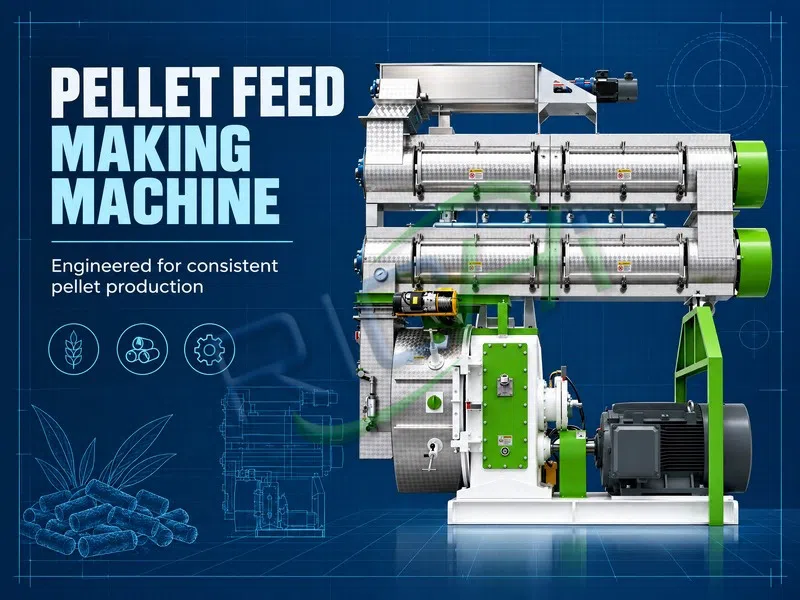
Producing nutritionally balanced animal feed requires more than selecting the right ingredients. Raw materials must be accurately measured, evenly mixed, and processed under suitable conditions so that each batch delivers a consistent nutritional composition. The equipment used during pelleting also influences the physical characteristics of the finished product. A properly configured pellet feed making machine helps manufacturers convert prepared feed mash into uniform pellets while maintaining stable production conditions.
Why Consistency Matters in Compound Feed
Compound feed typically contains several ingredients, including corn, wheat bran, soybean meal, mineral supplements, vitamins, and other nutritional components. Each ingredient contributes different nutrients to the formula. If the proportions vary between batches or the ingredients are not distributed evenly, the nutritional value of the finished feed may become inconsistent.
This is particularly important for commercial feed manufacturers supplying farms with regular production schedules. Livestock producers expect feed to maintain consistent specifications because changes in feed composition can affect feeding management and animal performance. A reliable manufacturing process helps reduce unnecessary variation between batches.
Consistency begins with accurate ingredient weighing. The batching system should measure major ingredients and smaller additions according to the formula. Mixing then distributes the ingredients throughout the batch. Only after these operations should the mash enter the conditioning and pelleting stages.
The Relationship Between Formula and Pellet Formation
Different feed formulas behave differently during pelleting. Grain-based formulas, protein-rich mixtures, and formulas containing fibrous ingredients may have different flow and binding characteristics. These differences influence how the mash responds to moisture, steam, pressure, and mechanical compression.
For example, a commercial chicken feed plant may produce broiler and layer feed using different ingredient proportions and pellet specifications. Although both products are intended for poultry, they may require different grinding sizes, pellet diameters, and operating conditions. The factory should establish suitable production parameters for each formula rather than assuming that one setting will work equally well for every product.
The physical properties of ingredients also influence the finished pellet. Particle size affects the contact between materials, while moisture and conditioning influence the behavior of the mash inside the pelleting chamber. If the material is not prepared consistently, the machine may produce pellets with varying density, length, or durability.
How the Pelleting Process Works
In a conventional ring die pellet mill, prepared mash is delivered to the pelleting chamber through a feeder. Before entering the chamber, the material generally passes through a conditioner where steam can be introduced to adjust temperature and moisture. The conditioned mash is then compressed by rollers through the holes in the rotating ring die.
The die determines the basic pellet diameter, while cutters control the finished length. The appropriate die specification depends on the target feed product and the requirements of the animals being fed. A factory producing several pellet sizes may need different die configurations.
Stable feeding is essential. If mash enters the chamber irregularly, the machine load may fluctuate and production can become inconsistent. A variable-frequency feeder can help regulate material supply, while regular inspection of the die and rollers helps maintain suitable working conditions.
Preserve Nutritional Quality After Pelleting
Pelleting is not the final step. Fresh pellets leave the machine at an elevated temperature and contain moisture from conditioning. They need to pass through a suitable cooling process before storage or packaging. Screening then separates acceptable pellets from fines and broken material.
The cooling stage should be matched to the production output and pellet characteristics. Insufficient cooling may create storage problems, while excessive handling can increase pellet breakage. If the product specification requires smaller particles, a crumbler can reduce larger pellets before final screening.
Manufacturers should also consider whether certain ingredients require special handling during processing. Some vitamins and other sensitive components may be affected by excessive heat or unsuitable processing conditions. Formula design and conditioning parameters should therefore be reviewed together by the feed formulation and production teams.
Monitor Finished Product Quality
A quality control program should examine more than the appearance of the pellets. Useful checks include pellet diameter, length, moisture, durability, fines content, and batch consistency. Depending on the product, manufacturers may also conduct nutritional testing to confirm that the finished feed meets its intended specification.
Records should connect the finished product with its raw material batch, formula, machine settings, and production date. If a quality issue occurs, operators can use these records to identify possible causes rather than changing several machine parameters without a clear reason.
When reviewing technical specifications, go to website pages that provide practical information about equipment applications, working principles, and process configurations. Product descriptions should help buyers understand how the machine fits into the complete manufacturing process.
Build Quality into the Entire Process
A reliable Richi manufacture equipment configuration should be evaluated according to the factory's formulas, raw materials, production capacity, and finished feed requirements. The objective is not simply to produce pellets as quickly as possible. It is to maintain a controlled process that supports nutritional consistency, suitable pellet quality, and stable daily operation.