Turning a Local Waste Challenge into a Market Opportunity
Commercial fertilizer production often begins with a practical problem: large quantities of organic material are available, but handling and selling them in their raw form is difficult. Livestock farms, agricultural cooperatives, and waste-processing businesses may have access to cattle manure that requires treatment before it can be used or marketed effectively.
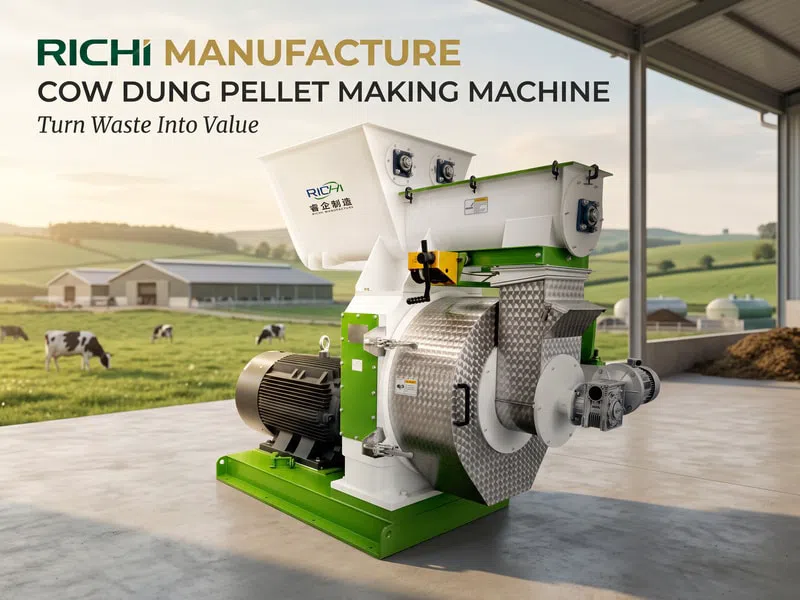
A cow dung pellet making machine provides a way to convert suitably prepared manure into compact particles. Pelletizing can improve the convenience of handling and distribution, creating an opportunity to supply growers, fertilizer retailers, and agricultural service providers. However, commercial success depends on more than the ability to form pellets. Raw-material supply, process stability, product quality, distribution costs, and market demand must all be considered.
The first step is to identify a market that the proposed plant can realistically serve. A business supplying nearby farms may require a different production and packaging strategy from one targeting distant distributors.
Define the Commercial Product Before Designing the Plant
Fertilizer Requirements and Customer Expectations
Different buyers may value different product characteristics. Some agricultural customers prioritize nutrient composition and maturity, while others place greater emphasis on convenient application, consistent particle size, or bulk availability. Retail distributors may require uniform packaging and labeling.
Before purchasing equipment, the operator should identify the intended crop markets, relevant product standards, and any local requirements for organic fertilizer registration or sale. Laboratory testing can help establish the nutrient content and other relevant characteristics of the finished material.
Cattle manure is not nutritionally identical to every other organic input. Its composition depends on animal diets, bedding, collection methods, and processing conditions. Formulations should therefore be developed from actual material analysis rather than assumptions about a universal nutrient profile.
Selecting a Processing Route
A commercial facility may receive fresh manure, partially dehydrated material, or manure that has already undergone fermentation. These starting conditions determine how much preparation the plant needs. Fresh material can require extensive moisture management, whereas pretreated feedstock may need less processing before granulation.
The design should account for the volume of material arriving each day and the amount of finished product expected after moisture removal and other processing losses. Raw input tonnage and finished pellet tonnage are not necessarily equivalent.
Designing for Commercial Throughput
A commercial organic fertilizer pellet machine should be evaluated as part of a coordinated production system. The granulator needs a steady supply of appropriately prepared material, while downstream equipment must handle the output without creating bottlenecks.
Fermentation areas require sufficient space and process management. Crushing equipment should produce a suitable particle size, and drying capacity should reflect the moisture that must be removed. Following granulation, cooling and screening help prepare the product for storage or packaging.
The system should also account for maintenance downtime. A production line designed around uninterrupted operation may struggle if there is no allowance for routine servicing, die replacement, or cleaning. Realistic capacity planning helps prevent overestimating annual output.
Building a Practical Operating Model
Raw-Material Logistics
The cost of collecting and transporting manure can significantly influence commercial performance. A plant located close to a large cattle operation may have a different cost structure from one that depends on material delivered from several distant suppliers.
Agreements with farms can help stabilize supply, but the business should consider seasonal changes, storage arrangements, and variations in feedstock quality. Incoming material inspection helps identify problems before they disrupt the processing line.
Labor, Utilities, and Maintenance
Commercial operations need a staffing plan that reflects the degree of automation and the complexity of the process. Even a highly automated plant requires people to inspect equipment, monitor production, manage packaging, and perform maintenance.
Energy consumption deserves particular attention when wet manure must be dried. Operators can assess the effect of moisture variation by recording incoming material conditions, dryer performance, and electricity or fuel consumption over time.
For planning purposes, more helpful hints can come from comparing actual production records with the original engineering assumptions. Such records reveal where material handling, drying, or packaging is restricting throughput and help guide future improvements.
Sales, Storage, and Distribution
Pellets may be easier to transport and measure than loose manure, but they still require appropriate storage. Excessive humidity can affect product stability, while rough handling can generate fines and reduce the proportion of saleable pellets.
A commercial plant should choose packaging that suits its customers and distribution channels. Bulk delivery may work for nearby agricultural users, whereas smaller bags may be more suitable for retail outlets. Packaging decisions affect equipment costs, labor, warehouse space, and transport efficiency.
Sales forecasts should be based on identifiable customer demand rather than assuming that every ton produced can be sold immediately. A gradual expansion strategy may be preferable when the market is still developing.
Integrating Equipment with Business Goals
Richi Pelletizer is a brand-related term relevant to buyers researching pelletizing equipment. RICHI's published product information describes equipment for manure and organic fertilizer processing, including ring-die pellet presses and supporting production-line machinery. Commercial buyers should request a proposal that specifies the complete equipment scope, expected throughput conditions, and commissioning responsibilities.
A well-prepared supplier inquiry should include feedstock information, target production, product specifications, site constraints, and future expansion plans. This gives the engineering team a clearer basis for recommending a suitable configuration.
From Processing Capacity to Sustainable Revenue
A successful commercial manure pellet business connects reliable raw-material supply with dependable production and a credible sales strategy. Equipment creates the ability to process material, but market research, product testing, operating discipline, and distribution planning determine whether that capability becomes a sustainable business.
The most effective investment is therefore not automatically the largest installation. It is a system that matches available feedstock, market demand, operational resources, and realistic financial expectations.