Commercial shrimp feed manufacturing requires more than simply producing pellets. A factory needs a stable process that can handle repeated production cycles, maintain consistent product specifications, and coordinate multiple machines. A properly selected commercial shrimp feed pellet machine becomes an important part of this process because the pelleting stage determines how prepared feed material is compressed and formed.
Production Begins Before the Pellet Mill
The pellet mill cannot work independently from raw material preparation.
Shrimp feed ingredients may contain grains, protein sources, minerals, vitamins, oils, and other nutritional components. These materials need to be received, stored, cleaned when necessary, and prepared before they enter the pelleting process.
Particle size is particularly important. Fine grinding can make the material more suitable for producing small aquatic feed pellets.
Grinding and Mixing
After grinding, ingredients are proportioned according to the formula and mixed thoroughly.
A consistent mixture provides the pellet mill with more uniform material.
If ingredient distribution varies significantly, the finished pellets may also show differences in density, size, or physical strength.
For commercial production, this preparation stage therefore deserves as much attention as the pellet mill itself.
Conditioning Before Pelleting
The mixed feed normally passes through a conditioner before entering the compression chamber.
Steam and moisture change the physical properties of the feed material and prepare it for compression.
A longer conditioning path can provide additional residence time for the material to interact with steam.
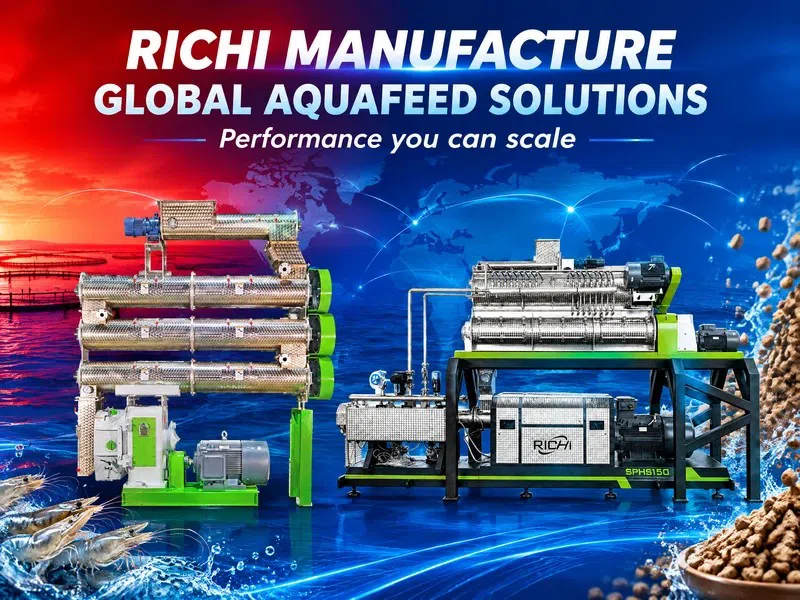
RICHI's shrimp feed pellet equipment uses a three-layer conditioner in relevant configurations.
Compression and Forming
After conditioning, the material enters the pelleting chamber.
The feeder controls the amount of material entering the machine. Rollers then press the material against the ring die.
As pressure increases, the conditioned feed passes through the die holes and forms continuous strands.
The cutter separates these strands into individual pellets.
The die determines the basic pellet diameter, while cutter adjustment influences pellet length.
Matching Capacity With the Factory
A large factory may require a 1-120t/h fish feed mill plant, depending on the product range, production schedule, and number of processing lines.
However, the capacity of the pellet mill cannot be considered independently.
The grinding, mixing, conditioning, cooling, screening, conveying, and packaging systems must all have compatible capacities.
Otherwise, one undersized machine can become a bottleneck for the entire line.
Maintaining Consistent Production
Commercial production requires stable operating conditions.
Operators should monitor feeding, motor load, temperature, vibration, steam supply, and pellet formation.
Regular inspection of the ring die and rollers is also important because these components experience continuous mechanical pressure.
Routine lubrication and maintenance should be incorporated into the production schedule.
look at here now when evaluating technical information about commercial pelleting equipment, especially the relationship between capacity, conditioning, die configuration, and downstream processing.
The feed pellet machine is the central forming unit, but its performance depends on the complete process around it.
A commercial shrimp feed factory therefore needs to approach equipment planning as an integrated engineering task. The objective is not simply to purchase a high-capacity machine, but to build a production system where material preparation, pelleting, cooling, screening, and packaging operate in balance.