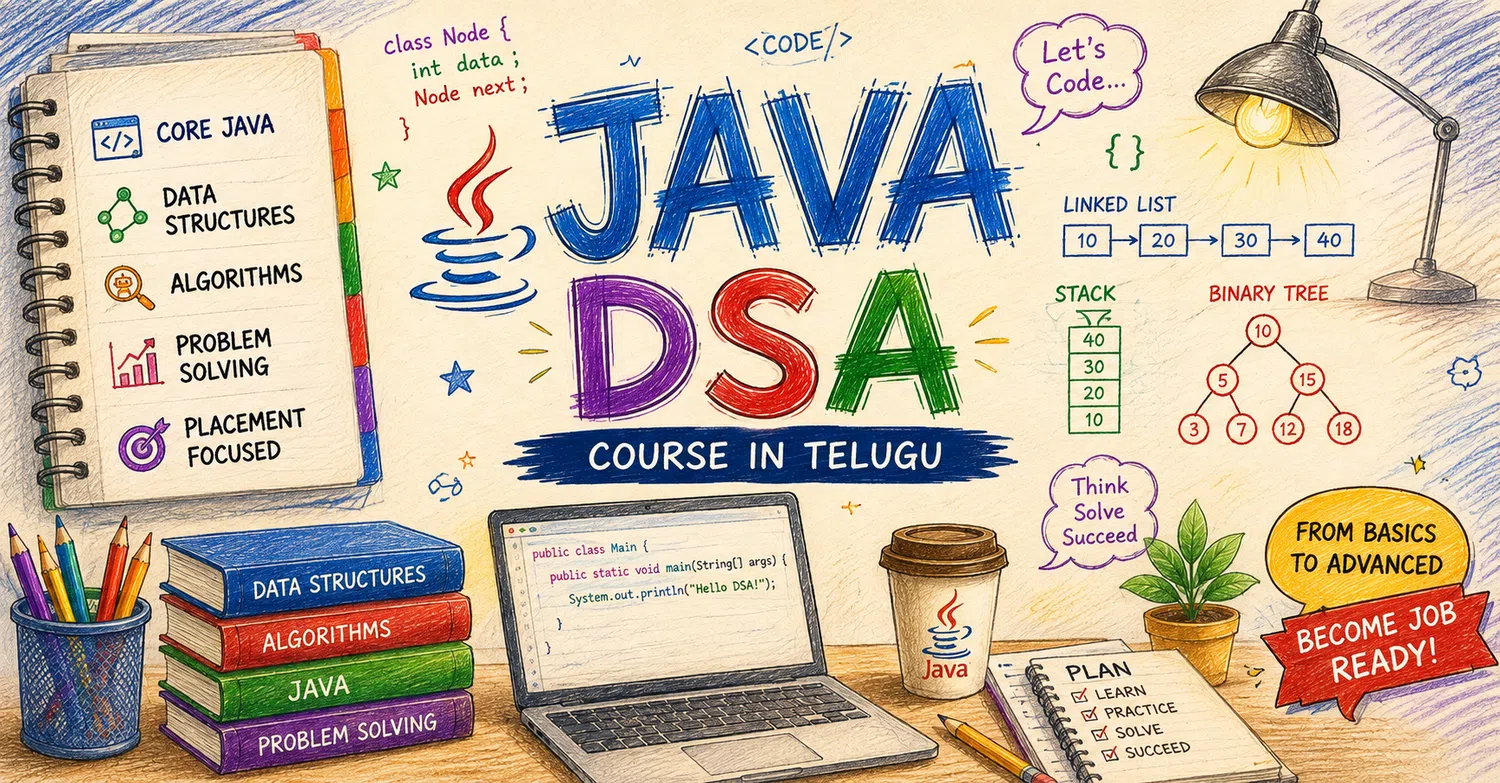
Learning Java alongside Data Structures and Algorithms can provide beginners with a strong foundation for developing logical thinking and solving programming problems. Java offers a structured programming environment, while DSA helps learners understand how data can be organized and how problems can be solved efficiently. A Java DSA Course in Telugucan make this learning process easier by combining Java fundamentals, DSA concepts, problem-solving techniques, and practical learning in a Telugu-friendly environment.
Building a Strong Java Foundation
Before approaching advanced DSA problems, learners need to understand the fundamentals of Java programming. Concepts such as variables, data types, operators, conditions, loops, methods, arrays, classes, and objects form the foundation for writing effective Java programs.
Learning these concepts through practical examples can help beginners understand how individual programming elements work together. A strong Java foundation also makes it easier to implement data structures and algorithms later in the learning journey.
Connecting Java with Problem Solving
Problem solving is not simply about writing a program that produces the expected output. It involves understanding the problem, identifying the required information, developing a logical approach, and selecting an efficient way to implement the solution.
A Java DSA Course in Telugu can help learners gradually connect Java programming concepts with problem-solving techniques. Instead of approaching every problem as a completely new challenge, learners can begin recognizing patterns and applying familiar strategies.
Understanding Data Structures
Data structures determine how information is organized and accessed within a program. Arrays, linked lists, stacks, queues, hash-based structures, trees, and graphs each serve different purposes.
Learning these structures through Java can help learners understand their operations, advantages, limitations, and practical applications. This knowledge becomes particularly useful when a programming problem requires an appropriate structure for efficient data management.
Developing Algorithmic Thinking
Algorithms provide a systematic way of solving computational problems. Learners can study searching, sorting, recursion, traversal, greedy approaches, dynamic programming, and other techniques as they progress.
The important goal is to understand why an algorithm works and when it should be used. This encourages learners to think about the problem before beginning implementation.
Improving Logical Reasoning
Regular DSA practice can help learners develop logical reasoning. A problem may require breaking a large task into smaller steps, identifying repeated patterns, comparing possible approaches, or determining how information should be processed.
Through consistent practice, learners can become more comfortable analyzing unfamiliar problems and developing solutions based on logic rather than relying entirely on memorized approaches.
Learning Through Telugu-Based Training
Programming terminology can sometimes create an additional challenge for beginners who are more comfortable learning technical concepts in Telugu. Telugu-based explanations can make programming logic and DSA concepts easier to follow.
A Java DSA Course in Telugu can explain Java fundamentals, data structures, algorithms, complexity, and problem-solving strategies in Telugu while retaining the English technical terms used in professional programming environments. This can help learners understand concepts clearly while gradually becoming familiar with standard programming terminology.
Understanding Complexity and Efficiency
A solution can be correct but still inefficient when working with large amounts of data. This makes time and space complexity an important part of DSA learning.
Learners can study Big O notation and understand how different approaches behave as input sizes increase. Comparing simple and optimized approaches can help them recognize why algorithm selection and data structure choice matter in real software development.
Practicing Common Problem-Solving Patterns
Many programming challenges are based on recurring patterns. Learners can gradually become familiar with techniques involving two pointers, sliding windows, hashing, binary search, recursion, prefix calculations, and stack-based processing.
Understanding these patterns can make it easier to approach new problems because learners can identify similarities between previously solved challenges and unfamiliar ones.
Strengthening Java Collections Knowledge
Java provides a collection of useful data structures through its Collections Framework. Learning structures such as ArrayList, LinkedList, HashMap, HashSet, Queue, Deque, and PriorityQueue can help learners connect theoretical DSA concepts with practical Java development.
Understanding these collections also helps learners select suitable structures based on the operations required by a particular problem.
Learning from Practical DSA Problems
Problem-solving becomes more meaningful when learners work with realistic scenarios. Customer records, inventory systems, task scheduling, search functionality, network connections, and transaction processing can all provide contexts for applying data structures and algorithms.
A Java DSA Course in Telugu can use such scenarios to help learners understand how DSA concepts relate to actual programming requirements rather than treating them only as theoretical topics.
Preparing for Coding Challenges
DSA knowledge is commonly relevant to coding assessments and technical interviews. Problems involving arrays, strings, linked lists, hashing, trees, graphs, searching, sorting, recursion, and dynamic programming can test both programming ability and logical reasoning.
Developing Java and DSA skills together can help learners become more comfortable reading problem statements, analyzing constraints, selecting approaches, and evaluating solution efficiency.
Developing a Consistent Learning Approach
Problem-solving skills generally improve through continuous practice. Learners can strengthen their abilities by studying a concept, solving related problems, reviewing mistakes, and attempting alternative approaches.
Progressive learning can help beginners move from basic programming exercises toward more challenging DSA problems without becoming overwhelmed by advanced concepts too early.
Building a Foundation for Software Development
Java combined with DSA can provide a useful technical foundation for learners interested in software development. Understanding how programs process information and how algorithms affect performance can help developers make more informed implementation decisions.
The concepts learned through DSA can also support further learning in areas such as application development, backend programming, competitive programming, and technical interview preparation.
Conclusion
Learning Java and problem solving together can help beginners develop both programming knowledge and algorithmic thinking. Java provides the programming foundation, while Data Structures and Algorithms teach learners how to organize information and approach computational problems efficiently.
A Java DSA Course in Telugu can provide a structured and accessible learning path by explaining Java fundamentals, data structures, algorithms, complexity, and problem-solving techniques in a Telugu-friendly format. With consistent practice and a focus on understanding concepts rather than memorizing solutions, learners can build stronger programming skills and prepare themselves for more advanced software development and coding challenges.