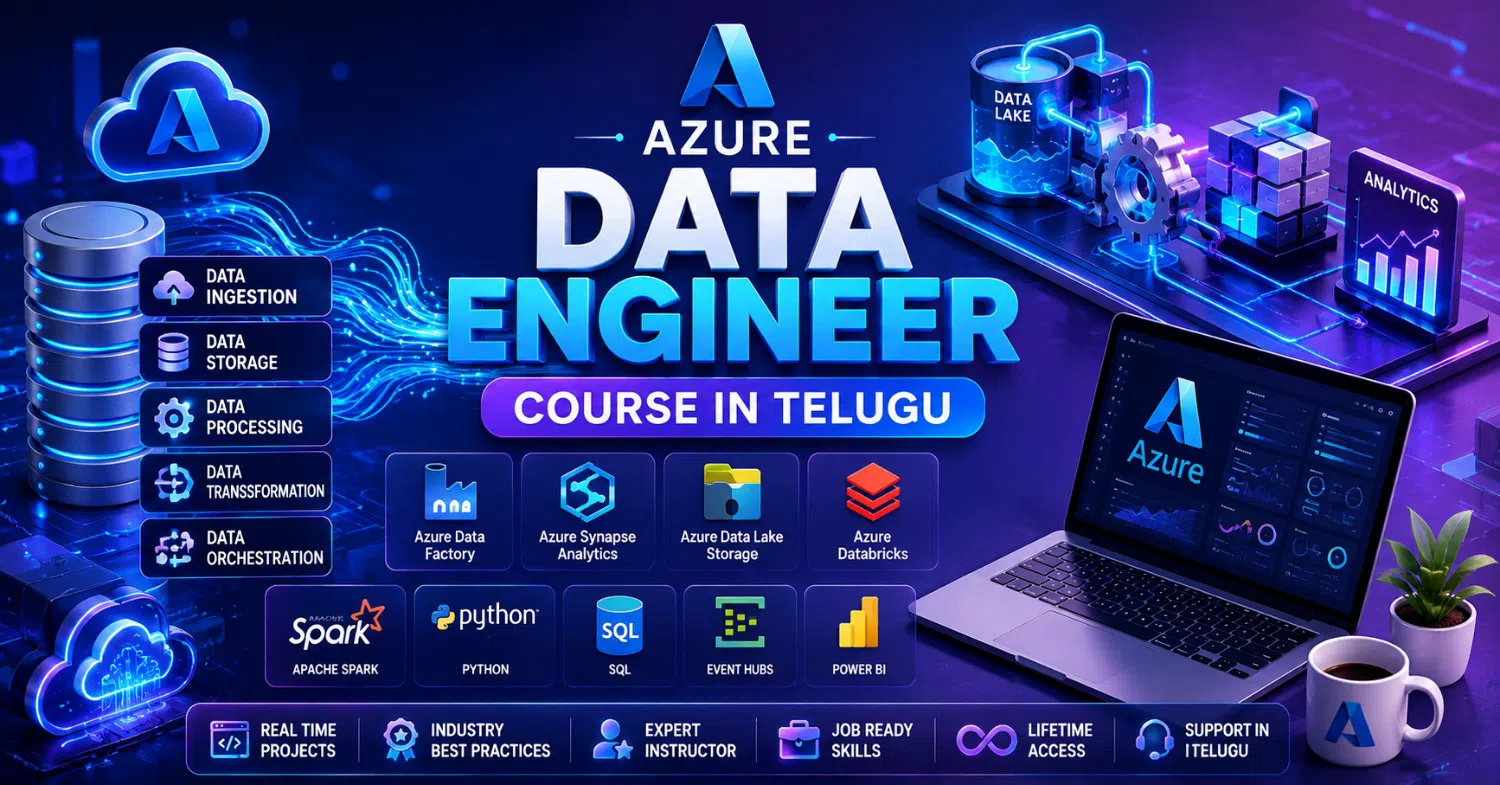
Organizations today generate data from applications, websites, databases, customer platforms, IoT systems, and business operations. Turning this growing volume of information into useful insights requires well-designed cloud data solutions that can collect, store, process, and deliver data efficiently. For learners interested in developing these capabilities, anAzure Data Engineer Course In Telugucan provide a structured path to understanding modern Azure data technologies while building practical cloud data skills.
Understanding Cloud Data Solutions
A cloud data solution brings together multiple technologies to manage information throughout its lifecycle. Instead of relying on a single database or application, organizations can use cloud services for ingestion, storage, transformation, processing, analytics, and monitoring.
A typical architecture can follow:
Data Sources → Data Ingestion → Cloud Storage → Data Processing → Data Warehouse → Analytics
Understanding this flow helps learners see how individual Azure services contribute to a complete solution.
Building a Foundation in Azure Data Engineering
Before designing complex solutions, learners need to understand core data engineering principles. These include databases, SQL, data integration, ETL, cloud storage, data transformation, and analytical processing.
An Azure Data Engineer Course In Telugu can introduce these concepts progressively, helping learners connect foundational knowledge with Azure-based implementations.
This structured approach can make it easier to understand why a particular service is used at a particular stage of a data workflow.
Designing Data Ingestion Pipelines
Data ingestion is the process of bringing information from source systems into a data platform.
Organizations may collect information from relational databases, applications, APIs, files, and other systems.
Learners can develop pipelines that automate this process and understand how ingestion requirements can vary depending on data format, source type, volume, and frequency.
Working with Azure Data Factory
Azure Data Factory is an important Azure service for data integration and pipeline orchestration.
Learners can explore:
Pipeline creation
Copy activities
Linked services
Datasets
Triggers
Scheduling
Pipeline dependencies
Monitoring
Practical pipeline development can help learners understand how automated data movement works in cloud environments.
Organizing Data with Azure Data Lake Storage
Cloud data solutions often require scalable storage for raw and processed information.
Azure Data Lake Storage can support the storage of large volumes of structured and semi-structured data.
Learners can understand how data can be organized into raw, transformed, and curated layers. This organization can make downstream processing and analytics easier to manage.
Mastering Data Transformation
Raw data frequently contains inconsistencies and unnecessary information.
Learners can practice transformation tasks such as:
Filtering unwanted records
Removing duplicates
Handling missing values
Standardizing formats
Joining datasets
Creating calculated fields
Understanding these operations can help learners prepare reliable datasets for analytical use.
Strengthening SQL Skills
SQL is an essential part of many data engineering workflows.
Learners can use SQL to query databases, transform datasets, validate information, and prepare analytical results.
An Azure Data Engineer Course In Telugu can teach SQL through cloud-focused examples so learners understand how SQL connects with Azure storage, data warehouses, and analytical platforms.
Exploring Azure Synapse Analytics
Azure Synapse Analytics supports data warehousing and analytical workloads.
Learners can explore how data prepared through ingestion and transformation pipelines can be loaded into analytical environments.
They can work with SQL-based analysis and understand how Synapse can become part of a broader cloud data architecture.
Learning Azure Databricks
Some workloads require distributed processing for large or complex datasets.
Azure Databricks provides a platform based on Apache Spark that can support data engineering and analytics.
Learners can work with PySpark, DataFrames, Spark SQL, and distributed transformations to understand how large-scale processing can be incorporated into cloud data solutions.
Understanding ETL and ELT Architectures
Modern cloud platforms support different approaches to preparing data.
ETL involves extracting information, transforming it, and then loading it into a target environment. ELT can involve loading information into a suitable cloud platform first and transforming it afterward.
Learners can explore both patterns and understand how architectural choices depend on data volume, processing requirements, platform capabilities, and business objectives.
Implementing Incremental Data Processing
Cloud data systems often process information repeatedly as new records become available.
Rather than processing an entire dataset every time, learners can explore incremental loading approaches that focus on new or modified information.
This can help them understand how data pipelines can be designed to handle continuously growing datasets more efficiently.
Building Reliable Data Quality Checks
Cloud data solutions need reliable information to produce meaningful analytical results.
Learners can create validation processes to identify:
Missing values
Duplicate records
Invalid data
Incorrect formats
Unexpected schema changes
Including data quality checks in projects can help learners understand how reliability is maintained throughout the data lifecycle.
Learning Data Pipeline Monitoring
Data engineering does not end after deployment.
Pipelines need to be monitored to identify failures, performance issues, and unexpected behavior.
Learners can practice reviewing execution details, identifying failed activities, checking processing times, and validating outputs.
This provides practical insight into maintaining cloud data solutions.
Developing Troubleshooting Skills
Real-world data platforms can encounter a variety of technical problems.
A pipeline may fail because of a source connection issue, a changed schema, incorrect permissions, or invalid data.
Learners can practice troubleshooting by examining logs, checking source and target datasets, reviewing transformation logic, and identifying the stage where an error occurred.
These problem-solving skills can strengthen their practical understanding of cloud data engineering.
Understanding Cloud Data Security
Data platforms often contain important business information, so security should be considered throughout the architecture.
Learners can explore concepts such as authentication, authorization, access control, secure connections, and responsible data handling.
Understanding security alongside storage, pipelines, and analytics can help learners develop a more complete view of cloud data solutions.
Building Real-World Cloud Data Projects
Project-based learning can bring multiple technologies together.
A practical project could involve customer transaction data coming from several sources. Learners can use Azure Data Factory for ingestion, Azure Data Lake Storage for raw data, Databricks or SQL for transformation, and Synapse Analytics for analytical processing.
The project can also include validation, monitoring, and incremental processing.
This provides experience with an end-to-end cloud data workflow.
Learning Cloud Data Architecture Through Telugu
Cloud data engineering includes numerous services and technical terms. Telugu-based explanations can make these concepts easier to understand for Telugu-speaking learners.
An Azure Data Engineer Course In Telugu can explain Azure Data Factory, Data Lake Storage, Synapse Analytics, Databricks, SQL, ETL, data pipelines, and cloud architecture in Telugu while retaining the English technical terminology used in Azure environments.
This can help learners understand complex concepts while gradually becoming comfortable with professional data engineering vocabulary.
Developing End-to-End Solution Design Skills
Mastering cloud data solutions involves understanding how different components interact.
Learners can practice designing architectures such as:
Source Systems → Data Factory → Data Lake → Databricks/Synapse → Analytical Data → Reporting
They can also evaluate where transformation should occur, how data should be stored, and how workflows should be monitored.
This encourages solution-oriented thinking rather than focusing only on individual tools.
Building a Technical Portfolio
Cloud data projects can provide practical examples for a technical portfolio.
Learners can document their architecture, explain the business problem, describe the data sources, show pipeline design, discuss transformation logic, and explain how data quality and monitoring were handled.
A portfolio built around complete projects can demonstrate practical understanding of cloud data engineering concepts.
Preparing for Evolving Data Technologies
Cloud data engineering continues to evolve as organizations adopt new platforms, processing techniques, automation methods, and analytics capabilities.
Strong fundamentals in SQL, cloud architecture, data integration, storage, transformation, distributed processing, security, and monitoring can help learners adapt to new technologies.
Continuous project practice can further strengthen their ability to apply these concepts to changing requirements.
Conclusion
Mastering cloud data solutions requires an understanding of how data moves from source systems through ingestion, storage, transformation, processing, and analytics. Azure provides technologies that support each of these stages, allowing learners to explore complete cloud-based data architectures.
An Azure Data Engineer Course In Telugu can help learners develop these skills through Azure Data Factory, Azure Data Lake Storage, Azure Synapse Analytics, Azure Databricks, SQL, ETL, data quality, monitoring, and practical projects. By connecting these technologies into realistic end-to-end solutions, learners can build a stronger foundation in modern cloud data engineering and better understand how scalable data platforms are designed and maintained.