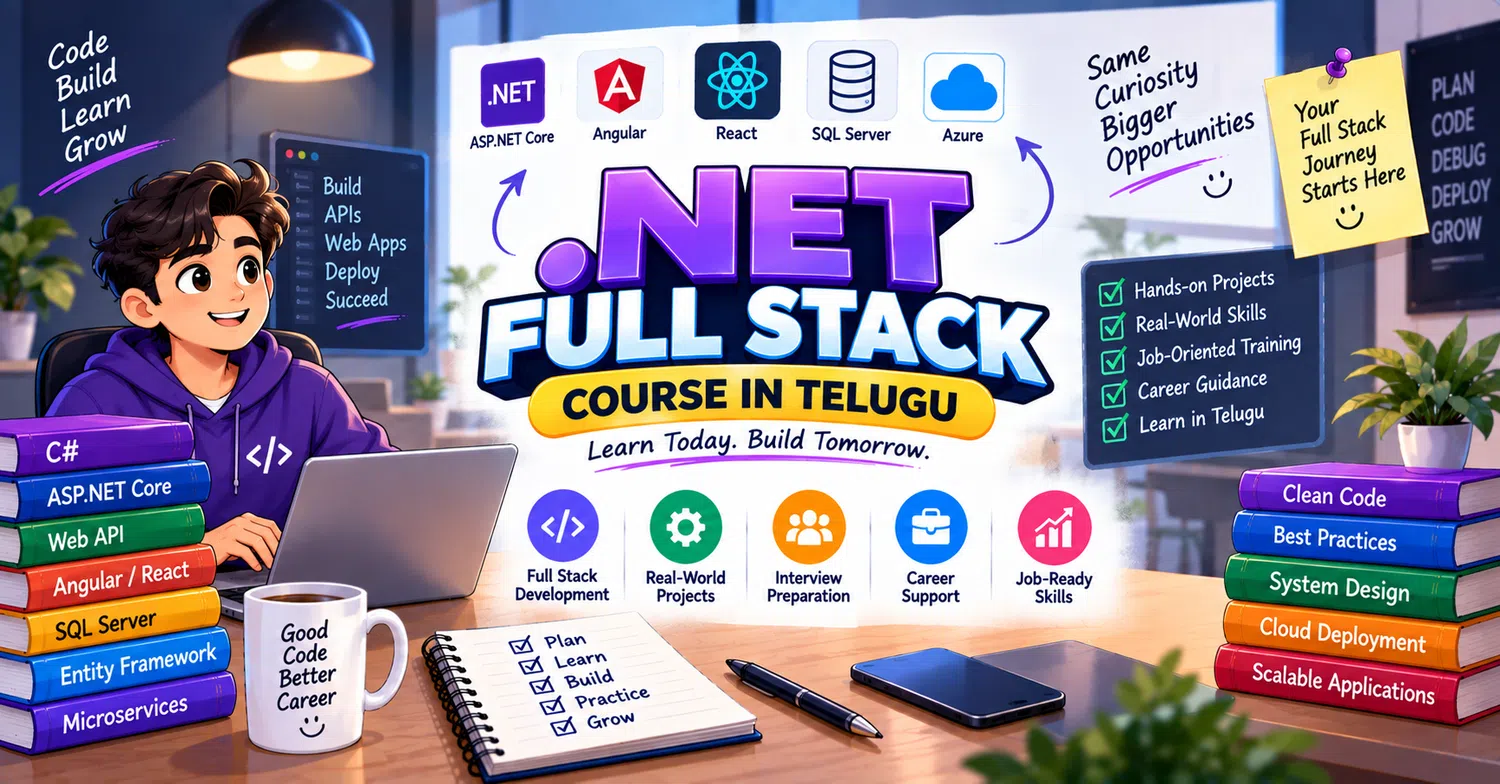
ASP.NET Core plays an important role in building modern web applications and backend services within the .NET ecosystem. Learning it allows developers to understand how incoming requests are processed, business logic is organized, APIs are created, data is managed, and different application components communicate. A .NET Full Stack Course in Telugu can help learners approach ASP.NET Core through structured concepts and hands-on development, making it easier to connect C# knowledge with practical server-side application requirements.
Move from C# Programming to Web Development
Before working with ASP.NET Core, learners should be comfortable applying core C# concepts to application logic. Classes, objects, methods, interfaces, collections, and exception handling become especially useful when applications contain multiple features.
Consider developing an inventory management platform for a growing electronics distributor. The application needs to maintain products, categories, suppliers, available quantities, and stock movements.
Such a project provides a practical environment for turning C# concepts into working web application features rather than treating programming topics as isolated exercises.
Understand the ASP.NET Core Application Structure
A web application becomes easier to maintain when its responsibilities are clearly organized. ASP.NET Core development introduces learners to a structured approach where request handling, business logic, models, and data operations can be separated.
Instead of placing all inventory functionality in one large section of code, developers can organize responsibilities according to their purpose.
A structured application may contain:
Product-related functionality
Supplier management
Inventory operations
Request handling
Data access
Validation
Application configuration
Error management
Understanding this organization prepares learners to work with applications that gradually become larger and more complex.
Learn How HTTP Requests Are Processed
Web applications constantly receive requests from users or other applications. Understanding how those requests move through the backend is a key part of ASP.NET Core development.
For example, when an employee requests the details of a particular product, the application needs to receive the request, identify the required operation, process it, retrieve relevant information, and return a response.
Learners can understand concepts such as:
HTTP methods
Routes
Request parameters
Request bodies
Response data
Status codes
Backend processing
Following the complete request-response cycle makes backend behavior much easier to visualize.
Create REST APIs for Application Features
APIs allow frontend applications and other systems to communicate with backend functionality. Building REST APIs is therefore an important practical area when learning ASP.NET Core.
Through a .NET Full Stack Course in Telugu, learners can create endpoints for meaningful inventory operations. One endpoint may retrieve products, another may create a new product, while additional operations can update or remove existing information.
Working with GET, POST, PUT, PATCH, and DELETE operations helps learners understand how application functionality can be exposed through clear API endpoints.
Organize Business Logic Effectively
Backend development involves more than accepting a request and accessing a database. Applications often contain rules that determine whether an operation should be allowed.
Suppose an employee attempts to record an outgoing stock quantity greater than the available inventory. The backend should identify the problem and prevent an unsuitable update.
This type of scenario teaches learners how to keep business rules separate from basic request handling. Clear separation also makes application behavior easier to understand, test, and modify.
Connect ASP.NET Core with Database Operations
Most practical backend applications need persistent data. Connecting ASP.NET Core functionality with a database helps learners understand how user actions eventually become stored or retrieved information.
The inventory platform may maintain data for products, categories, suppliers, stock entries, and stock movements. These entities need appropriate relationships so that the application can retrieve meaningful information.
Learners can connect backend development with database concepts such as tables, primary keys, foreign keys, relationships, queries, and CRUD operations.
Work with Data Models and Application Entities
Models provide a structured way to represent information within an application. An inventory system might contain Product, Category, Supplier, and StockMovement entities.
Each model can contain properties relevant to its responsibility. A product, for instance, may contain an identifier, name, category, price, and other required details.
Working with application entities helps learners understand how real business information is represented in code and how that information relates to database records.
Validate Incoming Application Data
APIs should not accept every request without checking the supplied information. Validation helps protect data quality and prevents unsuitable operations.
If someone attempts to create a product without required information, the application should identify the missing data before continuing. Similarly, quantities or other values may need to follow defined requirements.
Learners can practice checking incoming data and returning meaningful responses when validation fails. This introduces a more reliable approach to backend development.
Understand Dependency Injection in Practical Development
As applications grow, different components often depend on services provided by other components. ASP.NET Core supports dependency injection as a way to manage these relationships more cleanly.
Instead of creating every dependency directly inside a class, required services can be supplied where they are needed.
Learners can understand this concept by separating inventory-related services from request-handling components. Applying dependency injection within a project makes the concept easier to understand than learning it only as a definition.
Explore Middleware and the Request Pipeline
ASP.NET Core applications process requests through a pipeline. Middleware components can perform specific tasks while a request moves through that pipeline.
Learners can gradually understand how middleware may contribute to areas such as error handling, request processing, authentication, or other shared application behavior.
Seeing middleware within the context of an actual project helps explain why certain functionality should be applied centrally rather than repeated separately across many endpoints.
Handle Errors More Consistently
Unexpected situations can occur during backend processing. A requested product may not exist, a database operation may fail, or an incoming value may be unsuitable.
Developers need to handle these situations without allowing the application to produce unclear or inconsistent behavior.
Learners can work with exception handling and structured API responses so that different failure situations are communicated appropriately. This also encourages them to test more than the successful path of each feature.
Add Authentication and Controlled Access
Business applications often contain functionality that should only be available to authorized users. An inventory system may allow employees to view products while restricting certain administrative operations.
Learners can understand the purpose of authentication and authorization by connecting them with actual application requirements.
This introduces the idea that backend development must consider not only what an endpoint does but also who should be permitted to use it.
Test APIs During Development
API testing helps developers confirm whether backend functionality behaves correctly before it is fully connected to the frontend.
Learners can submit requests with different values and inspect the returned data and status codes. They can also test situations involving missing records, invalid input, or unsuccessful operations.
This practice strengthens debugging skills because learners can isolate backend behavior and identify whether a problem originates in routing, application logic, validation, or data handling.
Connect ASP.NET Core with the Frontend
ASP.NET Core becomes especially meaningful in full stack development when learners connect backend APIs with a user-facing interface.
For the inventory platform, a frontend dashboard could retrieve product records, display stock information, submit new entries, and send updates through API requests.
This creates a complete workflow where the frontend collects or displays information while ASP.NET Core processes requests and communicates with the data layer.
Build an ASP.NET Core Project for Your Portfolio
A complete backend project can demonstrate several abilities within one application. Learners can develop modules for products, suppliers, categories, and inventory movements while implementing APIs, validation, database integration, and error handling.
They can then connect these services with a frontend interface and present the project as an end-to-end application.
A well-organized project demonstrates not only familiarity with ASP.NET Core but also an understanding of how backend development contributes to a larger software solution.
Strengthen ASP.NET Core Skills Through Practice
ASP.NET Core contains several concepts that become clearer through repeated implementation. Building endpoints, processing requests, applying business rules, managing dependencies, working with data, and debugging errors gives learners practical reasons to understand each feature.
A .NET Full Stack Course in Telugu can support this progression by connecting ASP.NET Core development with C#, APIs, databases, frontend integration, and project work. As learners practice these concepts together, they can gradually build a stronger understanding of modern .NET web application development.
Conclusion
Mastering ASP.NET Core requires more than learning individual commands or framework features. Developers need to understand the complete backend workflow, from receiving an HTTP request to processing business logic, accessing data, validating information, handling errors, and returning a useful response.
By applying these concepts through practical projects, learners can strengthen both ASP.NET Core knowledge and broader full stack development skills. Consistent implementation, testing, and refinement can provide a solid foundation for building increasingly capable .NET web applications.