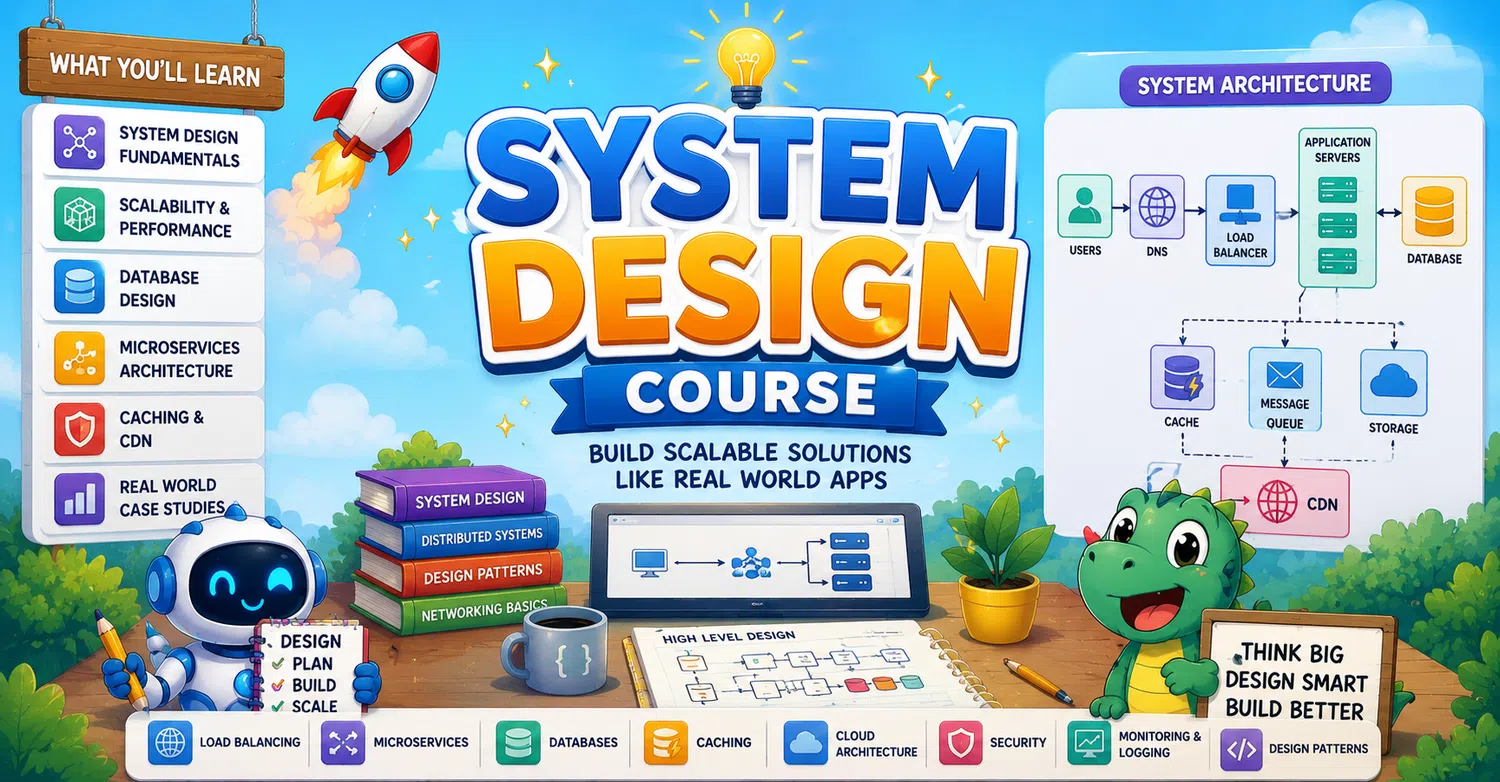
Modern software development is no longer limited to writing code for individual applications. Today's software often involves cloud infrastructure, APIs, distributed services, large databases, real-time communication, and applications that need to support continuously changing workloads. Understanding how these components work together is becoming an important part of effective software engineering. A System Design Course can help learners build this understanding and explore the architectural principles used in modern software development.
Understand Modern Software Architecture
Software architecture provides the structure that connects different parts of an application. Developers need to understand how frontend applications communicate with backend services, how APIs exchange data, and how databases support application functionality.
A System Design Course can introduce learners to important areas such as:
Client-server architecture
RESTful APIs and service communication
Database architecture
Caching systems
Load balancing
Microservices
Message queues
Cloud-based infrastructure
Scalability and reliability
These concepts help learners understand how modern applications are structured beyond individual programming tasks.
Connect Development with System Design
Programming and system design are closely connected. Developers write the logic that powers application features, while system design determines how those features fit into the larger application.
For example, developing an online shopping feature may involve product services, user authentication, inventory management, order processing, payment integration, and notifications. Each component has its own responsibilities, but they must communicate effectively.
Learning system design helps developers consider questions such as:
How should application components communicate?
Where should data be stored?
How can frequently accessed information be served efficiently?
What happens when one service becomes unavailable?
How can the application support increasing traffic?
This broader perspective can lead to more thoughtful development decisions.
Learn Microservices and Distributed Architecture
Many modern applications use multiple independent services instead of placing every feature inside one large application. Microservices architecture allows different services to be developed, deployed, and scaled independently.
A System Design Course can help learners understand how microservices work and the challenges that come with distributed architecture.
Important concepts may include:
Service-to-service communication
API gateways
Service discovery
Independent deployment
Distributed data management
Event-driven communication
Fault isolation
Understanding these concepts can help developers work more effectively on applications composed of multiple services.
Build Scalable Applications
Modern applications may experience changing traffic patterns. A platform can have a relatively low workload during one period and receive a large number of requests during another.
System design helps developers prepare applications for such changes. Techniques such as horizontal scaling, load balancing, caching, and database replication can help distribute workloads more effectively.
Learners can study how to:
Identify potential performance bottlenecks
Distribute requests across multiple instances
Reduce unnecessary database queries
Cache frequently requested information
Scale services independently
Process background tasks asynchronously
The right solution depends on application requirements, making architectural decision-making an important part of the learning process.
Explore Cloud-Native Development
Cloud platforms have changed the way software applications are built, deployed, and operated. Modern development may involve containers, managed databases, serverless functions, distributed storage, and automated deployment systems.
A System Design Course can help learners understand these technologies from an architectural perspective instead of simply learning how to use individual cloud services.
For example, a cloud-based application may combine an API service with a database, caching layer, object storage, monitoring system, and message queue. Understanding the role of each component makes it easier to reason about the complete system.
Focus on Reliability and Performance
Modern software needs to remain responsive and dependable even when unexpected problems occur. System design encourages developers to think about failure scenarios before they happen.
Important reliability concepts include:
Redundancy and failover
Timeouts and retries
Health checks
Circuit breakers
Monitoring and observability
Graceful degradation
Performance also needs to be considered at different levels, including application code, databases, networks, and external services.
By learning these concepts, developers can design applications that are better prepared for real-world operating conditions.
Understand Data Management
Data is at the center of most modern applications. Choosing an appropriate storage solution and designing an efficient data flow can have a major impact on application performance and maintainability.
A System Design Course can introduce learners to different approaches for handling application data, including relational databases, NoSQL databases, caching, replication, partitioning, and indexing.
For example, a real-time application may require fast access to frequently changing information, while a financial application may prioritize transactional consistency. Understanding these differences helps developers select architectures based on actual requirements.
Develop Practical System Design Skills
Modern software development requires continuous problem-solving. Practical system design exercises can help learners apply architectural concepts to realistic applications.
Projects or design scenarios may involve:
Designing a real-time chat application
Building an online marketplace
Creating a video streaming platform
Designing a food delivery system
Developing a scalable booking application
These scenarios allow learners to connect APIs, databases, services, caching, messaging, and scalability into a complete architecture.
Prepare for the Future of Software Engineering
Technology continues to evolve, but fundamental system design principles remain valuable. Developers who understand how applications are structured can adapt more easily when new frameworks, cloud services, or development approaches emerge.
A System Design Course can strengthen this foundation by teaching learners to focus on requirements, architecture, trade-offs, scalability, and reliability rather than depending entirely on specific technologies.
This approach can support continuous learning as developers move from basic application development toward more complex engineering responsibilities.
Conclusion
Modern software development requires developers to understand more than programming languages and frameworks. They need to recognize how APIs, databases, cloud infrastructure, distributed services, caching, messaging, and scalability work together to create complete applications.
A System Design Course can provide a structured path for developing this broader understanding. By studying architecture and applying concepts to practical scenarios, learners can build stronger system-level thinking and become better prepared to contribute to modern software development projects.