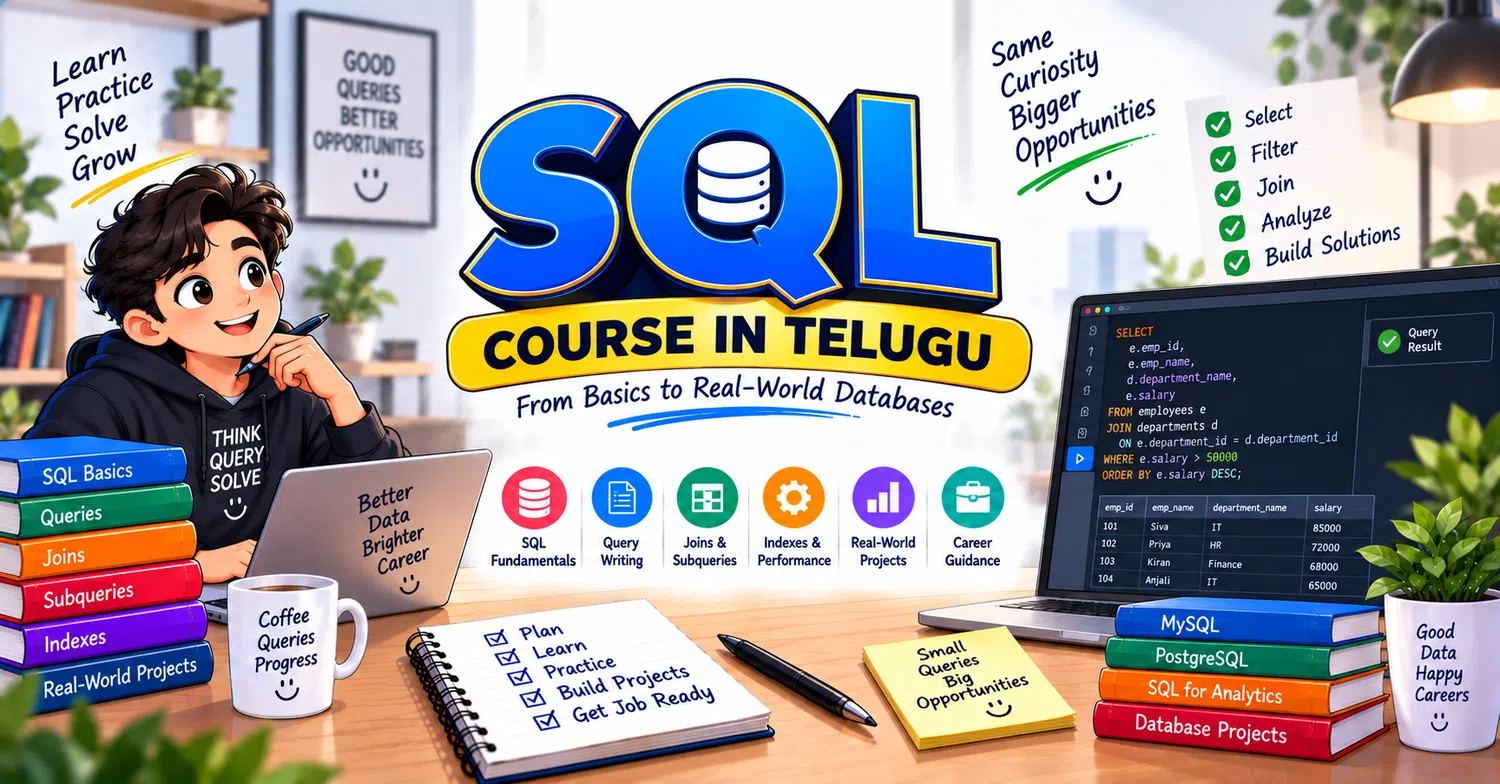
Learning basic SQL commands helps you retrieve and modify database records, but practical database work often requires better ways to simplify repeated queries, improve data-access performance, and organize reusable database operations. Views, indexes, and stored procedures address these requirements in different ways. A SQL Course in Telugu can help learners understand how these database objects work, why they are created, and where they can be applied. By studying them through realistic scenarios, learners can progress from writing individual SQL statements toward designing more organized and efficient database solutions.
Move Beyond Individual Queries into Reusable Database Design
Imagine an employee attendance management system used by an organization. The database contains employee details, departments, attendance records, shifts, and leave information. Managers regularly need attendance summaries, while administrators perform repeated operations involving the same tables.
Writing a long query from scratch every time can make database work repetitive. Searching large tables without appropriate optimization can also affect query performance as data grows.
Views, indexes, and stored procedures provide different solutions to these challenges. Understanding their individual purposes is an important step toward more advanced SQL development.
What Is a View and Why Would a Database User Create One?
A view is a virtual table based on the result of a stored SQL query. It can present selected information from one or more underlying tables without necessarily storing a separate copy of that result as ordinary table data.
For the attendance system, managers may frequently need employee names, departments, attendance dates, and attendance status. Instead of repeatedly writing the same multi-table query, a suitable view can provide a simpler interface to that information.
Views can therefore make frequently required data easier to access and can hide unnecessary complexity from users who only need a specific representation of the database.
Simplify Reporting Without Duplicating the Original Tables
One advantage of a view is that it can represent information already maintained in underlying tables.
Suppose an HR team needs a consistent attendance reporting structure. A view can expose only the fields required for that reporting task while leaving the original database design unchanged.
This can make reporting queries easier to read because users can query the view rather than repeatedly reconstructing the complete table relationship.
Learners should still understand the original tables because a view depends on the query and data structures beneath it.
Discover Why Indexes Matter as Database Tables Grow
A small practice table may return results quickly even without much optimization. Real databases, however, can contain significantly more records.
An index is a database structure designed to help the database locate relevant data more efficiently for suitable queries. It can be especially useful when certain columns are frequently involved in searching, filtering, joining, or sorting.
For example, if attendance records are regularly searched using an employee identifier, an appropriate index may help the database locate matching records more efficiently than repeatedly examining every row.
Does Creating More Indexes Always Make a Database Faster?
No. Indexes can improve particular read operations, but creating unnecessary indexes can consume storage and add maintenance work when records are inserted, updated, or deleted.
This is why indexing should be based on actual query requirements rather than the assumption that every column needs an index.
Learners should understand which columns are frequently searched, how tables are joined, and which queries matter most before making indexing decisions.
This introduces an important database-development principle: optimization involves trade-offs.
Learn to Think About Queries from the Database Engine's Perspective
When learners write SQL, they usually focus first on whether the query returns the correct output. Advanced practice also encourages them to consider how the database reaches that output.
A query searching attendance records by employee, date, or department may behave differently depending on table size, conditions, available indexes, and database design.
Through a SQL Course in Telugu, learners can begin connecting query structure with performance considerations instead of treating optimization as an unrelated advanced topic.
This perspective becomes increasingly useful as datasets and applications grow.
What Is a Stored Procedure Used for in SQL?
A stored procedure is a named set of SQL statements stored within the database and designed to perform a defined operation when called.
Suppose the attendance system needs a standard process that produces an employee's attendance summary for a selected period. Rather than repeatedly sending the complete sequence of SQL statements, the required database logic can be organized into a stored procedure where the database platform supports it.
Stored procedures may accept parameters, perform database operations, and return results depending on their design and the database system being used.
Turn Repeated Database Logic into Structured Operations
Stored procedures become particularly meaningful when an application repeatedly performs the same database-oriented workflow.
The attendance system might require a procedure that receives an employee identifier and date range before generating relevant attendance information. Another operation might perform a defined administrative update according to business rules.
Organizing repeated logic in this way can improve consistency and make certain database operations easier to manage.
Learners should also understand that stored procedure syntax and capabilities can vary between database management systems, so the underlying concepts are more transferable than memorizing one platform's exact syntax.
How Do Views, Indexes and Stored Procedures Differ?
Views simplify how query results are presented, indexes primarily support efficient data access, and stored procedures organize executable database operations.
Although all three are database objects or mechanisms used beyond basic querying, they solve different problems.
A learner should therefore avoid thinking of them as interchangeable features. The correct choice begins by identifying the requirement. If repeated query complexity is the issue, a view may be relevant. If suitable queries need faster data access, indexing may be considered. If repeated database logic needs to be organized and executed, a stored procedure may be appropriate.
Build Practical Knowledge by Combining the Three Concepts
A realistic database project can demonstrate how these techniques complement one another.
In the employee attendance system, learners could design a reporting view that presents commonly required attendance information. They could examine frequently searched fields and evaluate where indexing may be useful. They could then create a stored procedure for a recurring attendance-related operation.
This project structure gives every concept a clear role.
Instead of remembering three separate definitions, learners understand how database design, performance, reporting, and reusable operations can coexist within one system.
Why Are These Topics Useful for Advancing SQL Skills?
Basic SQL knowledge helps learners communicate with relational databases. Views, indexes, and stored procedures introduce them to broader database responsibilities.
Views encourage thinking about reusable data presentation. Indexes introduce performance awareness. Stored procedures develop an understanding of database-side logic and repeatable operations.
These concepts can be useful for learners exploring database development, backend development, reporting, application support, data-oriented work, or other roles where relational databases are involved.
Their relevance depends on the database platform and responsibilities of a particular role.
Practice Decisions Instead of Only Practicing Syntax
A learner can memorize how to create an index or view without understanding whether it should exist.
Practical exercises should therefore include decision-making. Learners can examine a requirement, choose an appropriate database technique, implement it, and evaluate the result.
For indexes, this may include comparing query behavior before and after an appropriate indexing decision. For views, learners can identify repetitive reporting queries. For procedures, they can find operations containing repeatable database logic.
This develops database reasoning alongside SQL syntax.
Frequently Asked Questions
1. Does a standard SQL view store another permanent copy of table data?
Usually, a standard view represents the result of a stored query rather than maintaining an independent copy like an ordinary table. Exact behavior and additional view types can depend on the database system.
2. Which columns are good candidates for database indexes?
Columns frequently involved in important searches, joins, filters, or sorting may be candidates. Index decisions should consider actual query patterns, table size, and the cost of maintaining the index.
3. Can an index change the records returned by a SQL query?
An index is intended to influence how efficiently suitable data can be accessed, not to change the logical result that a correctly written query should return.
4. Why use a stored procedure instead of repeatedly writing the same SQL statements?
A stored procedure can organize reusable database logic under a defined operation. This can be useful when the same database process needs to be executed consistently with appropriate inputs.
5. Should learners study views, indexes, or stored procedures first?
A practical sequence is to first become comfortable with tables, queries, joins, filtering, and aggregation. Views can then introduce reusable query representations, indexes can add performance concepts, and stored procedures can extend learning into reusable database operations.
Conclusion
Views, indexes, and stored procedures help learners move beyond basic SQL querying into more practical database development. Views can simplify repeated access to structured results, indexes can support efficient retrieval for appropriate queries, and stored procedures can organize reusable database operations.
Understanding these concepts through a realistic database project makes their differences and relationships clearer. By learning not only how to create them but also why and when they should be used, learners can develop stronger SQL knowledge for increasingly complex database tasks.