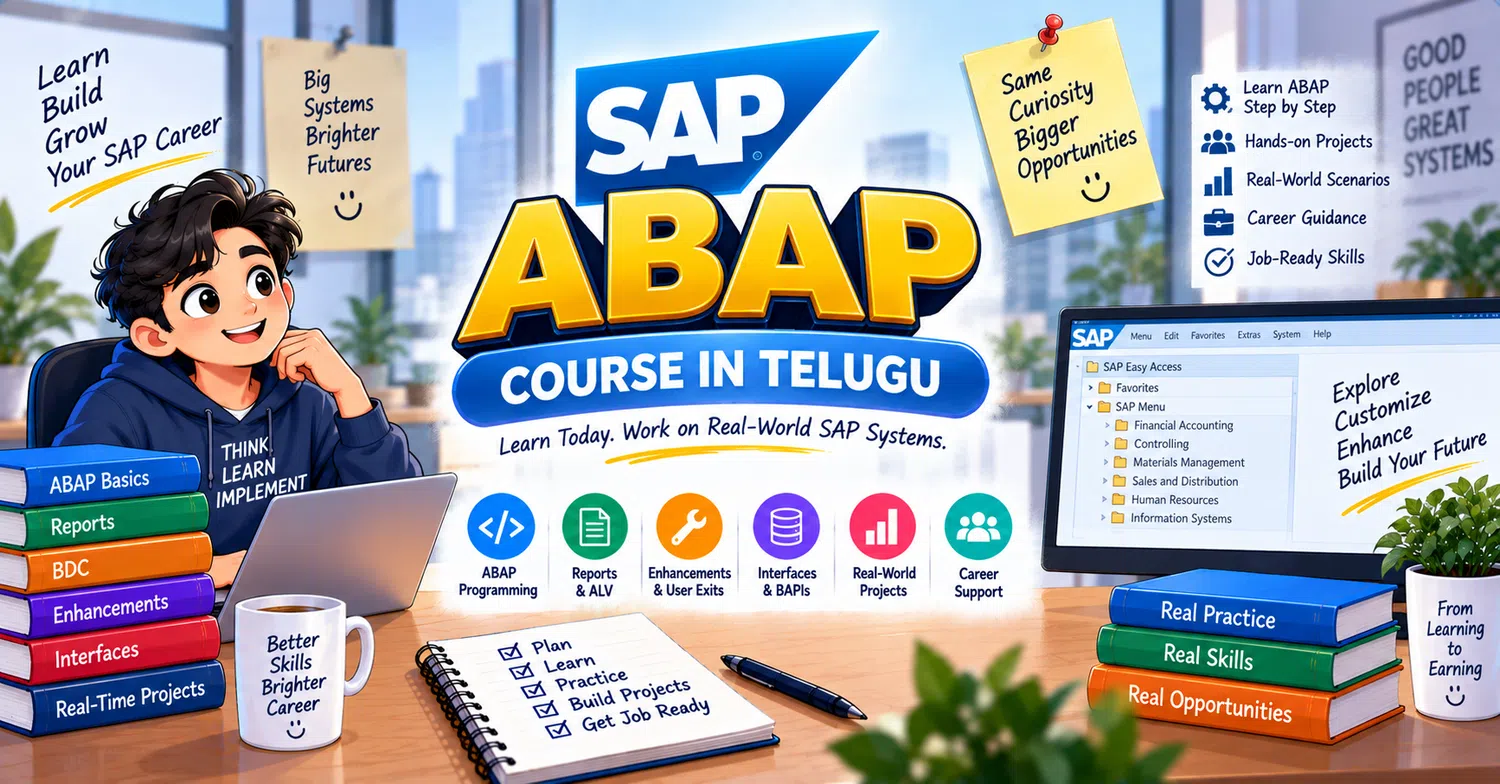
Starting SAP development can seem challenging for beginners because it combines programming concepts with enterprise business processes and structured data. ABAP provides a programming environment for developing and customizing applications within SAP systems. Beginners can approach it gradually by first understanding basic syntax and then progressing toward data processing, reports, debugging, and practical business applications. A SAP ABAP Course in Telugu can help learners build this foundation step by step while connecting programming concepts with realistic SAP development requirements.
Begin by Understanding the Purpose of ABAP
Before writing programs, beginners should understand where ABAP fits within SAP. Businesses use SAP systems to manage activities related to sales, purchasing, finance, inventory, employees, and other operations. These standard processes may sometimes require custom reports or additional functionality based on organizational requirements.
ABAP developers work on technical solutions for such requirements. Their work can involve retrieving business information, processing records, creating reports, modifying custom programs, and supporting application enhancements.
Understanding this purpose gives beginners a clearer reason for learning individual programming concepts.
Take the First Steps with ABAP Syntax
The best way to start programming is with small programs that demonstrate how instructions are written and executed. Beginners can first become familiar with program structure and basic statements before attempting business-oriented applications.
Initial learning can cover:
Variables and constants
Basic data types
Operators and expressions
Output statements
Simple calculations
Program structure
Small exercises allow learners to observe how different statements affect program output. They also create a foundation for understanding more complex logic later.
Build Logical Thinking with Conditions
After learning basic syntax, beginners can move toward decision-making concepts. Conditions allow a program to behave differently depending on available information.
Consider a simple inventory scenario. A company wants to identify whether the available quantity of a product is below a predefined reorder level. The program needs to compare the two values and determine the appropriate result.
Learners can use such scenarios to understand how conditional statements control program execution. Instead of memorizing syntax independently, they see how conditions represent actual business rules.
Handle Repeated Operations with Loops
Business applications frequently process multiple records or repeat similar operations. Loops help developers perform these tasks without writing the same instructions again and again.
For example, an inventory program may need to examine several material records and identify products with low stock levels.
Through a SAP ABAP Course in Telugu, beginners can practice using loops with progressively larger examples. This allows them to understand how repeated processing works and how conditions can be combined with loops to produce specific results.
Progress from Individual Values to Structured Data
Once learners understand basic program flow, they can begin working with structured information. SAP applications involve business records containing several related fields rather than isolated values.
An inventory record, for example, may contain a material number, description, category, available quantity, and storage location.
Learning how related values are organized helps beginners prepare for more realistic data-processing tasks. It also introduces them to the structured nature of enterprise application development.
Understand Internal Tables Through Practical Examples
Internal tables are an important part of ABAP programming because applications frequently need to process collections of records temporarily within a program.
In the inventory scenario, multiple material records can be stored in an internal table and processed according to the requirement.
Beginners can gradually learn how to add information, read records, modify values, loop through entries, and organize data. Working with a recognizable business scenario makes these operations easier to understand than studying internal tables only through isolated syntax examples.
Learn How ABAP Works with Business Data
After becoming comfortable with internal program data, learners can progress toward database-oriented development. SAP applications maintain large amounts of structured business information, and developers often need to retrieve only the records required for a particular task.
Suppose the inventory team wants information about materials stored at a specific location. The developer needs to understand which information is required and apply suitable conditions when retrieving it.
Database exercises help learners understand the connection between stored business data and the programs that use it.
Create Your First Business-Oriented Report
Reports provide beginners with an opportunity to combine multiple ABAP concepts within a single practical task.
The inventory team may require a report that displays materials whose available quantity falls below the reorder level. Users may also need to filter the report according to specific criteria.
Building this report can bring together input handling, data retrieval, conditions, loops, internal tables, and output presentation.
Instead of learning each concept independently, learners begin to understand how different programming skills cooperate to solve one business requirement.
Organize Programs for Better Readability
As learners move beyond small exercises, code organization becomes increasingly important. A program that places every operation inside one large section can become difficult to understand.
Beginners should gradually learn to separate different responsibilities and use meaningful names for program elements.
Good organization makes it easier to understand what a program does, locate errors, modify functionality, and reuse common logic. These habits are useful even in small exercises because they prepare learners for larger development tasks.
Make Debugging Part of the Learning Process
Programming errors are normal, especially while learning from scratch. Instead of treating errors only as failures, beginners can use them to understand how a program actually executes.
Suppose the inventory report displays an incorrect quantity for certain materials. The learner can inspect values during execution and identify where the result changes unexpectedly.
A practical debugging process can involve:
Reproducing the problem
Identifying the affected logic
Checking variable values
Reviewing conditions
Examining processed data
Correcting the issue
Running the program again
Repeated debugging can gradually strengthen programming confidence and logical thinking.
Learn to Validate Different Situations
A program should work correctly under more than one ideal condition. Beginners need to understand what happens when required information is unavailable or when input does not match expectations.
The inventory report may return no materials for a particular selection. Instead of displaying confusing output, the program should handle the situation appropriately.
Testing different conditions teaches learners to think about how users interact with software rather than focusing only on whether the program executes successfully.
Practice Reading Existing ABAP Code
Learning from scratch does not mean learners should only create new programs. Reading existing code is another useful way to strengthen programming understanding.
Beginners can examine a small program and identify declarations, conditions, loops, internal table operations, and output logic. They can then explain how information moves through the program.
Later, they can make small modifications, such as adding another field or changing a condition.
This develops the ability to understand and maintain existing programs, which is an important aspect of development work.
Move from Exercises to Connected SAP Projects
Once individual concepts become familiar, learners can combine them through practical projects. A SAP ABAP Course in Telugu can support this transition by connecting programming fundamentals with business-oriented development scenarios.
An inventory project can gradually expand from simple stock calculations into material reports, selection-based data retrieval, stock-level analysis, and additional validations.
Learners can later explore different scenarios involving sales, purchasing, employee information, or other business areas. Working with varied projects helps them understand how the same programming fundamentals can solve different requirements.
Conclusion
Learning ABAP from scratch becomes more manageable when learners progress gradually from basic syntax to practical SAP development. Variables, conditions, loops, structured data, internal tables, database operations, reports, debugging, and validation each contribute to the overall programming foundation.
The most effective learning approach connects these concepts with understandable business scenarios instead of treating them as isolated topics. By practicing regularly, reading existing programs, solving errors, and building connected projects, beginners can gradually strengthen their ABAP programming knowledge and prepare themselves for more advanced SAP development concepts.