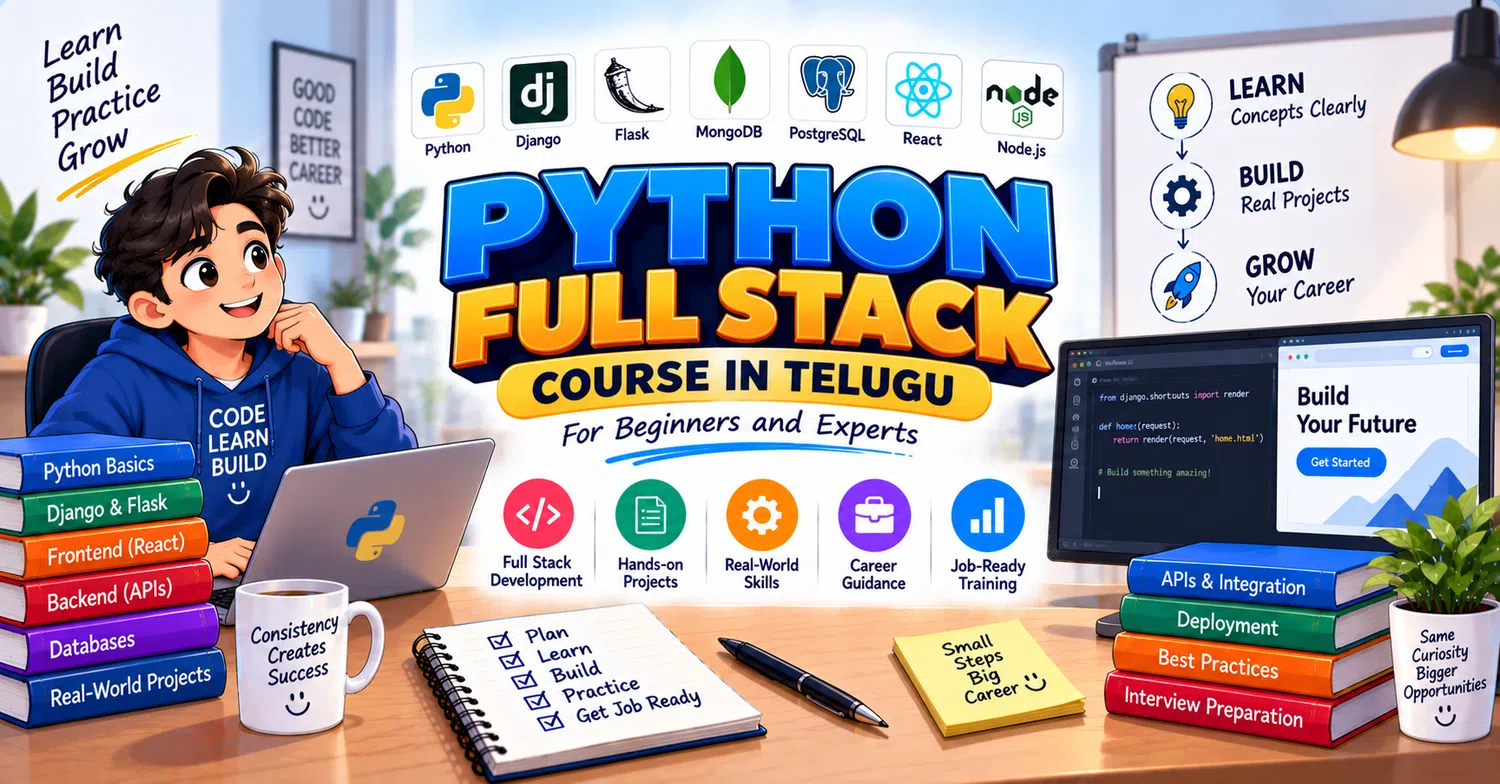
Mastering web development means understanding much more than how to design a webpage or write a few backend functions. A complete web application involves user interfaces, programming logic, databases, APIs, validation, testing, and communication between different components. Learners who understand how these areas connect can approach web projects with greater clarity. A Python Full Stack Course for Beginners and Experts in Telugu can provide a structured learning path that combines Python with essential frontend and backend concepts, helping learners progress from individual coding exercises to complete, functional web applications.
Master Web Development by Understanding the Complete Application Flow
A useful way to understand web development is to follow what happens after a user performs an action.
Consider an online library membership platform. A visitor creates an account, searches for available books, saves selected titles, and views borrowing information. Each action moves through several application layers.
The browser captures the interaction, backend logic processes the request, the database provides or stores information, and the application sends an appropriate result back to the user.
Seeing this complete cycle helps learners understand why full stack knowledge is valuable.
What Skills Are Essential for Building Complete Web Applications?
Complete web development requires a combination of frontend, backend, database, API, debugging, and code-management skills.
Rather than treating them as unrelated subjects, learners should understand the responsibility of each area.
Important capabilities can include:
Structuring interfaces with HTML
Styling responsive pages with CSS
Adding browser interactions using JavaScript
Writing application logic with Python
Managing stored information with databases
Creating and consuming APIs
Validating application inputs
Debugging unexpected behavior
Managing source code with Git
Combining these abilities gives learners a broader understanding of application development.
Turn Python into the Engine Behind Web Features
Python becomes particularly meaningful when learners use it to implement actual application behavior.
In the library platform, Python backend logic could process account creation, retrieve available titles, handle search requests, validate submitted information, and communicate with stored records.
This gives familiar programming concepts a practical purpose.
Functions can organize reusable operations, conditions can enforce application rules, classes can structure related behavior, and exception handling can help applications respond appropriately when something unexpected occurs.
Create Interfaces That Communicate Clearly with Users
A successful application should make its features understandable and accessible to users.
For the library platform, learners might design search fields, book cards, account forms, navigation areas, and borrowing-history pages. HTML creates the structure, CSS manages presentation, and JavaScript can improve interaction.
Frontend practice can teach learners how to transform application requirements into usable browser experiences.
It also demonstrates that frontend development is not simply decoration. It is the layer through which users communicate with the rest of the system.
How Does Python Full Stack Learning Make Web Development Easier to Understand?
Full stack learning can make web development easier to understand by showing how individual technologies contribute to one working application.
Instead of learning Python, JavaScript, databases, and APIs without knowing how they connect, learners can follow information as it travels through a feature.
Through a Python Full Stack Course for Beginners and Experts in Telugu, a learner can see how browser input becomes a server request, how Python processes that request, how the database contributes information, and how the final response returns to the interface.
This creates context around each technology.
Make Database Knowledge Part of Everyday Development
Web applications frequently need to remember information between user sessions.
A library platform may store members, books, categories, borrowing records, and account activity. Learners can understand how database tables represent these entities and how relationships connect them.
They can then practice creating queries that retrieve useful information or modify records when application actions occur.
Database learning becomes easier to relate to when every query supports a visible feature instead of existing only as a standalone exercise.
Discover the Role of APIs in Modern Web Systems
An API allows different software components to exchange information through clearly defined requests and responses.
For example, the library interface could request matching book information from a backend endpoint when a user searches by title or category.
This creates opportunities to understand HTTP methods, endpoints, JSON, request parameters, response structures, status codes, and error handling.
API knowledge is useful because many modern applications involve communication between separate frontend clients, backend services, mobile applications, or external platforms.
Why Can This Course Be Useful for Someone Learning Independently?
Independent learning provides access to large amounts of technical information, but deciding what to learn and how topics connect can be challenging.
A structured course can provide a sequence that moves from foundations toward integrated development.
Learners can understand one concept, apply it in a smaller exercise, and later reuse it inside a larger project. This reduces the gap between watching tutorials and independently developing an application.
The course is most helpful when learners actively code, question the implementation, modify examples, and solve problems rather than only completing lessons.
Move Beyond Tutorials by Building Features Independently
Following a tutorial can introduce a new technology, but mastery develops when learners attempt similar functionality without copying every step.
After learning how a search feature works, for example, learners could independently add category filters, sorting, or availability information to the library platform.
This requires them to decide which layer needs modification.
Does the interface need a new input? Does the backend need additional logic? Does the database query need to change?
Questions like these develop stronger application reasoning.
Is Python Full Stack Helpful for Both Beginners and Experienced Learners?
It can be useful for different experience levels when the learning depth matches the learner's existing knowledge.
Beginners can concentrate on programming fundamentals, basic interfaces, application flow, and smaller projects before progressing toward more complex integrations.
Experienced learners can focus on deeper backend development, API design, database relationships, authentication, testing, application organization, and maintainable code.
The same full stack path can therefore support different learning goals without requiring everyone to begin at exactly the same technical level.
Learn to Diagnose Web Applications, Not Just Build Them
Web development mastery also involves understanding why an application fails.
If a library search returns incorrect results, the problem could originate from the user input, JavaScript logic, API request, Python processing, database query, or response formatting.
Learners who understand the complete stack can trace the issue systematically.
Debugging develops technical judgment because it requires developers to inspect evidence, identify the responsible layer, test a correction, and confirm that the change solves the original problem.
Why Should Learners Consider a Full Stack Course for Career Preparation?
A full stack course can be worth considering when the learner wants a guided path toward building complete web applications rather than studying programming topics separately.
The practical value comes from connecting learning with projects. A learner who can build and explain an application can demonstrate knowledge of application flow, backend logic, database design, APIs, frontend behavior, and troubleshooting.
These abilities can support preparation for development opportunities where Python and related web technologies are relevant, although individual job requirements can differ.
Build Web Development Knowledge That Can Grow with You
A Python Full Stack Course for Beginners and Experts in Telugu can establish a foundation, but web development learning should continue beyond the initial course.
Learners can later expand into automated testing, application security, deployment workflows, cloud environments, containers, performance considerations, and software architecture.
Frameworks and tools can evolve, but understanding how requests, application logic, data, interfaces, and software components work together provides knowledge that can transfer to future technologies.
Conclusion
Mastering web development is a gradual process of connecting technologies and applying them to increasingly complete problems. Python provides backend programming capabilities, frontend technologies create interactive browser experiences, databases preserve application information, and APIs connect software components.
A structured full stack learning path can make these relationships easier to understand while providing opportunities for practical coding, independent feature development, debugging, and project building. For learners who consistently apply what they study, this approach can create a strong foundation for continued growth in modern web and software development.