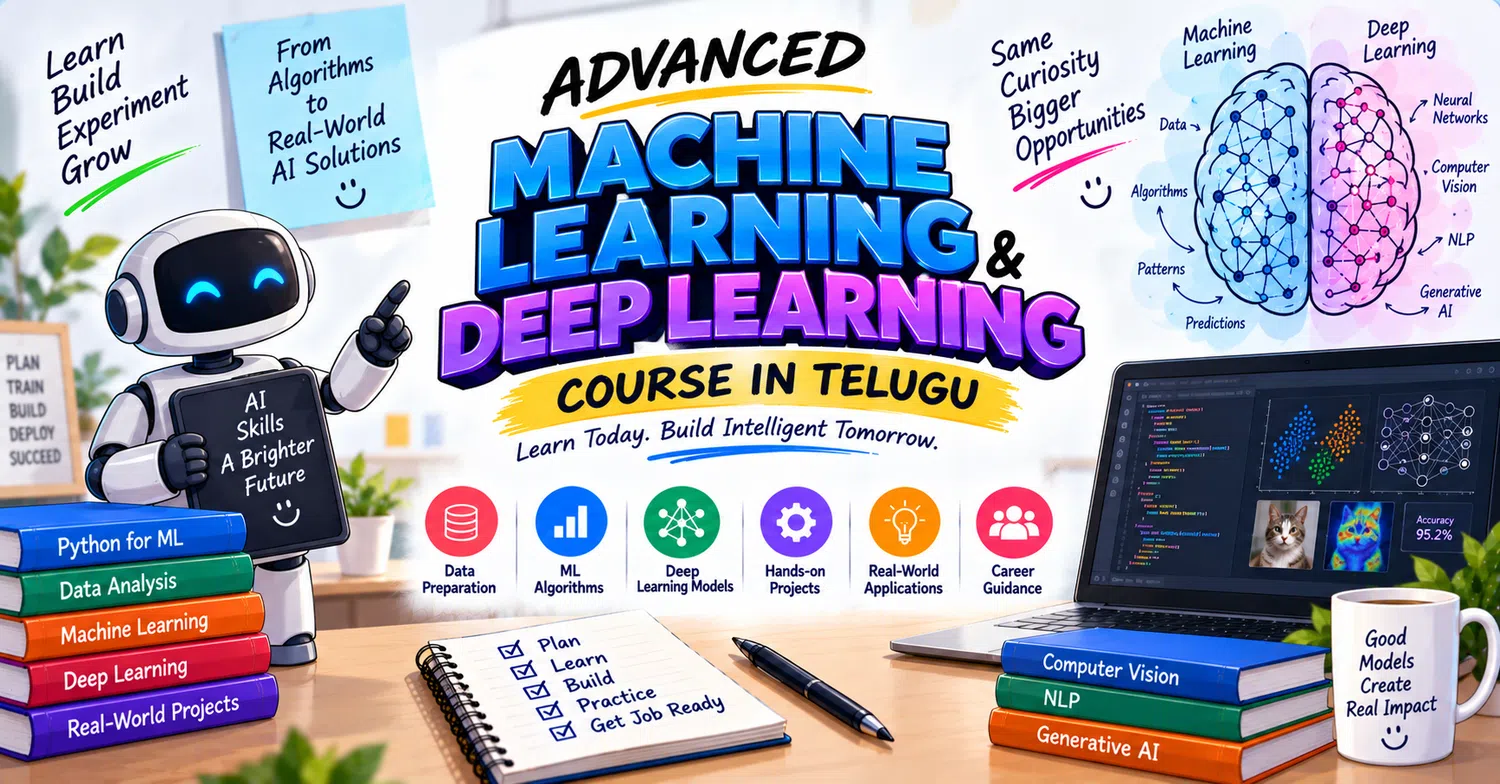
Artificial Intelligence careers increasingly require professionals to understand how data can be transformed into intelligent models capable of recognizing patterns, generating predictions, and supporting automated decisions. Basic machine learning knowledge provides an important starting point, but advanced AI work often involves more sophisticated algorithms, neural networks, model optimization, and experimentation. An Advanced Machine Learning Course & Deep Learning in Telugu can help learners strengthen these technical areas while developing the practical problem-solving abilities needed to explore different AI career paths.
Advanced AI Skills Go Beyond Basic Prediction
Basic machine learning introduces important ideas such as classification, regression, training data, and model evaluation. Advanced learning extends these foundations by helping learners work with more complex datasets and modeling challenges.
Learners can strengthen areas such as:
Advanced classification and regression
Ensemble learning
Feature engineering
Model optimization
Hyperparameter tuning
Neural network development
Deep learning architectures
Model evaluation and error analysis
Understanding how these concepts connect is useful for learners who want to move from introductory projects toward more challenging AI applications.
Real AI Careers Require Strong Data Skills
AI models depend on data, making data preparation a fundamental skill for practical machine learning work.
Consider a cybersecurity services company analyzing system activity to identify unusual patterns for further investigation. Raw information may contain missing values, categorical fields, numerical measurements, duplicated records, and features with different scales.
Before building models, learners may need to:
Explore available data
Handle missing information
Transform categorical features
Scale suitable variables
Identify useful inputs
Prepare training and testing datasets
These activities teach learners that successful AI development begins long before an algorithm is trained.
Advanced Algorithms Improve Modeling Knowledge
Different machine learning problems can require different algorithms. Learning advanced methods helps learners understand how model selection changes according to data characteristics and project requirements.
Practical experimentation can include:
Random Forest
Support Vector Machines
Gradient boosting techniques
Ensemble methods
Advanced regression approaches
Advanced classification techniques
Through an Advanced Machine Learning Course & Deep Learning in Telugu, learners can compare these approaches instead of assuming that one model is suitable for every problem.
This comparison-oriented mindset is valuable because real AI development frequently involves testing multiple approaches.
Feature Engineering Builds Problem-Solving Ability
Strong AI professionals need to understand what information should be presented to a model.
Raw variables may not always represent a problem effectively. Feature engineering allows learners to create more meaningful representations from existing data.
For the cybersecurity scenario, learners might investigate activity frequency, time-based behavior, repeated events, or combinations of available variables.
They can then compare model performance before and after modifying the feature set.
This develops the ability to connect domain understanding with technical modeling decisions.
Deep Learning Expands the Range of AI Problems
Deep learning introduces learners to neural networks capable of learning complex representations from data.
A strong foundation begins with understanding:
Neurons and layers
Weights and biases
Activation functions
Forward propagation
Loss functions
Backpropagation
Optimizers
These concepts explain how neural networks learn rather than treating deep learning frameworks as tools that automatically produce intelligent results.
Understanding the learning process also makes it easier to investigate poor model performance.
Computer Vision Creates Another AI Career Direction
Learners interested in visual AI applications can develop knowledge of Convolutional Neural Networks.
CNNs are designed to learn useful visual features from image data. A practical project might involve classifying different types of equipment images, identifying product categories, or recognizing visible patterns within a controlled dataset.
Important areas can include:
Image preprocessing
Convolutional layers
Filters and kernels
Feature maps
Pooling
Classification layers
Computer vision projects expose learners to AI challenges that are significantly different from traditional tabular datasets.
Sequential Learning Broadens Deep Learning Knowledge
Text and time-dependent information introduce another category of AI problems.
Learners can explore Recurrent Neural Networks and understand why sequential models consider relationships across ordered information. They can later study LSTM and GRU concepts to understand approaches designed for more complex sequence dependencies.
Working with multiple data types is valuable because AI careers are not limited to one modeling technique.
A learner who understands tabular, visual, and sequential problems develops a broader perspective on selecting suitable architectures.
Model Optimization Develops Experimental Thinking
AI development involves repeated experimentation. A first model rarely represents the final solution.
Learners should understand how different parameters influence model behavior. Depending on the algorithm, experiments might involve:
Learning rate
Batch size
Number of estimators
Tree depth
Network depth
Optimizer selection
Regularization settings
Instead of changing settings randomly, learners can record each experiment and compare the resulting performance.
This builds a systematic approach to model improvement.
Evaluation Skills Help Learners Judge Models Correctly
A high accuracy value does not automatically mean that a model is suitable for its intended application.
Learners should understand evaluation metrics such as precision, recall, F1-score, confusion matrices, and suitable regression metrics.
For example, when analyzing uncommon events within a cybersecurity dataset, overall accuracy may provide an incomplete picture of model behavior.
Understanding what different metrics reveal helps learners evaluate models according to the actual objective rather than relying on a single number.
Error Analysis Strengthens AI Problem Solving
Incorrect predictions are valuable learning opportunities.
Instead of immediately replacing a model, learners can investigate why certain examples were predicted incorrectly. Problems may come from insufficient data, weak features, class imbalance, preprocessing decisions, or model configuration.
A practical workflow can include:
Identifying repeated prediction errors
Investigating possible causes
Modifying data or model settings
Retraining the model
Comparing results
This iterative process develops troubleshooting skills that are useful across machine learning projects.
Projects Turn Technical Knowledge into Practical Skills
AI career preparation becomes more meaningful when learners build complete projects rather than collecting isolated algorithm examples.
A project should ideally connect problem definition, data exploration, preprocessing, feature engineering, model selection, training, evaluation, optimization, and documentation.
Learners can gradually create projects involving different data types instead of repeatedly building similar prediction models.
This demonstrates an understanding of the complete AI workflow and provides opportunities to explain technical decisions clearly.
Explore Different AI Career Directions
Advanced machine learning and deep learning can provide foundational knowledge relevant to several technical career directions.
Depending on additional skills and interests, learners may explore areas such as:
Machine learning engineering
Data science
Deep learning development
Computer vision
AI application development
Model testing and experimentation
Each direction can require additional knowledge in programming, mathematics, data engineering, software development, cloud platforms, deployment, or specialized AI technologies.
Understanding this helps learners create a realistic learning path instead of expecting one course to cover every requirement of an AI career.
Develop Skills That Can Continue Evolving
AI technologies continue to change, so long-term learning ability is especially important.
An Advanced Machine Learning Course & Deep Learning in Telugu can provide a structured foundation for understanding advanced models and neural networks, but learners should continue experimenting with new datasets, architectures, libraries, and technical concepts.
The ability to understand unfamiliar techniques, test them systematically, evaluate their results, and identify their limitations can be more valuable over time than memorizing one particular model architecture.
Conclusion
Advanced machine learning and deep learning are valuable areas for AI career development because they strengthen knowledge across data preparation, advanced algorithms, neural networks, computer vision, sequential modeling, optimization, evaluation, and practical experimentation.
Learners who combine these concepts with end-to-end projects can develop a stronger understanding of how AI solutions are actually built and improved. Rather than focusing only on algorithms, developing problem-solving, evaluation, and continuous learning skills creates a broader technical foundation for exploring different AI career opportunities.