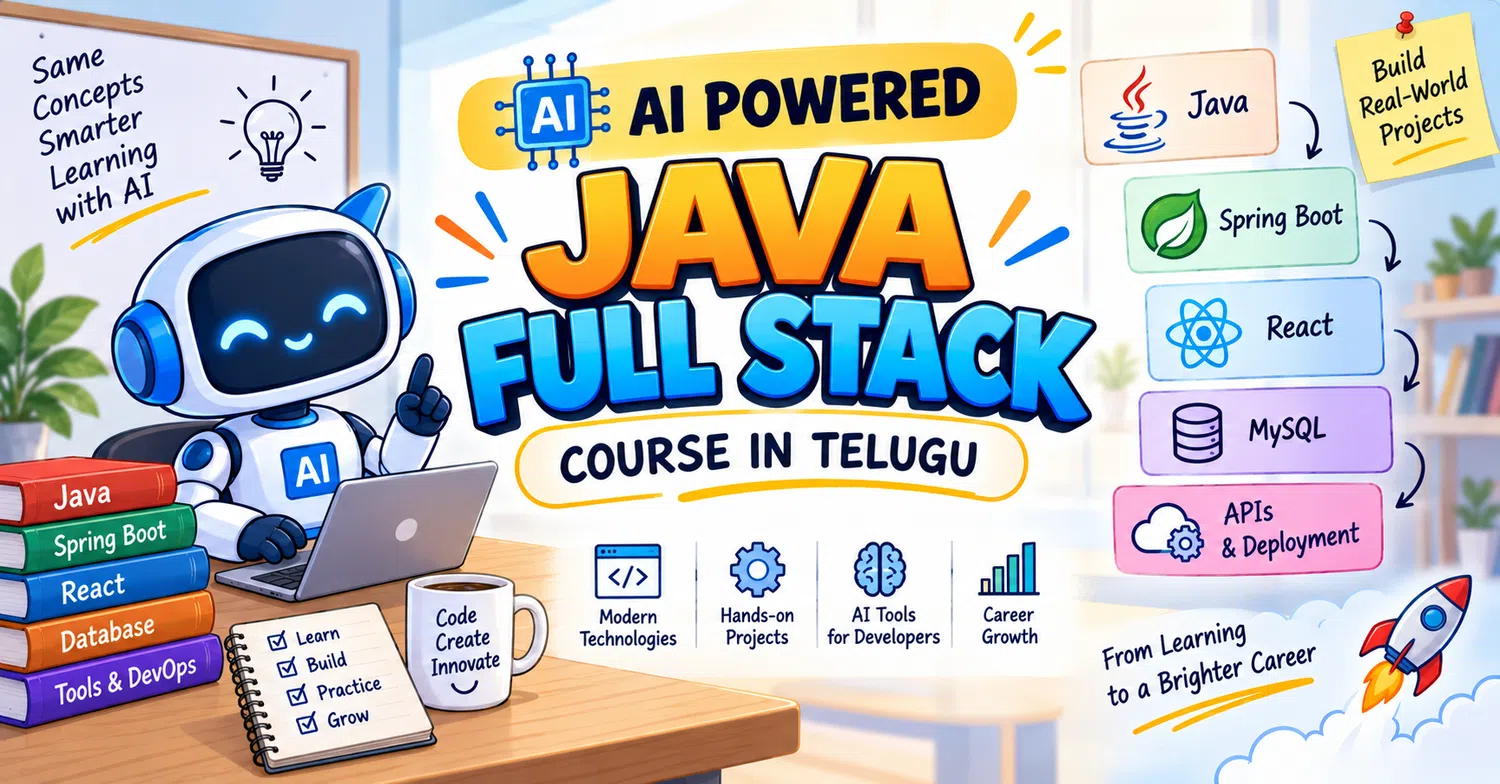
Starting a software development career requires more than learning programming syntax or completing a few coding exercises. Aspiring developers need to understand how applications are planned, coded, connected to databases, tested, debugged, and delivered to users. An AI Powered Java Full Stack Course in Telugu can help beginners develop this broader understanding by combining Java programming, backend development, frontend technologies, databases, APIs, projects, and AI-assisted development practices.
For freshers, the most effective approach is to build skills in a logical order. Strong fundamentals make advanced technologies easier to understand, while practical projects show how those technologies work together in real software development.
Begin by Learning How Developers Solve Problems
Before building web applications, beginners need to develop programming logic. Core Java provides a useful environment for understanding how developers convert requirements into working code.
Learners can begin with variables, operators, conditions, loops, methods, arrays, and strings before progressing to object-oriented programming. Classes, objects, encapsulation, inheritance, abstraction, and interfaces help them understand how larger programs can be organized.
Exception handling, collections, Java 8 features, and other important concepts can then expand their ability to solve more realistic problems.
For example, learners could initially create a simple appointment scheduling program. They can model customers, appointments, available slots, and booking rules using Java. This teaches them to think about application requirements before introducing web technologies.
Step into Backend Development with Spring Boot
Once Java fundamentals are strong, Spring Boot provides a path toward professional backend development.
Instead of writing only standalone programs, learners can begin creating applications that receive requests, process information, communicate with databases, and return responses through REST APIs.
Through an AI Powered Java Full Stack Course in Telugu, learners can understand how controllers, service layers, repositories, entities, dependency injection, validation, and exception handling contribute to a structured backend.
The appointment system can now become a web-based application. A user may request an available time slot, and the Spring Boot backend can check the request, apply booking rules, retrieve information from the database, and return the result.
This progression helps beginners see how their Core Java knowledge becomes useful in actual application development.
Understand the Complete Full-Stack Workflow
Backend knowledge alone does not provide a complete picture of web development. Aspiring developers should also understand what users see and how frontend applications communicate with backend systems.
HTML and CSS establish the structure and appearance of web pages, while JavaScript introduces browser-based programming and interaction. React can then be used to build reusable components and dynamic interfaces.
Database and SQL knowledge complete another important part of the stack. Developers need to understand how information is structured, queried, inserted, updated, and connected through relationships.
When these technologies come together, a learner can follow an entire application request. A user submits an appointment through React, the frontend calls a Spring Boot REST API, Java business logic validates the booking, the database stores the information, and the result is returned to the interface.
Understanding this complete flow is an important milestone for someone preparing to become a full-stack developer.
Add AI to Your Development Process
Modern developers can use AI tools to support several stages of software development. They can assist with understanding errors, exploring unfamiliar code, creating initial test cases, generating documentation, suggesting refactoring ideas, and accelerating repetitive coding tasks.
An AI Powered Java Full Stack Course in Telugu can help learners combine these capabilities with strong development fundamentals rather than becoming dependent on generated code.
For example, AI might suggest a solution for preventing duplicate appointments. The learner should still examine the logic, test different conditions, verify database behavior, and determine whether the implementation satisfies the actual requirement.
Learning to question and validate AI output is an important skill. Developers remain responsible for understanding the code they use and the decisions behind it.
Turn Learning into a Career-Focused Project
A complete project gives beginners an opportunity to bring their skills together. The appointment platform could be expanded with registration, authentication, scheduling, cancellation, search, user dashboards, database operations, REST APIs, and a responsive React interface.
During development, learners can also gain experience with Git and GitHub, API testing, debugging, validation, exception handling, basic application security, and deployment concepts.
The project should become more than a collection of features. Learners should understand its architecture and be prepared to explain why they designed particular components, how frontend and backend communication works, how information is maintained in the database, and how they resolved problems during development.
This type of project-based experience can provide useful material for resumes, portfolios, and technical interview discussions.
Conclusion
Starting a developer career becomes more manageable when technologies are learned in a clear sequence. Core Java builds programming ability, Spring Boot introduces backend development, React supports modern frontend development, and SQL provides the foundation for working with application data.
Combining these skills with REST APIs, practical projects, debugging, version control, and responsible AI usage can help beginners develop a well-rounded foundation for pursuing Java Full Stack development and continuing toward more advanced software engineering skills.