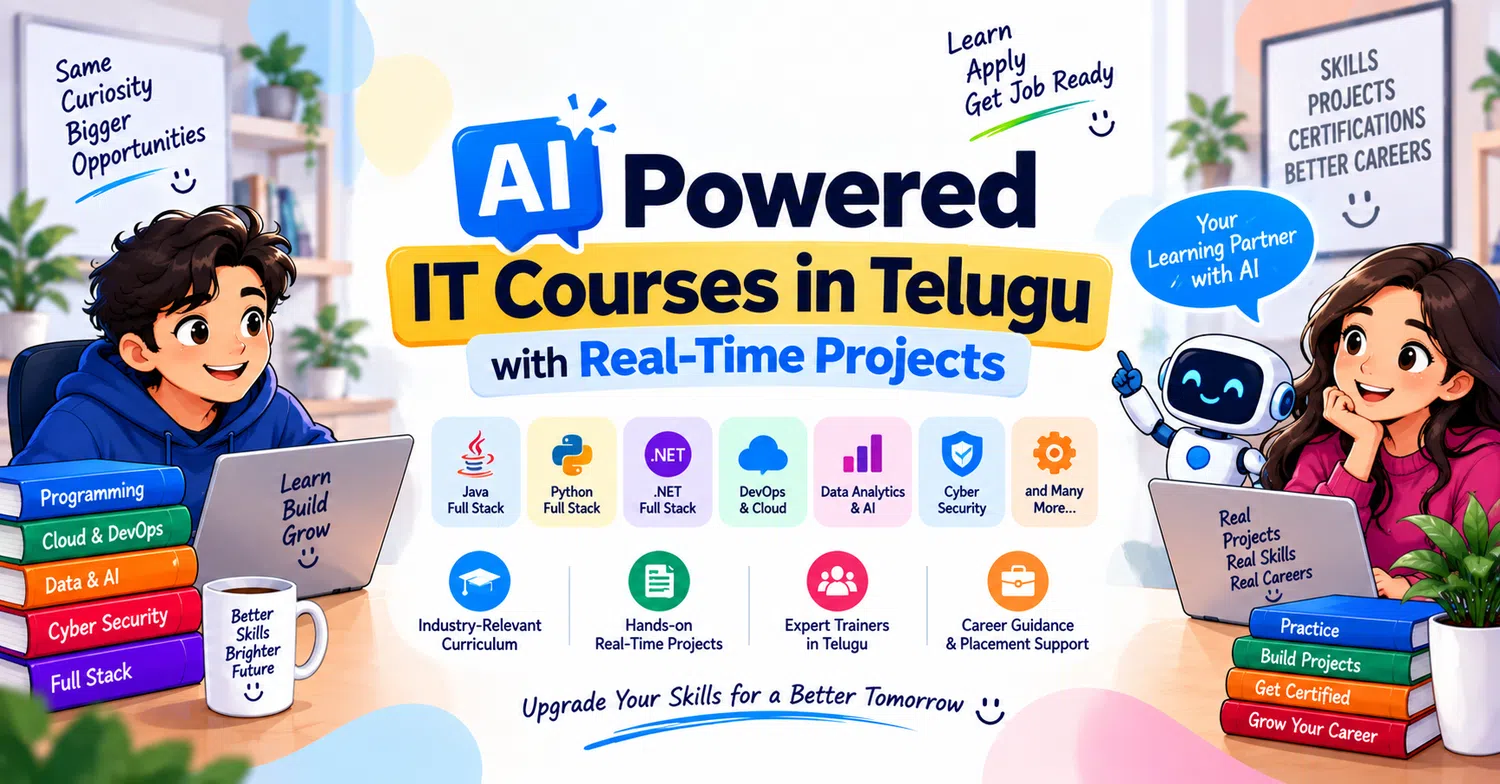
Modern IT careers are no longer built around a single technology. Applications depend on programming, databases, cloud platforms, automation, security, data, and increasingly artificial intelligence. For learners, the challenge is understanding which technologies matter for their chosen path and how those technologies work together in practical environments. AI Powered IT Courses in Telugu with Real-Time Projects can help learners develop this understanding by combining technical foundations with hands-on projects, AI-assisted workflows, troubleshooting, and practical problem-solving.
Understand Modern Technology as a Connected Ecosystem
A web application may look simple to its users, but several technologies can operate behind it.
Consider a fictional online learning portal where students create accounts, access lessons, track progress, and complete assessments. Building and operating this platform may involve software development, databases, APIs, cloud resources, security controls, testing, and deployment.
Modern IT learning can therefore involve areas such as:
Programming and application development
SQL and database management
Data analytics
Cloud computing
DevOps and automation
Cybersecurity
Software testing
Artificial intelligence
Learners do not need to master all these areas together. They should first build depth in the technologies related to their chosen career path.
Modern Development Goes Beyond Writing Code
Programming remains an important foundation for many technology careers, but modern application development involves more than writing functions and solving coding exercises.
Developers may need to understand how applications communicate, where information is stored, how users are authenticated, and how errors are handled.
For the online learning portal, development might involve creating student registration, course access, progress tracking, and assessment features.
A project like this can expose learners to:
Application logic
Database integration
API communication
User authentication
Input validation
Error handling
Testing and debugging
This helps learners understand how programming becomes part of a complete software solution.
Databases Keep Modern Applications Organized
Applications continuously create and retrieve information. Databases provide structured ways to manage that information.
In the learning portal, a database might contain student profiles, courses, lessons, assessment results, and progress information.
Learning databases through this context makes SQL more practical.
Instead of writing unrelated queries, learners can understand how queries answer specific application requirements. They may retrieve a student's courses, update progress, calculate results, or organize information for reports.
Database skills also introduce learners to data relationships, accuracy, and efficient information retrieval.
Cloud Computing Creates Flexible Technology Environments
Cloud platforms have changed how applications and infrastructure can be managed.
Beginners do not need to memorize every cloud service immediately. Understanding the underlying concepts provides a better starting point.
Important areas can include:
Computing resources
Storage
Networking
Identity and access
Application hosting
Scalability
Monitoring
Once learners understand these concepts, individual cloud services become easier to place within a broader architecture.
A project can provide practical context by showing what an application requires when moving beyond a local development environment.
DevOps Connects Development with Continuous Delivery
Modern software may be updated frequently. Development teams therefore need reliable ways to build, test, package, and deploy applications.
DevOps introduces learners to the processes and automation that support this lifecycle.
A learner might gradually explore:
Version control
Build workflows
Automated testing
CI/CD concepts
Containers
Deployment
Application monitoring
Working with these concepts through one project makes their relationships easier to understand.
Instead of treating every DevOps tool as a separate skill, learners see how each stage contributes to delivering and maintaining software.
Cybersecurity Should Be Part of Modern IT Learning
Security is relevant whenever applications handle users, systems, networks, or information.
Even learners who are not pursuing dedicated cybersecurity roles can benefit from understanding basic security principles.
Useful areas include:
Authentication and authorization
Access control
Secure configurations
Network fundamentals
Vulnerability awareness
Security monitoring
Data protection
For example, the learning portal should not allow every user to access administrative features. Understanding why those boundaries exist introduces learners to practical security thinking.
How Is AI Changing the Way IT Skills Are Applied?
AI can assist technology professionals with analysis, troubleshooting, automation, documentation, pattern recognition, and other technical tasks.
Its exact role depends on the field.
Developers can use AI to understand errors or compare implementation ideas. Data professionals may use AI to support exploration and analysis. Testers can use it to generate ideas for test scenarios. Security teams may use AI-assisted systems to identify unusual patterns across large amounts of information.
Learners may use AI for:
Clarifying difficult concepts
Understanding error messages
Reviewing possible solutions
Generating testing ideas
Supporting data exploration
Improving technical documentation
Summarizing complex information
AI output still needs human verification. Learners should understand what they accept, modify, or implement.
Real-Time Projects Connect Modern Technologies
Individual lessons explain technologies. Projects show how those technologies interact.
The online learning portal could begin as a simple application with a database. Later versions might introduce cloud hosting, automated testing, deployment workflows, security controls, analytics, or an AI-supported feature.
This gradual expansion allows learners to see technology as a connected system.
AI Powered IT Courses in Telugu with Real-Time Projects can support this practical approach by giving learners opportunities to move from concepts toward implementation.
During project work, learners may need to:
Understand a requirement
Select an appropriate approach
Connect multiple components
Diagnose errors
Test functionality
Validate AI suggestions
Document the solution
These activities develop technical judgment alongside tool knowledge.
Learn Troubleshooting Alongside Technology
Modern tools do not remove technical problems. In some cases, combining multiple technologies creates new troubleshooting challenges.
An application may work locally but behave differently after deployment. A database query may produce unexpected results. An automated workflow may fail during one stage.
Learners can approach such problems systematically by examining available evidence, isolating the affected component, testing possible causes, and confirming whether a correction works.
AI may assist with the investigation, but learners should avoid making unexplained changes simply because a tool suggested them.
Understanding the cause is part of building practical skill.
Turn Modern Skills into Portfolio Evidence
A project portfolio should show how technologies were applied rather than simply listing their names.
Learners can describe:
The problem they wanted to solve
Technologies selected
Project architecture or workflow
Features they implemented
Difficulties they encountered
How they debugged problems
Where AI assisted them
What they would improve next
This creates useful material for interview preparation.
It also encourages learners to understand their projects deeply enough to explain technical decisions without depending on memorized descriptions.
Frequently Asked Questions
Do beginners need to learn every modern IT technology?
No. Beginners should first focus on the technologies required for one suitable career path and gradually expand into related areas.
Why are cloud and DevOps often connected with software development?
Cloud platforms can provide infrastructure for applications, while DevOps practices help automate building, testing, deployment, and operational workflows.
Can AI replace learning programming or other IT fundamentals?
AI can assist with many technical tasks, but foundational knowledge remains important for evaluating suggestions, identifying errors, and making appropriate decisions.
What makes a real-time project useful for learning modern technologies?
A useful project requires learners to connect concepts, solve practical problems, test their work, troubleshoot failures, and understand how multiple components interact.
How can learners present modern technology skills during interviews?
They can explain specific projects, their responsibilities, technologies used, technical decisions, challenges, debugging approaches, AI usage, and lessons learned.
Conclusion
Modern IT learning becomes more useful when technologies are understood as connected parts of practical systems. Programming, databases, cloud computing, DevOps, cybersecurity, data, testing, and AI can each contribute to different stages of building and managing technology solutions.
Real-time projects allow learners to experience these relationships directly. By combining strong fundamentals with practical implementation, troubleshooting, responsible AI usage, and clear project explanations, learners can develop modern technical skills they can continue building throughout their careers.