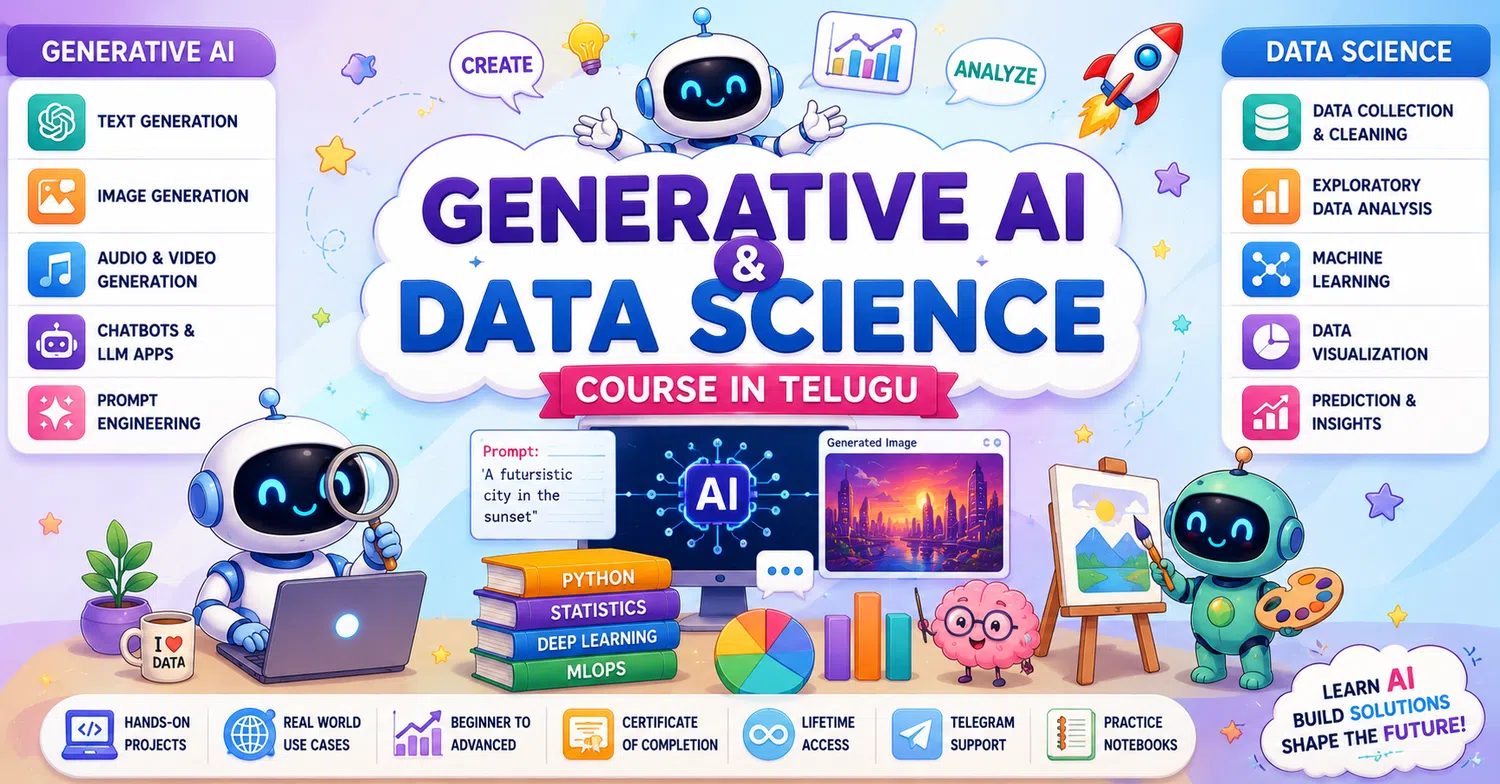
Learning Artificial Intelligence becomes more meaningful when learners can apply concepts to practical problems. Instead of only studying definitions and theoretical models, hands-on practice helps learners understand how AI solutions are planned, developed, tested, and improved. A Generative AI & Data Science Course in Telugu can provide a structured approach to practical AI learning by combining Data Science fundamentals with modern Generative AI concepts and application development.
A practical learning approach allows learners to gradually move from understanding data and programming to building AI-powered solutions. This can make the learning journey more engaging while helping learners understand how different AI technologies work together.
Start with Practical Data Science Skills
Data Science provides an important foundation for AI development. Before creating intelligent applications, learners need to understand how data is collected, cleaned, explored, and interpreted.
A practical learning path can include:
Python programming for data-related tasks
Data cleaning and preprocessing
Exploratory data analysis
Statistics fundamentals
Data visualization
Feature preparation
Machine learning basics
Model evaluation
Instead of learning these topics only through theory, learners can apply them to datasets and observe how different techniques affect the results.
Learn by Working with Realistic Data
Working with datasets can help learners understand the challenges that occur outside textbook examples. Real-world data may contain missing values, duplicate records, inconsistent formats, or unexpected patterns.
For example, learners can work with customer or sales data to identify trends and prepare the information for analysis. They can then create visualizations and interpret the findings.
This type of practice helps develop important habits such as checking data quality, understanding context, and validating analytical results.
Explore Generative AI Through Applications
Generative AI can be learned more effectively when learners understand how it is used inside applications. Instead of simply experimenting with prompts, they can explore complete workflows.
A Generative AI & Data Science Course in Telugu can introduce practical applications such as:
Text generation
Document summarization
Question-answering systems
AI-powered content analysis
Code assistance
Natural-language interfaces
Intelligent search
AI-based document interaction
These examples help learners understand how Generative AI can address specific user requirements.
Practice Prompt Engineering
Prompt engineering is an important practical skill when working with Generative AI. Learners can experiment with different instructions and observe how changes in context, structure, and constraints influence the output.
A useful prompt can clearly define:
The role or task
Relevant context
The expected result
Output structure
Specific limitations
Learners can compare different prompts and evaluate which produces more useful results. This encourages experimentation rather than treating prompting as a fixed formula.
Build AI Projects from Start to Finish
Project-based learning brings multiple concepts together. A practical AI project can begin with identifying a problem and continue through data preparation, development, testing, and evaluation.
Possible projects include:
Customer feedback analysis
Sales data insights application
AI-powered document summarizer
Question-answering assistant
Customer support knowledge assistant
Semantic document search
AI application for generating analytical summaries
Each project can introduce different technical challenges and encourage learners to think about how AI can be applied to actual requirements.
Understand RAG-Based AI Applications
Retrieval-Augmented Generation, or RAG, is an important concept for practical Generative AI development. It allows an AI application to retrieve relevant information from an external knowledge source before generating a response.
For example, learners can create a basic application that works with a collection of documents. The system can identify relevant content based on a user's question and provide that information as context to the Generative AI model.
Through such a project, learners can understand concepts including:
Document processing
Embeddings
Vector-based retrieval
Context retrieval
Response generation
Output evaluation
This provides a practical introduction to building AI applications that work with external information.
Combine Data Science and Generative AI
Practical AI learning becomes more powerful when Data Science and Generative AI are connected. Data Science techniques can help prepare and analyze information, while Generative AI can provide natural-language interaction with the results.
For example, a learner could create a sales analytics application that processes a dataset and generates a natural-language summary of important trends. The project would involve data preparation, analysis, and AI-generated explanations.
This demonstrates how multiple technologies can contribute to a single solution.
Develop Problem-Solving Skills
Practical AI development requires more than knowing programming syntax or AI terminology. Learners need to understand the problem first and then decide which approach is appropriate.
During projects, learners can consider:
What problem needs to be solved?
What data is available?
How should the data be prepared?
Which AI technique is appropriate?
How should the output be evaluated?
What limitations could affect the result?
These questions encourage learners to develop an engineering mindset and make technology choices based on requirements.
Learn AI Concepts Through Telugu
Complex technical concepts can be easier to understand when learners receive explanations in a familiar language. A Generative AI & Data Science Course in Telugu can help learners understand AI concepts through Telugu while gradually introducing commonly used English technical terminology.
This can make topics such as machine learning, embeddings, prompts, RAG, data preprocessing, and model evaluation more approachable.
Learners can simultaneously build technical vocabulary and practical programming skills, helping them become more comfortable with AI-related documentation and development environments.
Practice Testing and Evaluating AI Outputs
Building an AI application is only one part of practical learning. Learners also need to understand how to evaluate whether the application is producing useful results.
For Generative AI applications, evaluation may involve checking:
Relevance of responses
Accuracy of retrieved information
Quality of generated content
Consistency of outputs
Handling of incorrect or incomplete inputs
Response behavior for different prompts
This teaches learners to treat AI systems as applications that require testing and refinement rather than assuming every generated response is correct.
Create a Portfolio Through Projects
Practical projects can also demonstrate what a learner has understood. Instead of listing only course topics, learners can document the problems they solved, technologies they used, and decisions they made during development.
A project portfolio can include:
Data analysis notebooks
Machine learning experiments
AI-powered applications
Generative AI projects
RAG-based applications
Data visualization projects
Project documentation
Maintaining such work can help learners review their own progress and identify areas where additional practice is needed.
Keep Improving Through Hands-On Practice
AI technologies continue to evolve, making continuous experimentation an important part of learning. Learners can improve by working with different datasets, testing AI workflows, building small applications, and reviewing their results.
The focus should remain on understanding transferable concepts rather than depending entirely on one AI platform or tool. Strong foundations in programming, data, machine learning, and AI application development can make it easier to adapt to new technologies.
Conclusion
Practical AI learning is most effective when learners can connect concepts with real problems and build solutions through hands-on practice. A Generative AI & Data Science Course in Telugu can support this approach by combining programming, Data Science, machine learning, and Generative AI with practical projects.
By working with datasets, experimenting with AI workflows, developing applications, and evaluating results, learners can move beyond theoretical understanding and develop a practical foundation for exploring the broader field of Artificial Intelligence.