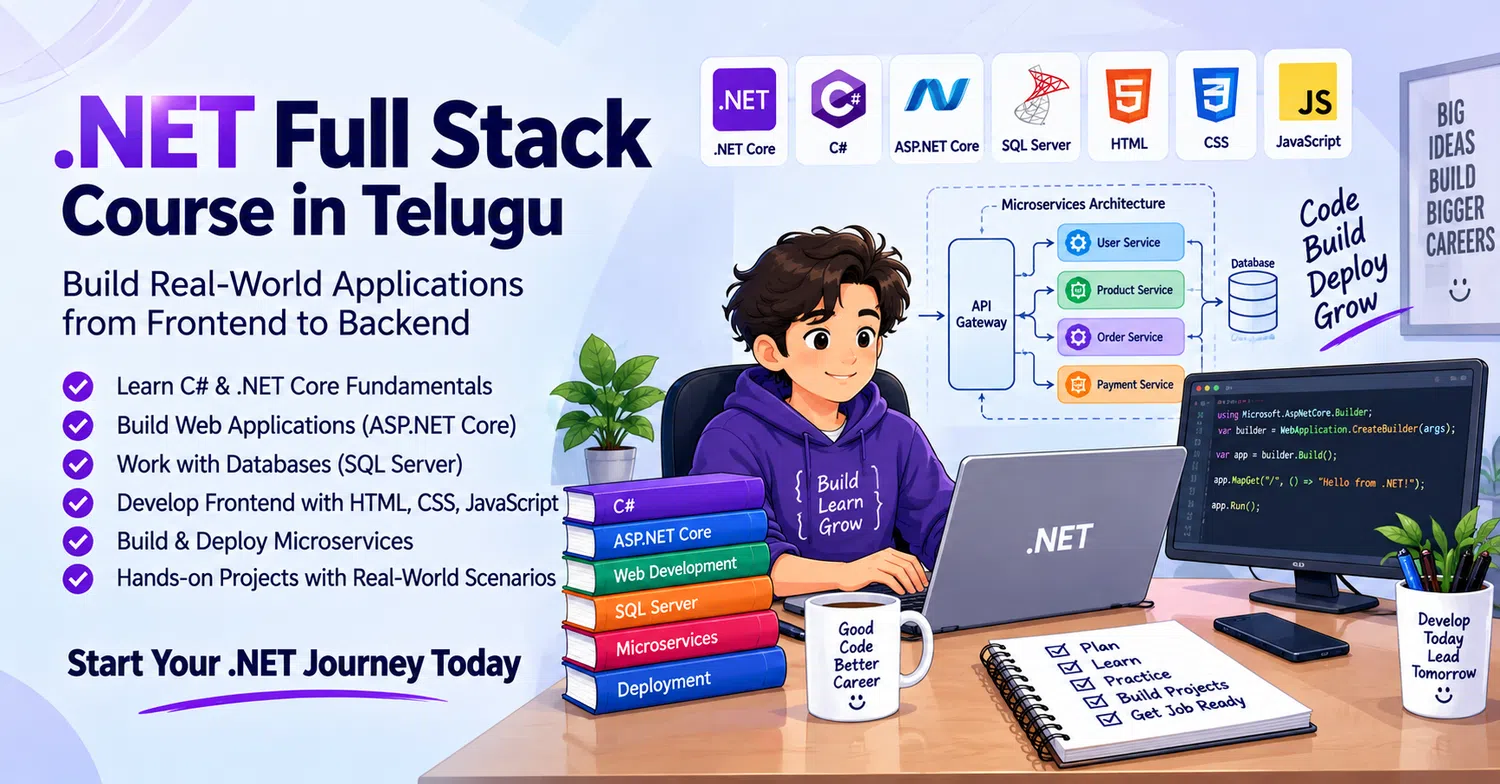
Distributed applications change the way developers think about backend systems. Instead of keeping every feature, database operation, and business rule inside one application, responsibilities can be distributed across multiple services that communicate over a network. This approach can provide architectural flexibility, but it also introduces challenges involving communication, failures, data consistency, security, and monitoring. A .NET with Microservices Course in Telugu can help developers understand these challenges through ASP.NET Core, Web APIs, service-to-service communication, messaging, databases, resilience, containers, and observability. Learning how these pieces interact is essential for understanding distributed applications beyond basic microservices theory.
See Distribution Through an Online Learning Platform
Consider an online learning platform where users register, browse courses, purchase access, track learning progress, and receive notifications.
A single application could initially manage all these responsibilities. As requirements grow, however, the platform may separate important business capabilities into services such as:
Identity Service
Course Catalog Service
Enrollment Service
Payment Service
Progress Service
Notification Service
Once these capabilities run independently, the system becomes distributed. A user action may involve more than one service, and those services may run in separate processes, containers, or environments.
This changes the problems developers need to solve.
Why Are Distributed Applications More Complex?
Distributed applications are more complex because communication happens across network boundaries, where delays, temporary failures, and partial availability must be considered.
Inside a single application, one method may call another directly. In a distributed architecture, the required functionality could belong to another service.
That remote service might respond successfully, respond slowly, or be temporarily unavailable.
Developers therefore need to design for situations where one part of the system continues working while another part experiences a problem.
Define Service Boundaries Before Writing Multiple APIs
A common mistake is assuming that microservices architecture means creating many small projects.
Useful service boundaries begin with business responsibilities.
The Course Catalog Service should concentrate on course-related information, while enrollment behaviour belongs to the Enrollment Service. If responsibilities are repeatedly mixed across services, the architecture can remain tightly coupled even though the code is physically separated.
Before creating a service, developers should consider:
What business capability does it own?
Which data belongs to it?
Which operations should it expose?
Which other services depend on it?
Can it evolve without unnecessary changes elsewhere?
Clear answers make the architecture easier to maintain.
Build Reliable Communication Between Services
Services need defined ways to exchange information.
Synchronous HTTP communication is useful when one service requires an immediate response from another. ASP.NET Core Web APIs can provide these interfaces.
For example, an enrollment workflow may need information related to a selected course before continuing.
Developers should think beyond simply making an HTTP request. Distributed communication also requires attention to:
Request and response contracts
Timeouts
Error handling
Authentication
Service availability
Logging
Version compatibility
These concerns become increasingly important as more services depend on one another.
When Is Asynchronous Messaging Useful?
Asynchronous messaging is useful when one service needs to communicate an event without requiring all interested services to complete their work within the original request.
Suppose an enrollment is successfully created. Several other actions might follow, but they do not necessarily need to happen inside the same synchronous request.
An event can communicate that something important occurred.
A Notification Service could react independently, while another service could perform its own processing.
A .NET with Microservices Course in Telugu can introduce tools such as RabbitMQ or Kafka within this context, helping learners understand why messaging is used instead of treating message brokers as isolated technologies.
Accept That Distributed Data Creates New Decisions
Separating services also changes how developers think about databases.
If every service directly reads and updates the same database tables, independent service boundaries can become weaker. A schema change made for one service may affect several others.
Clearer data ownership can reduce this direct coupling, but it creates another challenge.
Information needed for one business workflow may now exist across multiple services. Developers must decide how data is exchanged and how the system deals with changes that cannot be committed as one simple local database transaction.
This is where distributed architecture becomes more than ordinary CRUD development.
Learn Eventual Consistency Through Business Behaviour
In some distributed workflows, every service may not reflect a change at exactly the same instant.
Imagine that an enrollment is created and an event is published for another service to process. The second service may update its own information shortly afterward rather than within the same database transaction.
This introduces the idea of eventual consistency.
Developers need to understand what level of consistency the business process actually requires. Some operations may need immediate confirmation, while others can tolerate a short delay.
The correct choice depends on the requirement rather than a single rule applied to every service.
Prepare Services for Temporary Failures
Network-based dependencies can fail, so distributed systems need resilience strategies.
A remote request that takes too long should not necessarily leave the caller waiting indefinitely. Repeating every failed operation without limits can also make an overloaded service worse.
Developers can explore techniques such as:
Timeouts
Controlled retries
Circuit breakers
Graceful fallback behaviour where appropriate
Health checks
Failure-aware exception handling
These patterns teach an important principle: failures should be expected and managed rather than treated as impossible events.
Make Security Work Across Service Boundaries
A distributed application still needs reliable identity and access control.
A user may authenticate once and then make requests that eventually involve several backend services. The architecture needs a consistent way to determine whether requests are authenticated and whether specific operations are permitted.
JWT-based authentication is commonly used when learning secured .NET APIs.
An API Gateway may also participate in the overall security design, while individual services still need to protect the operations they own.
Security should therefore be considered across the architecture rather than added independently to each project at the end.
Use Containers to Create Repeatable Service Environments
Running six services manually from separate development windows can quickly become inconvenient.
Docker helps package services into isolated containers that can run with defined application environments.
Developers can practice:
Building separate service images
Running multiple containers
Passing environment configuration
Connecting services over container networks
Connecting applications with databases
Running messaging infrastructure alongside services
This makes the distributed nature of the application much more visible than running everything as one local process.
Observability Helps Find Problems Across Services
Debugging one application is different from tracing a request through several services.
A user may report that an operation failed, but the original request could have passed through a gateway and multiple backend components before the problem occurred.
Logs, metrics, health information, and distributed tracing help developers understand this path.
A useful distributed system should make it possible to answer questions such as where a request failed, which service was slow, and whether a dependency was unavailable.
Observability therefore becomes part of application design rather than an optional production feature.
Build the Architecture Gradually
Developers do not need to begin with a large network of services.
An online learning platform can start with two or three meaningful services. Once basic APIs and databases work correctly, additional concepts can be introduced according to real architectural needs.
Communication can come first, followed by messaging, resilience, security, containers, and observability.
This gradual process helps developers understand the reason behind each component and prevents a project from becoming a collection of technologies with no clear architectural purpose.
Frequently Asked Questions
What makes a .NET application a distributed application?
A system becomes distributed when its components run separately and communicate across process or network boundaries. Microservices are one architectural approach for creating this type of system.
Why is network failure important when learning microservices?
Services communicate remotely, so requests can fail or become slow even when the calling service is working correctly. Developers need strategies for handling these situations safely.
Does every interaction between microservices need a message broker?
No. Some workflows are suitable for synchronous APIs, while others benefit from asynchronous messaging. The communication method should match the business requirement.
Why is data consistency harder across microservices?
Different services may own separate data stores, so one traditional database transaction cannot always update everything together. Developers need to understand suitable distributed data and consistency approaches.
How can I practice troubleshooting a distributed .NET application?
Create a small multi-service project and intentionally stop a dependency, delay responses, or test failed messages. Then use logs and other observability information to identify what happened and how the application responds.
Conclusion
Mastering distributed applications requires developers to understand what changes when software crosses service and network boundaries. Service design, remote communication, messaging, distributed data, consistency, resilience, security, containers, and observability all become connected architectural concerns.
A practical .NET microservices project provides an effective environment for learning these ideas. By building a small distributed system, testing failures, observing communication, and gradually introducing additional services, developers can gain a clearer understanding of how independently running components cooperate to deliver one complete application.