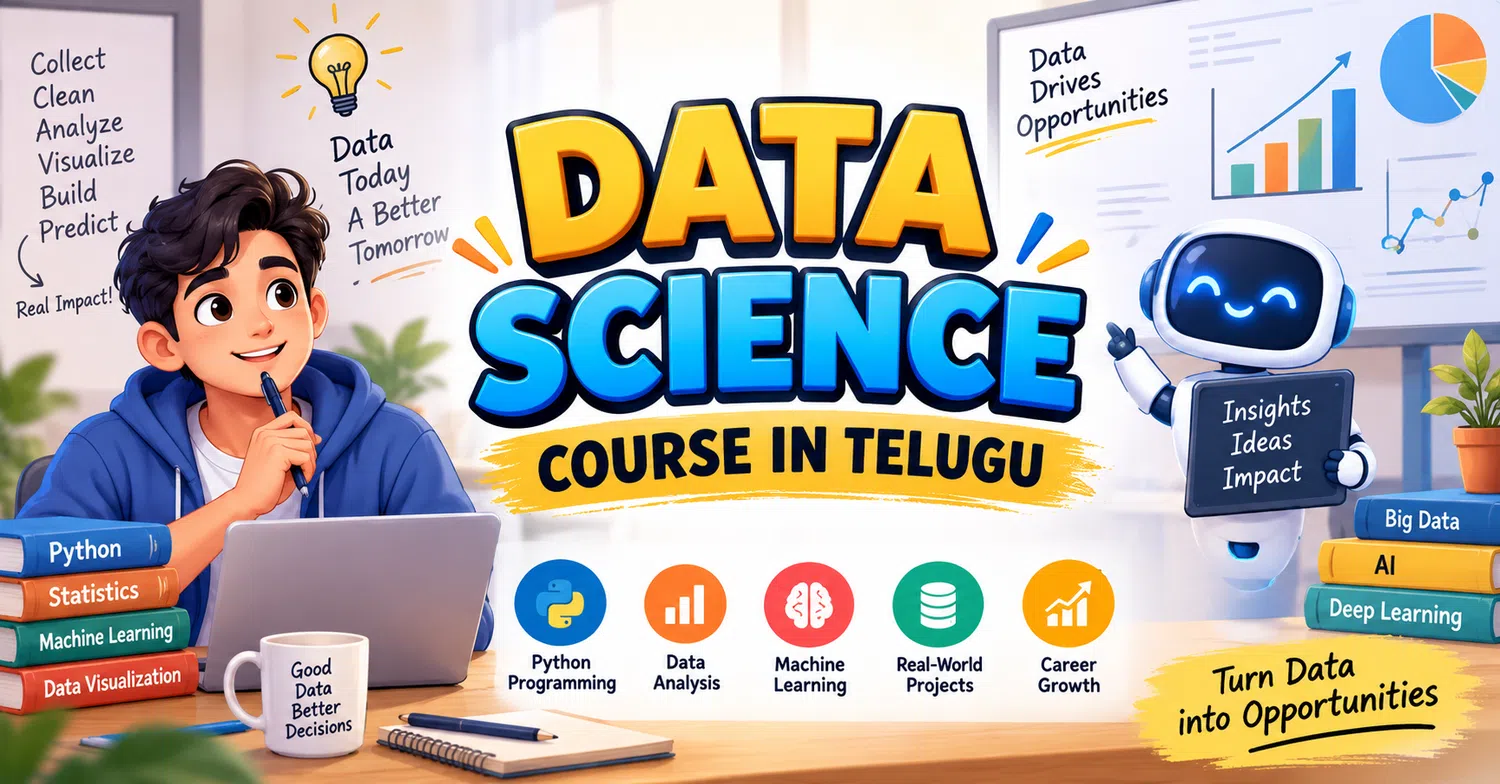
Data analysis is one of the most useful starting points for beginners entering the data field. It teaches learners how to examine information, identify patterns, compare results, and communicate findings clearly. A Data Science Course In Telugu can help beginners develop these abilities gradually by introducing data handling, Excel, SQL, Python, statistics, and visualization through practical examples rather than beginning with complicated models.
For someone with little experience, the first goal should be understanding how data can answer a question. Once this thinking becomes familiar, learning analytical tools becomes much easier.
Begin with Questions Hidden Inside Data
Imagine a streaming platform wants to understand how viewers interact with its content. It may have data about viewing hours, genres, subscription types, devices, and user activity. Looking at thousands of rows alone does not provide an answer.
A beginner can start by asking simple analytical questions. Which genres receive the highest engagement? Do viewing patterns change between weekdays and weekends? Which subscription groups spend more time on the platform?
This process introduces important beginner skills:
Understanding rows, columns, and data types
Filtering relevant information
Comparing different groups
Calculating totals and averages
Identifying trends and unusual values
Turning observations into useful findings
These exercises help beginners understand the purpose of analysis before moving toward advanced techniques.
Move from Spreadsheets to SQL and Python
Different tools become useful as analytical requirements grow. Spreadsheets can help beginners become comfortable with sorting, filtering, formulas, and basic summaries. SQL then introduces a structured way to retrieve specific information from databases.
Python provides another level of flexibility. With libraries such as Pandas, learners can clean datasets, transform columns, group information, calculate metrics, and automate repetitive analytical tasks.
A Data Science Course In Telugu can make this progression easier by connecting each tool to a practical requirement rather than teaching commands without context.
For example, a learner analyzing streaming behavior could use SQL to retrieve user activity for a particular period and Python to clean and explore the resulting dataset. Visualizations could then be created to compare engagement across genres or user groups.
The focus remains on analysis, while the tools support different stages of the work.
Develop Confidence with Data Cleaning
Beginners often expect datasets to be perfectly organized. In practice, missing values, duplicate entries, inconsistent labels, and incorrect formats are common.
Learning how to handle these issues is an important part of mastering data analysis.
Useful cleaning activities include:
Finding and handling missing information
Removing duplicate records
Correcting inconsistent categories
Converting columns into appropriate data types
Checking unusual or unrealistic values
Standardizing formats before analysis
For example, the same device type might appear as “Mobile,” “mobile,” and “MOBILE.” Treating them as separate categories could produce incorrect analysis. Cleaning the values before calculation improves the reliability of the findings.
These small practical problems help beginners develop attention to detail and understand why data quality matters.
Present Findings So Others Can Understand Them
Analysis is incomplete if the final findings are difficult to understand. Learners should therefore practice selecting suitable charts and explaining what those visualizations reveal.
A line chart may help show viewing activity over time, while a bar chart can compare engagement across content categories. The objective is not to add as many charts as possible but to choose visuals that make the important pattern easy to recognize.
A Data Science Course In Telugu can help beginners connect analysis with communication by encouraging them to explain results in simple terms.
A beginner project should ideally demonstrate:
A clearly defined question
Data cleaning and preparation
Relevant calculations
Meaningful visualizations
Important observations
A short interpretation of the findings
This creates a complete analytical workflow that learners can repeat with different datasets.
Conclusion
Mastering data analysis begins with learning how to ask useful questions and work confidently with information. Beginners do not need to start with complex machine learning algorithms. Building strong skills in data cleaning, Excel, SQL, Python, basic statistics, and visualization provides a more practical foundation.
By working with different datasets and explaining the insights they discover, learners can gradually become more independent in their analysis. These foundational abilities can later support deeper learning in data science, business analytics, machine learning, and other data-focused career paths.