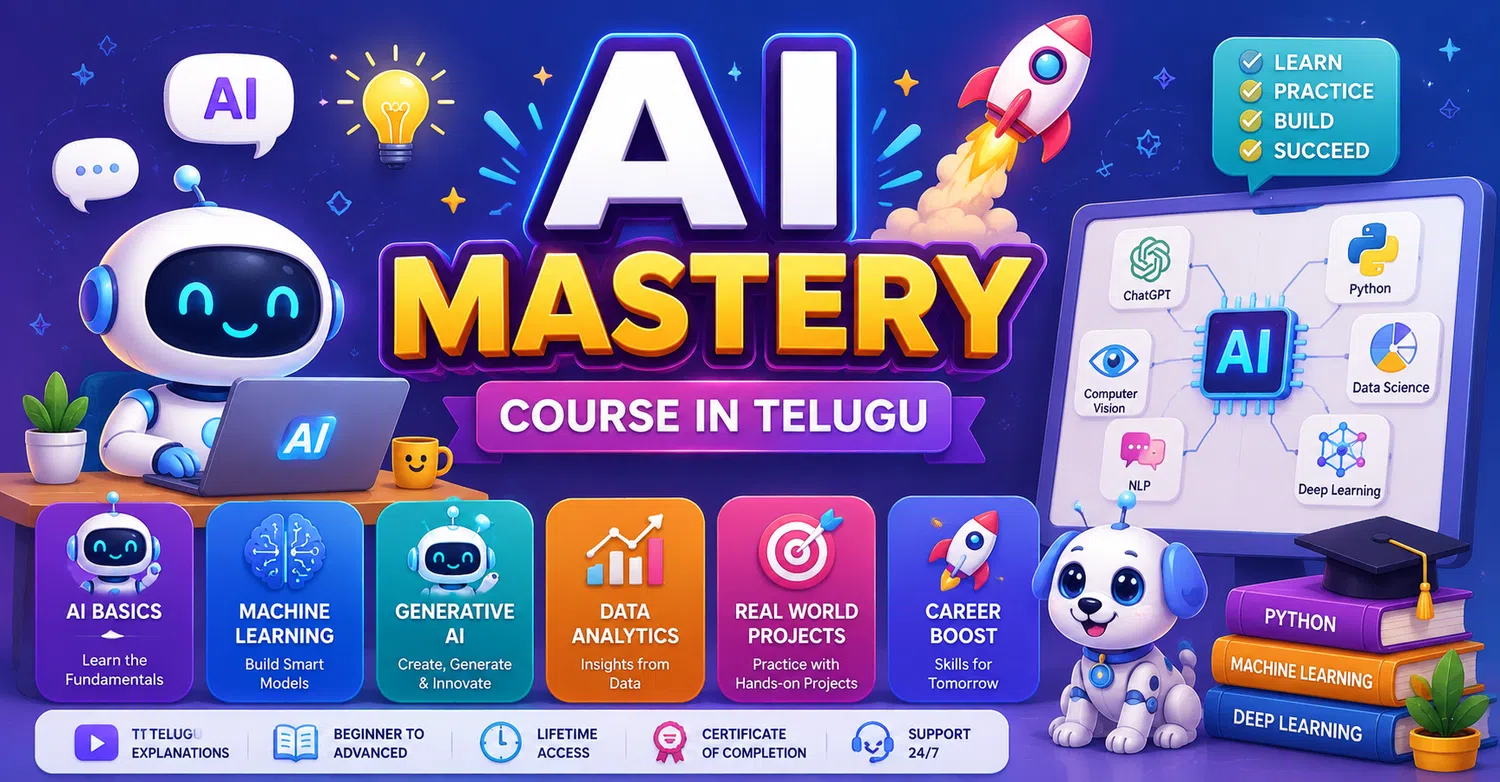
Artificial Intelligence is creating new possibilities across technology, business, education, healthcare, finance, marketing, and many other industries. As organizations explore AI-powered solutions, learners are looking for practical ways to understand this rapidly developing field. AnAI Mastery Course In Telugu can provide a structured learning path for students, professionals, and technology enthusiasts who want to explore AI concepts and discover where these skills can be applied.
AI is much broader than chatbots or content-generation tools. It includes machine learning, natural language processing, computer vision, automation, predictive systems, and other technologies. Understanding these areas can help learners identify opportunities that match their interests and existing skills.
Understanding the Growing AI Landscape
AI is becoming part of many everyday digital experiences. Recommendation systems suggest products and entertainment, intelligent assistants respond to questions, businesses use predictive models to analyze information, and automated systems help organizations handle repetitive processes.
This wide range of applications creates opportunities for people with different backgrounds. Someone with programming experience may explore AI development, while a business professional may focus on AI-powered analytics or automation.
The first step is understanding the different possibilities instead of assuming that AI has only one career path.
Explore Different Areas of Artificial Intelligence
A structured AI Mastery Course In Telugu can help learners explore multiple AI domains before deciding where they want to specialize.
Some important areas include:
Machine Learning
Machine learning enables systems to identify patterns from data and make predictions or decisions. Learners interested in data and programming can explore this area through practical models and projects.
Generative AI
Generative AI can produce content such as text, images, code, and other digital outputs. Its growing use has created opportunities for professionals interested in AI applications, content workflows, and intelligent software.
Natural Language Processing
NLP focuses on enabling computers to understand and work with human language. It supports applications such as conversational systems, text classification, translation, and information extraction.
Computer Vision
Computer vision allows machines to process and interpret visual information. It has applications in areas such as image analysis, quality inspection, security systems, and automation.
AI Automation
AI can be combined with automation technologies to streamline repetitive workflows. Understanding this area can be valuable for professionals interested in improving business processes.
Discover AI Opportunities Beyond Coding
One common misconception is that every AI opportunity requires advanced programming skills. Technical development is certainly an important part of the AI ecosystem, but AI is also being applied in roles that involve business, communication, analytics, operations, design, and content.
AI-related opportunities can involve:
AI-assisted business processes
Data analysis
AI product support
Prompt design
Workflow automation
AI content operations
Technology consulting
AI-enabled software development
Research and experimentation
The right direction depends on a learner's existing background, interests, and willingness to develop new skills.
Build Skills That Work Together
AI expertise is rarely based on a single skill. Learners can create stronger foundations by combining AI knowledge with other technical or professional abilities.
For example:
Programming + AI can support intelligent application development.
Data analysis + AI can support data-driven decision-making.
Business knowledge + AI can help identify practical automation opportunities.
Content skills + Generative AI can support modern content workflows.
Cloud knowledge + AI can contribute to deploying and managing AI applications.
This combination of skills can help learners find opportunities that align with their existing strengths.
Learn AI Through Telugu-Based Explanations
Learning technical concepts in a familiar language can make the early stages of AI education more comfortable. Telugu explanations can help learners understand difficult ideas before gradually becoming familiar with the English terminology used in technical documentation.
An AI Mastery Course In Telugu can be useful for learners who want to:
Start learning AI from the fundamentals
Understand complex concepts more comfortably
Explore different AI technologies
Develop practical knowledge
Connect AI with existing professional skills
Build confidence through structured learning
Learning in Telugu does not mean avoiding technical English. Instead, it can provide a clearer foundation for eventually working with industry resources and professional tools.
Turn AI Knowledge into Practical Experience
Understanding AI concepts is only one part of becoming comfortable with the technology. Practical experience helps learners understand how AI behaves in real situations.
A learner could begin with a small project such as:
Creating a document summarization workflow
Building a basic text classification model
Developing a simple AI-powered assistant
Experimenting with an AI content workflow
Creating a data-based prediction project
Designing an automated information-processing system
Each project provides an opportunity to learn how to plan, implement, test, and improve a solution.
Learn to Identify Real AI Problems
A valuable AI skill is recognizing when AI is actually useful. Not every problem requires artificial intelligence.
Before selecting an AI solution, learners should ask:
What problem needs to be solved?
Is the task repetitive or data-driven?
What information is available?
What outcome is expected?
Can AI realistically improve the process?
How will the result be evaluated?
Where is human review required?
This problem-first approach can help learners avoid using AI simply because it is popular.
Develop Prompt Engineering Skills
Generative AI has made prompt design an important practical skill. A well-structured prompt can provide the model with context, instructions, constraints, and an expected output format.
Learners can improve their prompts by specifying:
The purpose of the task
Relevant background information
The intended audience
Output structure
Required level of detail
Examples where useful
Prompt engineering becomes more effective when combined with subject knowledge. Understanding the task remains more important than simply knowing a collection of prompting techniques.
Understand Responsible AI
Exploring AI opportunities also requires understanding its limitations. AI systems can produce inaccurate information, reflect biases in data, or generate outputs that require human verification.
Responsible AI learning should include awareness of:
Data privacy
Accuracy and verification
Bias
Security
Transparency
Human oversight
Appropriate use of AI-generated content
These considerations are important when moving from experimentation to real-world applications.
AI Opportunities for Students
Students can use AI learning to explore technology before choosing a specific specialization. Building small projects can help them discover whether they enjoy programming, data, automation, Generative AI, or another area.
Instead of trying to master every AI technology at once, students can begin with fundamentals and gradually experiment with different domains.
A project portfolio can also help students document what they have learned and demonstrate their practical interests.
AI Opportunities for Working Professionals
Working professionals can approach AI from the perspective of their existing roles. Rather than completely changing careers immediately, they can first identify tasks where AI could improve productivity or decision-making.
For example, professionals may explore AI for:
Report preparation
Document analysis
Data interpretation
Customer-support workflows
Research assistance
Content development
Process automation
This approach can help professionals understand how AI relates to their current responsibilities while identifying potential areas for further learning.
Build a Continuous AI Learning Habit
AI is evolving quickly, so completing one course should not be considered the end of the learning process. New models, tools, applications, and techniques continue to emerge.
Learners can stay adaptable by:
Practicing regularly
Building small projects
Exploring new AI tools
Reading technical resources
Following major AI developments
Reviewing their previous projects
Experimenting with different approaches
Continuous learning can be especially valuable in a field where technology changes frequently.
Choose an AI Learning Path That Fits You
There is no single AI path that works for everyone. A learner's background should influence what they study next.
A beginner may start with AI fundamentals and basic programming. Someone with programming experience may move toward machine learning or AI application development. A business professional may explore AI automation, analytics, and Generative AI applications.
An AI Mastery Course In Telugu can serve as a foundation from which learners explore these different directions and gradually identify the areas that interest them most.
Discover Your Next AI Opportunity
Artificial Intelligence is opening new possibilities for people who are willing to understand the technology and apply it thoughtfully. The opportunities extend beyond a single job role or technical specialization. AI can connect with programming, data, business, automation, content, research, and many other areas.
An AI Mastery Course In Telugu can help learners begin this journey through accessible explanations, structured learning, practical experimentation, and exposure to different AI applications. By combining AI knowledge with existing skills and continuously practicing through real problems, learners can discover new directions that match their goals.
The most important step is to start with curiosity, build a strong foundation, and gradually turn that knowledge into practical capability. As AI continues to evolve, learners who develop adaptable skills can be better prepared to explore the opportunities created by this changing technology landscape.