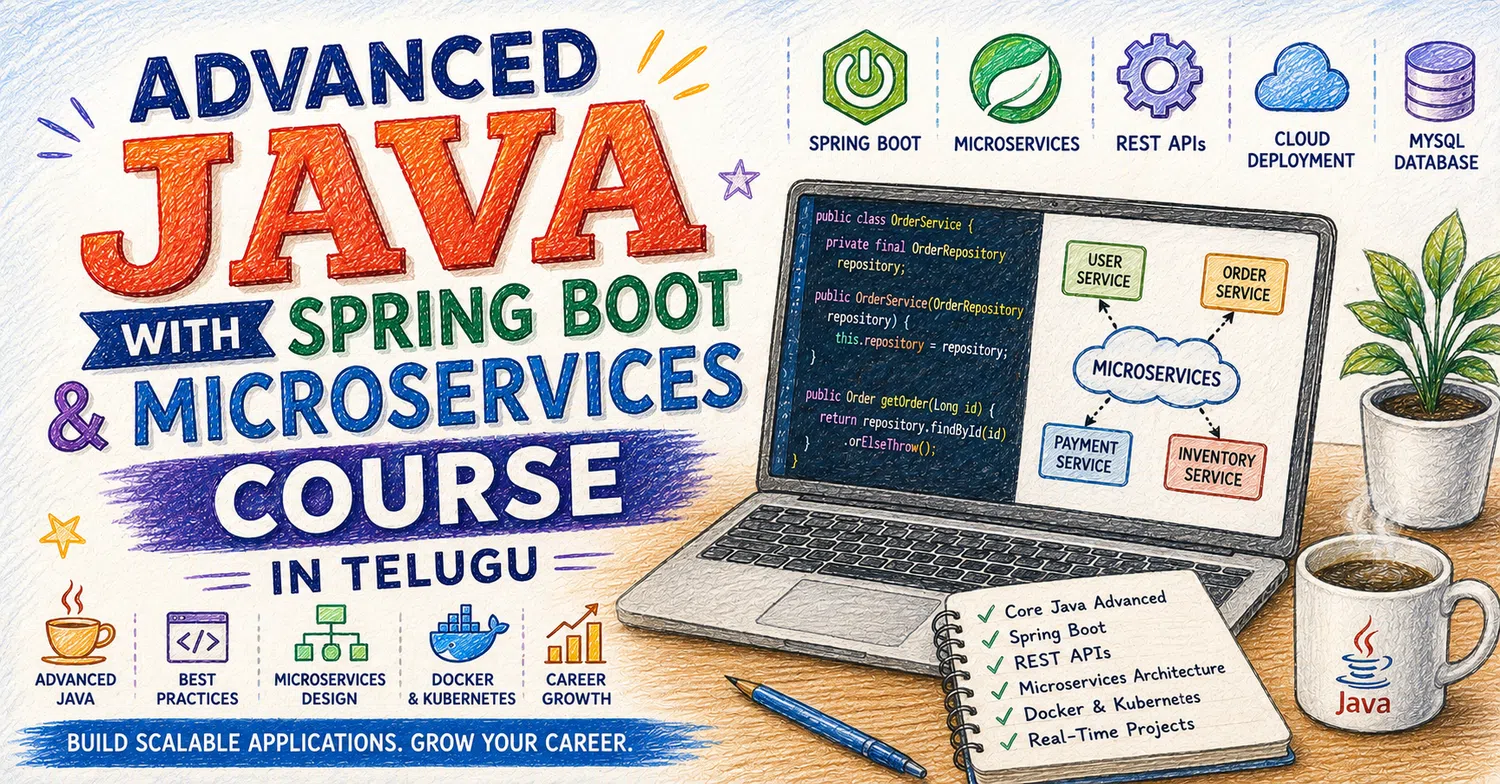
Learning Core Java gives developers a strong programming foundation, but modern Java backend development requires the ability to apply that knowledge to complete applications. Developers need to work with APIs, databases, application security, transactions, testing, distributed services, and real business requirements. AnAdvanced Java with Spring Boot & Microservices Course in Telugu can be particularly useful for Java developers who already understand programming fundamentals and now want to move toward practical backend and enterprise application development. Instead of starting from an entirely different technology stack, they can extend their existing Java knowledge into Spring Boot and gradually understand how Java applications evolve into modern backend systems.
A Java developer may already be comfortable with object-oriented programming, interfaces, collections, exception handling, multithreading, and other language concepts. However, knowing these concepts individually does not always answer an important question: how are they used when building an application that serves hundreds or thousands of requests and communicates with databases and other systems?
Spring Boot provides a natural next stage because it allows developers to continue working with Java while learning how backend applications are structured.
Java Knowledge Becomes Practical Backend Knowledge
Consider a Java developer who has previously built standalone applications and now needs to develop a backend system for a vehicle rental company.
The company manages vehicles across different branches. Customers should be able to search for available vehicles, create reservations, modify eligible bookings, and return vehicles. Staff members need additional functionality for managing availability and recording vehicle condition.
The developer already knows Java, but this requirement immediately introduces several new questions.
How will a mobile or web application communicate with the backend? Where should reservation information be stored? How should the system prevent two customers from reserving the same vehicle for overlapping periods? How can administrative operations be protected from normal customers?
These are backend-development questions.
Spring Boot helps Java developers apply their existing knowledge to these requirements. A developer can create REST APIs for reservation operations, organize business logic inside services, and connect the application to a relational database through a persistence layer.
Existing Java skills continue to matter throughout this process.
Object-oriented design helps developers represent business concepts clearly. Interfaces can support separation between contracts and implementations. Collections may be used while processing application data. Exception handling becomes important when reservations fail or required information cannot be found.
The difference is that these Java concepts now operate inside a complete application.
For example, exception handling is no longer limited to demonstrating try and catch. If a customer attempts to reserve a vehicle that is unavailable, the backend needs to communicate that business condition through a meaningful API response.
This helps Java developers understand why strong fundamentals remain relevant even when frameworks handle many common tasks.
An Advanced Java with Spring Boot & Microservices Course in Telugu can make this progression easier because developers can learn new framework concepts through Telugu explanations while retaining familiar English programming terminology.
Spring Boot Expands What Java Developers Can Build
Spring Boot introduces Java developers to the structure required for modern web and backend applications.
REST API development is one of the most important areas.
Developers learn how HTTP requests enter an application and how Java code processes those requests. They begin working with concepts such as:
REST controllers and API endpoints
HTTP methods and status codes
Request and response objects
Input validation
Service-layer business logic
Global exception handling
Database persistence
Application configuration
These concepts help transform Java knowledge into usable backend functionality.
Database interaction is especially important because most business applications need persistent data.
Returning to the vehicle rental platform, the application may store customers, branches, vehicles, reservations, payments, and maintenance information. Developers need to understand the relationships between this data and how those relationships should be represented.
Spring Data JPA can reduce repetitive persistence code, but SQL knowledge still matters. A Java developer who understands both JPA and the database beneath it is better prepared to investigate inefficient queries, incorrect mappings, or unexpected data behavior.
Transaction management also becomes meaningful.
Suppose confirming a vehicle return requires closing the active rental, updating vehicle availability, and recording the final condition. If the process fails halfway through, the database should not remain in an inconsistent state.
Understanding transactions teaches developers to think about business operations rather than individual database statements.
Security is another area where Java developers can significantly expand their skills.
A backend application may have customers, branch employees, regional managers, and system administrators. Each role can have different permissions.
Through Spring Security concepts, developers can learn the difference between authentication and authorization and understand why backend APIs need protection regardless of what is visible on the frontend.
Testing further improves development quality. Java developers can move from manually checking whether an endpoint works to creating repeatable tests around business logic and application behavior.
This is valuable because backend applications constantly change. When a new feature is introduced, existing functionality should continue to behave correctly.
Microservices Introduce a New Level of Java Development
Once Java developers become comfortable building complete Spring Boot applications, microservices provide an opportunity to understand distributed backend architecture.
Suppose the vehicle rental company expands internationally. Reservations, fleet management, pricing, customer accounts, payments, and maintenance operations are now substantial business capabilities.
Maintaining everything inside one large application may eventually create organizational or technical challenges.
A microservices architecture may separate appropriate capabilities into independently managed services.
For example, a Reservation Service could focus on bookings while a Fleet Service manages vehicle availability and status. Pricing could evolve as another independent capability.
For Java developers, this changes several assumptions.
Inside one application, calling another component may involve a direct Java method call. Across microservices, communication may happen through a network.
That creates additional concerns:
A service may be temporarily unavailable.
Network communication may be slower than an internal method call.
Requests may time out.
Duplicate requests may occur.
Different services may own separate data.
Debugging may involve tracing activity across several applications.
Learning these challenges helps Java developers move from application-level programming toward distributed-system thinking.
Developers also begin understanding that microservices are not simply multiple Spring Boot projects.
Service boundaries need to represent meaningful business responsibilities. Communication patterns need to match the requirement. Data ownership should be clear. Failures need to be considered before production problems occur.
Some processes may use synchronous REST communication, while others may benefit from asynchronous or event-driven approaches.
For example, completing a vehicle return may trigger maintenance inspection activities. The main return operation may not need to remain blocked while every downstream activity finishes. An event can allow another component to respond independently when the architecture and business requirement justify that approach.
This is where microservices learning becomes genuinely useful rather than simply adding another technology name to a developer's profile.
An Advanced Java with Spring Boot & Microservices Course in Telugu can therefore provide Java developers with a logical progression: strengthen existing Java capabilities, use Spring Boot to build complete backend applications, and then understand how those applications can evolve into distributed services.
AI can support this learning journey as well. Developers can use AI to understand complex stack traces, review possible API designs, compare architectural approaches, generate testing ideas, or clarify unfamiliar Spring concepts.
However, experienced development still requires technical judgment. Generated code needs to be reviewed for correctness, security, maintainability, and suitability for the actual business requirement.
Why This Learning Path Fits Java Developers
Java developers already possess an important advantage: they do not need to begin backend development without programming fundamentals. Their existing Java knowledge can become the foundation for learning more advanced development responsibilities.
This progression can help them strengthen areas such as:
Enterprise Java application design
Spring Boot backend development
REST API implementation
Database and JPA integration
Validation and exception handling
Transaction management
Application security
Automated testing
Microservices architecture
Service-to-service communication
Debugging and troubleshooting
The real benefit comes when these topics are connected through practical projects rather than studied independently.
A Java developer could begin with the vehicle rental system as a structured Spring Boot application. Security, validation, testing, and transaction handling can be added as the project matures. Later, selected business capabilities can be examined through microservices to understand the additional architectural complexity.
This provides a clear development story that can also be discussed during technical interviews.
Instead of merely saying that they know Spring Boot and Microservices, developers can explain how a business requirement was implemented, how data was modeled, why a transaction was required, how endpoints were protected, and how service communication was designed.
That depth of explanation demonstrates practical understanding.
Conclusion
For Java developers, moving into Spring Boot and microservices is a logical way to expand existing programming knowledge into modern backend development. Java fundamentals continue to provide the base, while Spring Boot introduces the APIs, persistence, security, configuration, and application structure required for real backend systems.
Microservices then extend this knowledge into distributed environments where developers must think about service boundaries, communication failures, independent data ownership, resilience, and observability.
An Advanced Java with Spring Boot & Microservices Course in Telugu is especially relevant for learners who want these advanced concepts explained in Telugu without losing the English technical terminology used in professional Java development.
By combining existing Java knowledge with hands-on Spring Boot development and a clear understanding of microservices architecture, Java developers can gradually move from writing standalone programs toward designing, building, testing, and troubleshooting complete backend applications.