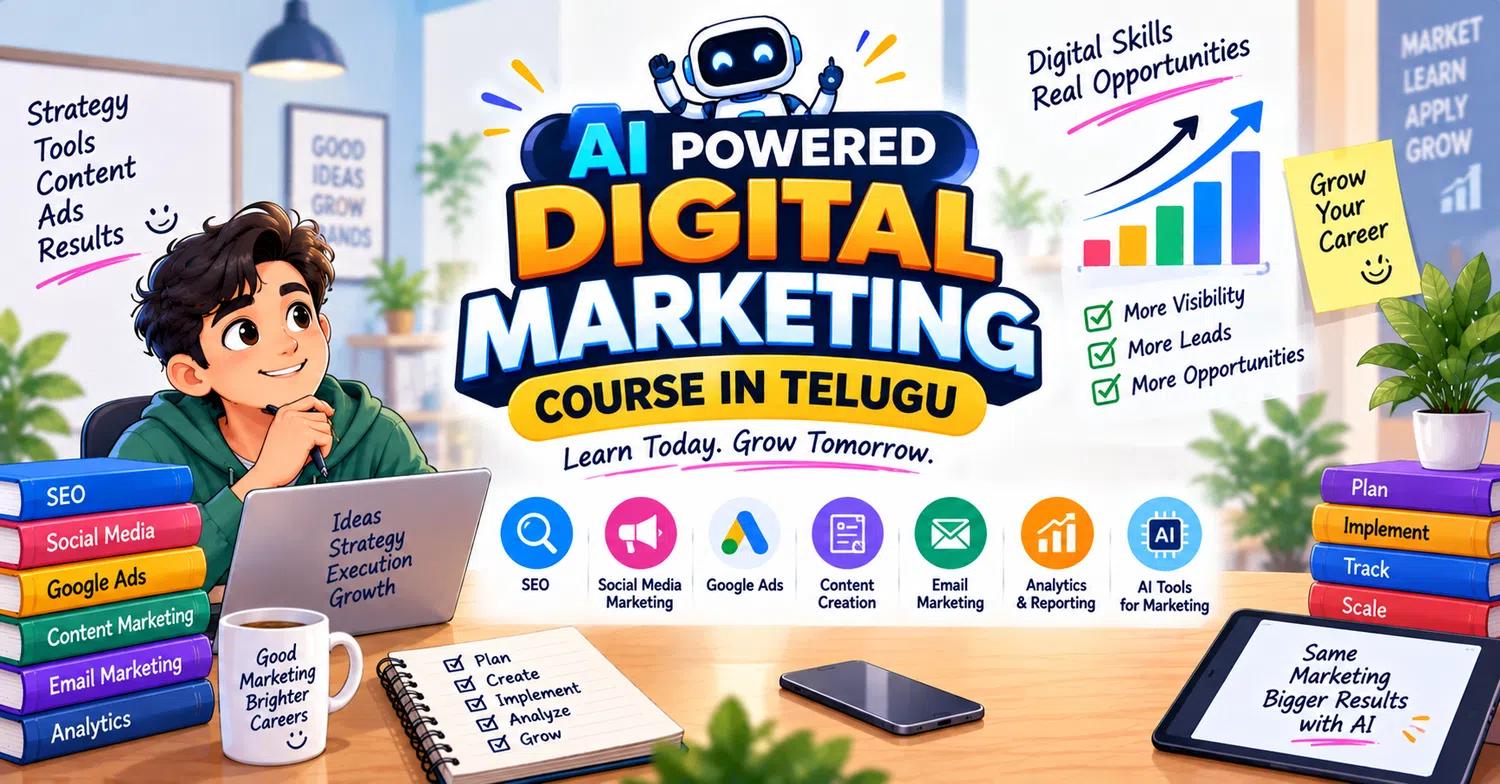
Digital marketing careers are changing as businesses combine traditional marketing knowledge with artificial intelligence, automation, and data-driven decision-making. Professionals are increasingly expected to understand customers, create effective campaigns, interpret performance data, and use AI tools productively without depending on them for every decision. Ai Powered Digital Marketing Course in Telugucan help learners build this combination of foundational and modern skills, making their learning more relevant to evolving digital marketing responsibilities.
Build Skills That Connect Marketing with Business Goals
Career growth in digital marketing requires more than learning how individual platforms work. Marketers need to understand why a campaign is being created and how it contributes to a broader business objective.
Consider a software company launching a subscription-based productivity application. The company needs to create awareness, attract relevant website visitors, generate product sign-ups, encourage trial users to engage with the platform, and eventually convert suitable users into paying customers.
Different marketing activities can support different stages of this journey. SEO and content can attract people searching for productivity solutions, social media can increase awareness, paid campaigns can reach selected audiences, and email marketing can communicate with users who have already shown interest.
Working with scenarios like this helps learners understand the relationship between marketing activities and business outcomes. This broader perspective is useful for progressing from simply executing tasks toward contributing to campaign planning and optimization.
Combine Core Digital Marketing Knowledge with AI Skills
AI is becoming useful across research, content development, campaign preparation, and analysis. However, marketers still need strong fundamentals to decide whether AI-generated suggestions are suitable.
Through Ai Powered Digital Marketing Course in Telugu, learners can explore SEO, social media marketing, content strategy, paid advertising, email marketing, lead generation, and analytics while understanding where AI can support each workflow.
For example, AI can assist with:
Organizing audience and competitor research
Brainstorming SEO and content themes
Developing initial campaign concepts
Creating headline and ad-copy variations
Repurposing content for multiple channels
Drafting email communication
Summarizing customer feedback
Reviewing campaign information for possible patterns
These activities can improve productivity, but the marketer remains responsible for evaluating the output. Facts may need verification, messaging may require editing, and suggestions should be checked against the target audience and campaign objective.
Learning this process develops a more valuable skill than simply knowing how to generate content with an AI tool.
Strengthen Career Growth Through Data-Driven Decision-Making
As marketers take on greater responsibilities, they need to explain what is happening in their campaigns and recommend what should happen next.
With Ai Powered Digital Marketing Course in Telugu, learners can practice interpreting metrics according to specific marketing objectives. They can examine website traffic, search visibility, impressions, clicks, engagement, leads, conversions, and campaign costs without assuming that every large number represents success.
For the productivity software company, a campaign might generate a high number of website visits but relatively few trial registrations. Another campaign may produce fewer visitors while generating a higher proportion of relevant sign-ups.
A marketer needs to understand this difference and investigate the complete journey. Audience targeting, advertising messages, landing-page experience, offer clarity, or other factors may influence performance.
AI can assist with organizing data or identifying trends worth investigating, but recommendations should come from verified evidence and an understanding of the campaign context.
Developing this analytical mindset can help learners move beyond content execution and become more confident when discussing campaign performance.
Create Practical Evidence of Your Marketing Capabilities
Career development becomes stronger when learners can demonstrate what they know through practical work.
A marketing portfolio can contain projects covering different business objectives rather than only collections of social media designs. One project might focus on organic visibility, another on lead generation, while another could demonstrate paid campaign planning and optimization.
Learners can document the business problem, target audience, marketing objective, selected channels, content strategy, AI-assisted activities, performance indicators, and optimization approach.
They can also explain where AI improved efficiency and where human judgment changed the initial output. This demonstrates an understanding of both technology and marketing strategy.
Working across different business scenarios such as SaaS, education, e-commerce, local services, or consumer brands can further improve adaptability. Each industry introduces different customer journeys and marketing challenges, encouraging learners to apply their knowledge rather than depend on one fixed campaign template.
Conclusion
The value of AI-powered digital marketing for career growth comes from combining technology with strong marketing fundamentals. SEO, content, social media, advertising, analytics, and customer understanding remain important, while AI provides new ways to accelerate research, experimentation, creation, and analysis.
Learners who practice complete marketing workflows, interpret performance carefully, and use AI with appropriate human review can develop a broader set of practical skills for adapting to changing digital marketing responsibilities.