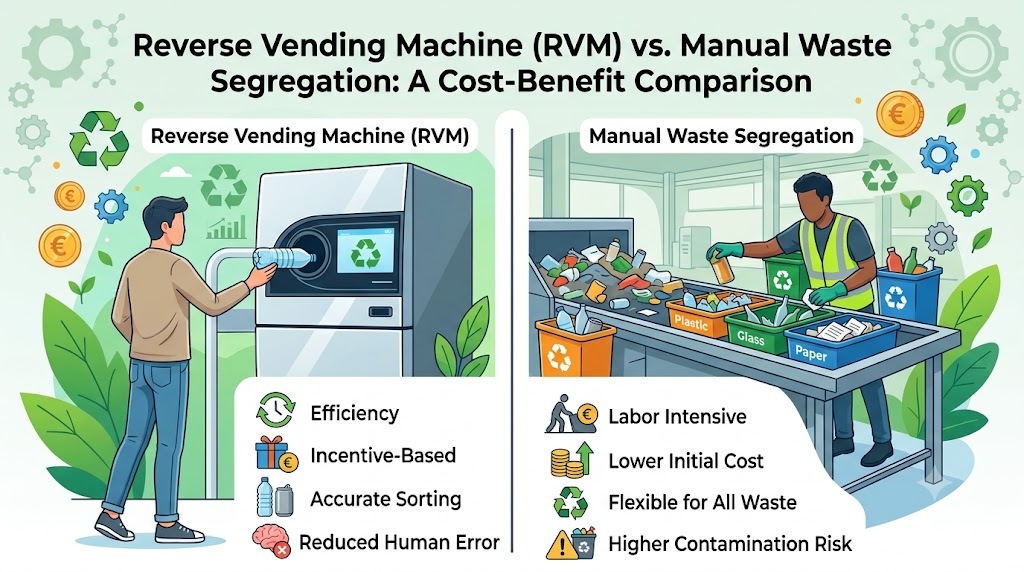
India generates massive volumes of plastic bottle waste every single day — from retail stores and corporate campuses to housing societies and public spaces. Managing this waste effectively comes down to one critical decision: should you rely on manual waste segregation, or invest in an automated Reverse Vending Machine (RVM)?
This blog breaks down the real cost-benefit difference between the two approaches, helping you make an informed decision for your business or facility.
What Is Manual Waste Segregation?
Manual waste segregation is the conventional method of managing recyclable waste, where workers physically sort plastic bottles and other recyclables from mixed waste streams. It has been the standard practice for decades, relying entirely on manpower, supervision, and consistent training.
While it requires little to no upfront investment, it comes with recurring operational challenges — inconsistent sorting, hygiene concerns, and rising labor costs over time.
What Is a Reverse Vending Machine (RVM)?
A Reverse Vending Machine is an automated plastic bottle recycling machinee that identifies, sorts, and compacts plastic bottles the moment a user deposits them. Unlike manual processes, an RVM performs automated waste segregation using built-in sensors — ensuring accuracy, speed, and hygiene without human intervention.
As a leading Reverse Vending Machine manufacturer in India, Endlos Innovations designs RVMs that also support Deposit Refund System (DRS) models — rewarding users for recycling and encouraging higher participation rates across retail outlets, corporate offices, and public installations.
Where Are RVMs Being Used Today?
Reverse Vending Machines are no longer a niche innovation — they're becoming a standard fixture across industries in India:
- Retail Stores & Supermarkets — Customers deposit plastic bottles in exchange for discounts, cashback, or loyalty points, driving footfall while supporting sustainability goals.
- Corporate Offices & IT Parks — Companies install RVMs to meet internal ESG targets and reduce office plastic waste responsibly.
- Housing Societies & Residential Complexes — Automated collection points make it easy for residents to recycle without relying on inconsistent municipal pickup.
- Educational Institutions — Schools and colleges use RVMs to build recycling habits among students through gamified rewards.
- Public Spaces & Transit Hubs — Railway stations, airports, and malls are deploying RVMs to manage high footfall waste more efficiently than manual bins.
This widespread adoption reflects a larger shift in how India is approaching plastic waste — moving from reactive cleanup to proactive, automated collection at the source.
Cost-Benefit Comparison: RVM vs Manual Segregation
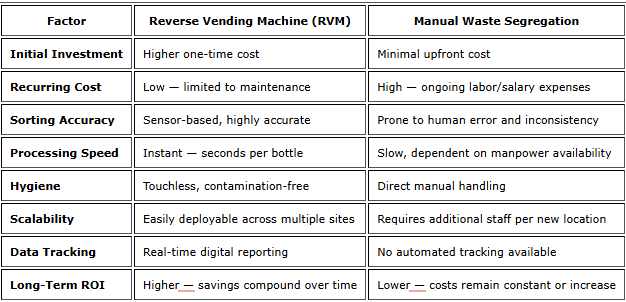
Manual Waste Segregation Cost vs Automation: The Real Picture
At first glance, manual segregation looks cheaper — no machinery, no installation. But the hidden costs tell a different story:
- Labor turnover and training — recurring expense as workers need to be repeatedly trained
- Inconsistent output — human sorting errors lead to contaminated recyclables, reducing resale value
- Limited scalability — expanding operations means hiring more staff, not just adding infrastructure
- No real-time insights — businesses can't track recycling volume or impact accurately
In comparison, a smart plastic bottle collection machine requires a bigger initial investment but delivers predictable, lower long-term costs, consistent output quality, and measurable sustainability data — a critical advantage for businesses tracking ESG goals.
Why Businesses Are Choosing RVMs Over Manual Segregation
- Consistent Accuracy — Sensor-based sorting eliminates contamination issues common in manual processes.
- Lower Long-Term Costs — While the initial cost is higher, reduced labor dependency makes RVMs more cost-effective over 3-5 years.
- Better Compliance — Automated systems align well with India's evolving Deposit Refund System frameworks and Extended Producer Responsibility (EPR) norms.
- Enhanced Brand Image — Visible automated recycling stations reflect positively on sustainability commitments.
- Scalable Deployment — RVMs can be installed across multiple locations without proportionally increasing manpower.
Which One Should You Choose?
If you're managing low, occasional plastic waste volumes, manual segregation may still suffice in the short term. But for businesses, retail chains, corporate campuses, or societies dealing with consistent, high-volume plastic waste, an automated waste segregation system through an RVM offers far superior long-term value — in cost savings, accuracy, and sustainability impact.
Environmental Impact: Beyond Just Cost Savings
While cost is a major deciding factor, the environmental case for automation is just as compelling. Manual segregation often results in contaminated recyclables — a single non-recyclable item mixed into a batch can render the entire lot unfit for high-quality recycling. This contamination lowers material value and increases landfill dependency.
A Reverse Vending Machine, on the other hand, ensures that only qualifying plastic bottles are accepted, verified through barcode and material recognition technology. This results in:
- Higher-quality recycled material — cleaner input means better output for manufacturers
- Reduced landfill burden — fewer contaminated batches being discarded
- Support for circular economy goals — bottles collected through RVMs can be processed into food-grade or industrial-grade recycled plastic (rPET), closing the material loop
For businesses working toward sustainability certifications or EPR (Extended Producer Responsibility) compliance, this improved material quality directly strengthens their environmental reporting and credibility.
Final Thoughts
The comparison between Reverse Vending Machines and manual waste segregation isn't just about upfront cost — it's about long-term efficiency, accuracy, and scalability. As India moves toward stricter recycling regulations and Deposit Refund System adoption, automation is quickly becoming the smarter choice for forward-thinking businesses.
Looking for a reliable Reverse Vending Machine manufacturer in India? Get in touch with Endlos Innovations to find the right RVM solution for your business.