Most retention technology purchases are evaluated on features and judged later on response rates, which is why so many end as an unused licence. Talent retention software produces value only when employees complete the measurement, supervisors receive the findings, and the output reaches a decision. Any of the three failing renders the other two irrelevant. Deloitte's Human Capital Trends research has repeatedly identified a gap between organisations collecting workforce data and organisations equipped to act on it, and in most cases the gap sits at the delivery point rather than the collection point.
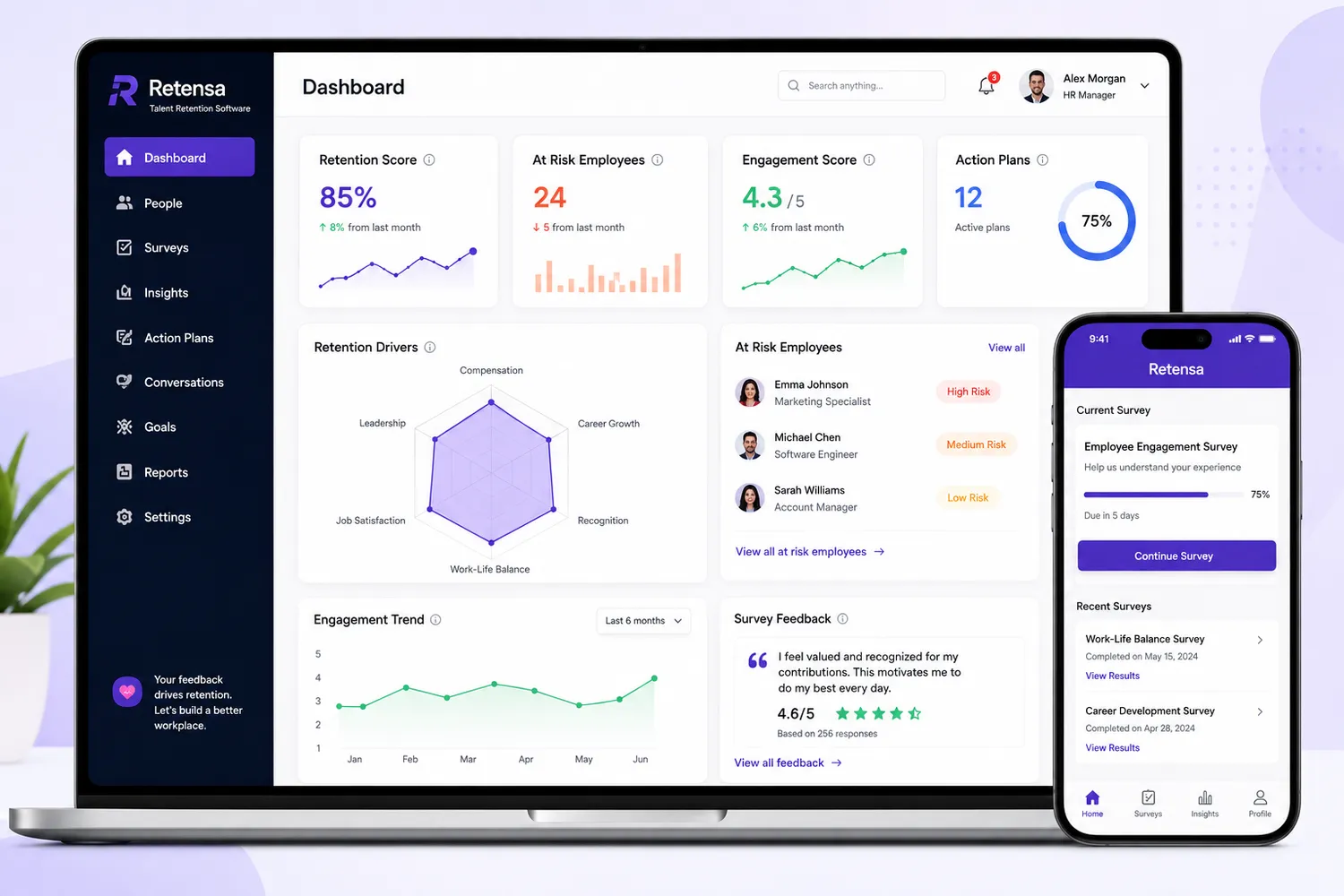
The Three Failure Points to Evaluate Against
Retention technology fails in predictable places, and evaluation should test each one directly rather than reviewing a capability list.
The first is response rate. A measurement completed by 30 per cent of a workforce produces a sample skewed toward the engaged and the aggrieved, and the middle population that generates most quiet exits is absent. Response rate is a design outcome rather than a communications problem, driven by length, format, timing, and whether previous rounds produced visible change.
The second is delivery. Findings that reach a central HR dashboard and stop there change nothing, because the conditions employees describe are controlled by supervisors who never see the data.
The third is decision. Output formatted as an index score gives a manager no instruction. Output formatted as a ranked action list with a timeframe produces behaviour.
Employers who evaluate against these three points rather than against feature comparison identify unsuitable systems before purchase rather than after the first cycle.
Evaluating Collection Design
Collection design determines response rate more than any communications campaign around it.
Length matters most. A measurement completing in under three minutes will be finished by a population that abandons a twenty-minute survey. Frequency then compensates for brevity: short and frequent produces more usable trend data than long and annual.
Format must match the workforce. A desk-based population completes a browser form. A store associate completes something on a phone in a break room. A driver completes voice-based feedback in a cab and nothing at all in written form. Systems supporting only one format will underperform in any mixed workforce.
Timing must be triggered rather than scheduled centrally, so that a day 7 check fires on the employee's seventh day rather than in the next quarterly wave.
Employers who test collection design against their actual workforce composition rather than against a demonstration produce representative response rates from the first cycle.
Four Selection Criteria That Predict Whether the System Will Be Used
1. Findings Route Automatically to the Line Manager
The system must deliver each team's ranked drivers and risk flags to the manager who controls those conditions, without an analyst preparing a report. Employers who require automatic routing see intervention activity within the first reporting cycle rather than at the next quarterly review.
2. Output Arrives as an Action, Not a Score
A ranked list of three conditions with a defined next step produces behaviour. A composite engagement index does not. Employers who require action-formatted output identify during evaluation which systems can produce it and which only report.
3. Predictive Classification, Not Only Retrospective Reporting
Exit data explains completed departures. Predictive scoring identifies employees, teams, and roles at elevated resignation likelihood while intervention remains possible. Employers who require predictive capability gain an intervention window measured in weeks after one complete feedback cycle.
4. Multi-Language and Multi-Format From the Same Instrument
Mixed and international workforces need one instrument and one driver taxonomy applied across languages and formats, or comparison collapses. Employers who require this from the outset reach comparable cross-site reporting within one quarter.
What the System Must Connect To
A retention system that reports engagement in isolation produces a score. A system connected to turnover and cost data produces a business metric.
Three connections matter. Turnover data, so that predicted risk can be validated against actual exits and the model improves. Time-to-fill data, so that exposure can be expressed in currency. Cost assumptions, so that avoided exits convert into avoided expense.
Employee retention services delivered without these connections leave the employer holding sentiment data and no way to report it to finance. Employers who require the connections at selection can express results in the same unit as the baseline from the first reporting period.
Validating the Cost Model Before Purchase
The business case for the software depends on a turnover cost figure the employer should hold before the evaluation begins rather than accept from a vendor.
Employers who calculate their own exposure and want to decrease turnover rate against a documented baseline enter the procurement with a ceiling for reasonable spend. The model needs internal pay rates, actual time to fill, onboarding duration including trainer hours, and productivity ramp from disengagement to full replacement competence.
SHRM benchmarking places average cost per hire in the region of $4,700, and that covers recruiting activity alone. Employers modelling all cost categories typically find total exposure two to four times the recruiting line item, which is the figure the software spend should be compared against.
Producing that baseline takes under two weeks and turns the procurement conversation from cost approval into cost avoidance.
Implementation Decisions That Determine Adoption
Selection is roughly half the outcome. Four implementation decisions determine the rest.
Start with one function or site rather than the whole organisation, so that response rate and routing can be corrected before scale. Publish what changed after the first cycle, since participation in cycle two depends almost entirely on whether cycle one produced visible action. Train supervisors on the response before the first findings arrive, not after. Set the reporting cadence at implementation rather than allowing it to settle at whatever proves convenient.
Employers who pilot before scaling identify collection and routing problems within one cycle rather than across an entire workforce.
Positioning the System Inside the Wider Approach
Technology supports a method rather than replacing one. The measurement instrument is useful because a defined approach determines what is measured, who receives it, and what they do with it.
Sound worker retention strategies specify the drivers to be measured, the owner of each, the target, and the cadence, and the system then executes that specification at scale. Purchasing the system first and deciding the method afterwards produces the common outcome of a well-configured platform generating reports nobody acts on.
The requirement is sharpest in frontline environments. Retail employee retention strategies depend on store managers receiving early-tenure signals in a form they can act on between shifts, which is a delivery requirement rather than an analytics one, and it should be tested during evaluation with an actual store manager rather than a project sponsor.
Employers who define the method before selecting the system see measurable voluntary turnover reduction within one to two quarters of implementation.
Frequently Asked Questions
How can employers evaluate talent retention software effectively?
Test three failure points directly: whether employees will complete the measurement, whether findings reach line managers automatically, and whether output arrives as a ranked action rather than a score. Feature comparison predicts none of the three.
How can employers achieve high survey response rates?
Keep each measurement under three minutes and increase frequency to compensate, match the format to the workforce, trigger by tenure date rather than in central waves, and publish what changed after each cycle to sustain participation.
How can employers connect retention software to financial reporting?
Require connections to turnover data, time-to-fill data, and cost assumptions at selection. Without them the system reports sentiment with no route to a currency figure finance recognises.
How can employers avoid buying a system nobody uses?
Pilot on one function or site first, train supervisors on the response before the first findings arrive, and test delivery with an actual line manager rather than a project sponsor during evaluation.
How can employers measure retention across a mixed workforce?
Require one instrument and one driver taxonomy applied across languages and formats, supporting browser, mobile, and voice collection. Separate instruments for different populations make cross-site comparison impossible.