Project-based employment breaks the assumption underneath most retention thinking, which is that an employee remains in one role, at one location, under one supervisor. A tradesperson moves between projects, sites, and foremen several times a year, and each transition is a decision point at which they compare staying against an approach from another contractor. Managing employee retention in construction industry settings therefore means managing transitions rather than managing conditions, because the transition is where the loss occurs. Skilled trades cannot be replaced from a general labour pool, so a single departure at the wrong phase can hold a milestone for weeks.
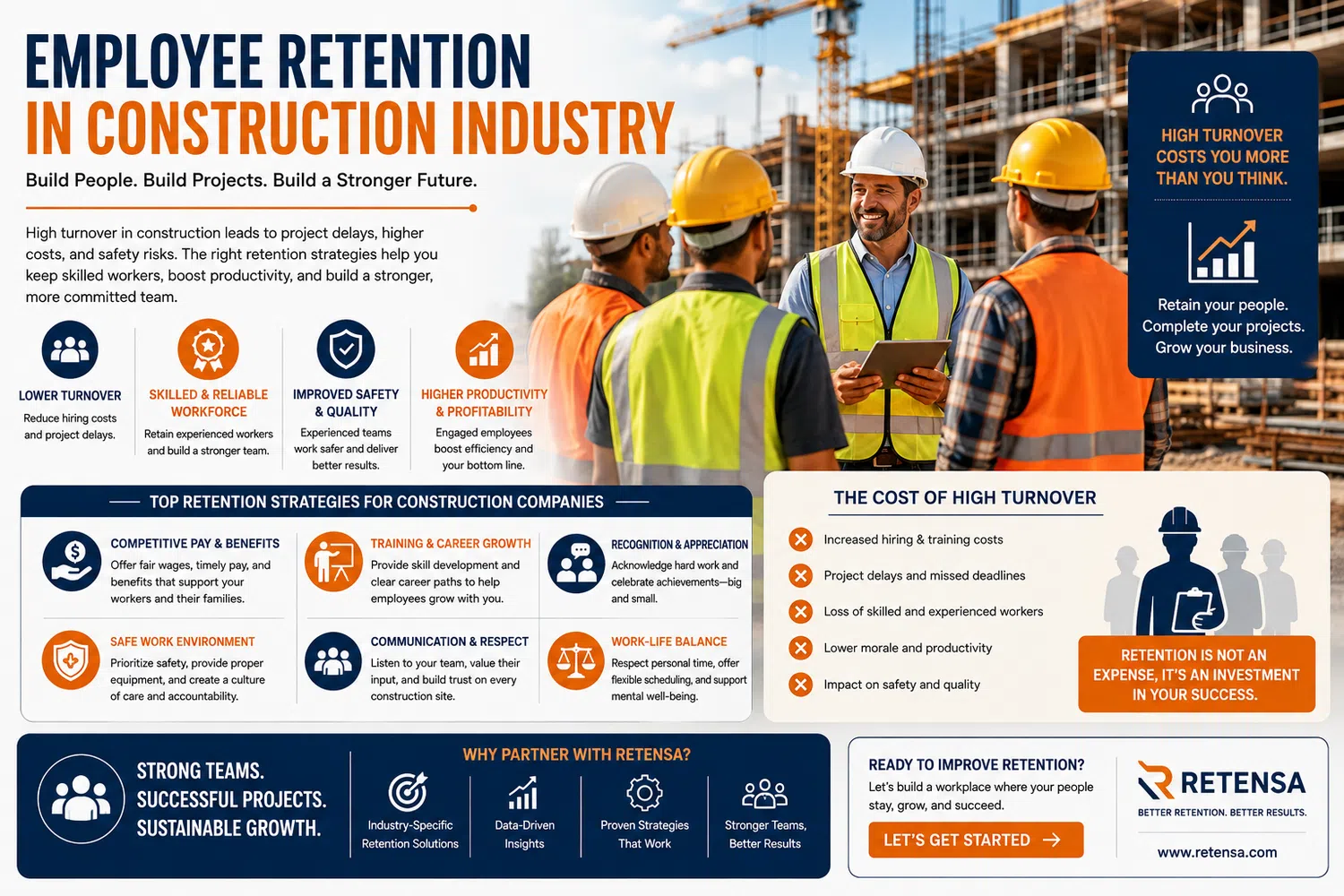
Why Project Transitions Concentrate Exit Risk
Three factors converge at every project completion.
Certainty about the next assignment is the dominant one. A tradesperson finishing a project without a confirmed next placement faces the same uncertainty as an employee after a restructuring announcement, and behaves the same way: external conversations begin, and the strongest people move first because their options are best.
The supervisor relationship resets. A crew member who developed a working relationship with one foreman may be assigned to another whose practice differs, and that reset removes the relationship that was holding them.
Commute and site conditions change materially. A new project forty minutes further from home is a substantive change in working conditions that no policy addresses, and it commonly appears in exit data disguised as a general dissatisfaction.
Employers who track exit timing against project transitions rather than against calendar periods identify whether attrition is transition-driven or condition-driven within two project cycles.
The Crew as the Unit of Measurement
Construction attrition frequently moves in groups rather than individuals, because crews form working relationships that travel. A foreman who moves takes people with him, and a crew that loses cohesion sheds members together.
Individual engagement scores miss this entirely. Crew-level measurement captures it, and crew is also the level at which intervention is possible, since the foreman controls daily conditions in a way head office does not.
Measurement must fit the environment. A tradesperson will not complete a corporate intranet survey, and any instrument requiring a desk will produce a response rate from office staff only. Collection has to work on a phone, at a site, in under three minutes, at variable times.
Employers who measure at crew level using site-appropriate collection hold usable data after one full project phase.
Four Practices That Retain Skilled Trades Across Projects
1. Confirm the Next Assignment Before the Current One Ends
The uncertainty window is where the loss happens, and closing it costs nothing but planning discipline. Where a confirmed assignment is impossible, a stated timeframe outperforms silence. Employers who confirm before completion remove the dominant transition driver within one project cycle.
2. Keep Crews Together Across Transitions Where Practical
Crew cohesion is an asset with measurable retention value, and reassigning intact crews preserves it. Scheduling convenience frequently overrides this without anyone costing the trade-off. Employers who track retention by crew continuity quantify the value within two project cycles.
3. Measure the Foreman, Not Only the Site
Site-level data averages across crews with different foremen and produces a figure describing none of them. Foreman-level reporting identifies where exits concentrate. Employers who report at foreman level identify the operative variable within one quarter.
4. Capture Feedback at Project Completion, Not Only at Exit
A tradesperson leaving a project is reachable and reflective in a way an exiting employee is not. A short completion check surfaces conditions that would otherwise appear only in an exit interview months later. Employers who measure at completion gain a leading indicator one to two project cycles ahead of the exits.
Managing the Contingent and Subcontracted Population
Most construction workforces contain directly employed staff, long-term contingent workers, and subcontracted labour, and retention thinking usually covers only the first.
The distinction matters less operationally than it does contractually. A long-term contingent tradesperson who has worked continuously across four projects functions as an employee from a delivery perspective, and their departure carries the same schedule cost. Excluding them from measurement removes a substantial part of the workforce from view.
The practical approach measures everyone performing the work, while recognising that the levers differ. Directly employed staff respond to progression and benefits. Contingent workers respond to assignment continuity, payment reliability, and site conditions. Neither responds to a programme designed for the other.
Employers who measure the full working population rather than the directly employed subset hold an accurate exposure picture within one project cycle.
Costing Schedule Impact Rather Than Replacement
Standard turnover cost models understate construction exposure, because they capture recruitment and onboarding and omit the schedule consequence.
Employers who model what it costs to reduce staff turnover in trades should add the delay cost: the days a milestone slips when a specialist role sits vacant, the liquidated damages exposure attached to that slip, and the overtime absorbed by the remaining crew. In specialist trades with scarce labour, the delay component frequently exceeds the replacement component several times over.
That calculation changes the investment argument entirely, because it moves retention from an HR cost into a project risk control.
Employers who model delay cost alongside replacement cost produce a defensible baseline within two weeks.
Applying the Same Logic to Other Mobile Workforces
Construction is not unique. Any workforce operating away from a fixed supervisor and a fixed site faces a version of the same problem, and the solutions transfer.
Transportation is the closest parallel. Practical truck driver retention strategies address the same three factors: assignment certainty, the dispatcher relationship in place of the foreman relationship, and route conditions in place of site conditions. The exit curve is similarly front-loaded, and the measurement design faces the same constraint, since a driver will not complete a written form any more readily than a tradesperson will.
Both sectors reward voice-based or single-tap collection over written instruments, and both reward measurement timed to transitions rather than to calendar quarters.
Employers who apply transition-timed measurement across mobile workforces identify early-tenure and transition risk within one assignment cycle.
Building the Reporting Layer
Manual measurement across multiple sites, rotating crews, and continuous project transitions is not sustainable, because the population changes faster than any survey schedule.
An employee retention platform triggers measurement by assignment and tenure events rather than by calendar date, applies consistent coding across sites, and delivers crew-level findings to the responsible foreman. Predictive classification identifies which crews and roles carry elevated resignation likelihood before a milestone is affected.
Sound staff retention strategies then specify what each recipient does with the finding and by when, which is the part technology cannot supply.
Employers who install event-triggered measurement across a project portfolio produce comparable cross-site reporting within one quarter and see measurable voluntary turnover reduction within one to two.
Frequently Asked Questions
How can construction employers reduce turnover between projects?
Confirm the next assignment before the current project ends, since the uncertainty window is where most transition losses occur. Where confirmation is impossible, a stated timeframe outperforms silence and costs nothing.
How can employers measure retention risk on a job site?
Use collection that works on a phone, at a site, in under three minutes, and report at crew level rather than individually. Crews form working relationships that travel, and they frequently quit as groups.
How can employers identify which foremen retain their crews?
Report exit data at foreman level rather than site level. Site figures average across crews with different supervisors and conceal the variable that most determines whether a crew stays intact.
How can employers cost construction turnover accurately?
Add schedule impact to replacement cost: milestone days lost while a specialist role sits vacant, associated damages exposure, and overtime absorbed by remaining crew. In scarce trades this component frequently exceeds replacement cost.
How can employers retain long-term contingent tradespeople?
Measure everyone performing the work rather than only directly employed staff, and recognise that contingent workers respond to assignment continuity, payment reliability, and site conditions rather than to progression and benefits programmes.