Most HR technology stacks already include an engagement survey tool, an HRIS, and some form of exit interview process. Few of those tools were built specifically to predict which employees are likely to quit, or to connect that prediction to a specific, actionable recommendation. Purpose-built employee retention software closes that gap by treating retention as the primary function rather than a secondary report generated from data collected for other purposes.
Why Generic HR Platforms Miss Retention Signals
SHRM's turnover-cost research has long placed the cost of replacing a departing employee at six to nine months of that employee's salary once recruiting, onboarding, and lost productivity are counted. Standard HRIS platforms track headcount, payroll, and compliance well, but most were not designed to answer the specific question retention requires: which employees, in which departments, are showing early signs of disengagement right now, before a resignation letter arrives.
Gallup's engagement research has found that engagement scores captured once a year, the standard cadence for most HR platforms, arrive too late to catch disengagement building in real time. A platform that only surfaces a single annual score per employee gives HR a snapshot, not a trend, and a snapshot cannot distinguish between an employee whose engagement has been stable for years and one whose engagement dropped sharply the previous month for a reason that has not yet surfaced in an exit interview.
Compliance-oriented HRIS platforms face a related structural limit: they were built to satisfy payroll accuracy and regulatory reporting requirements, not to forecast behavior. Adding a retention module to a compliance-first system tends to produce a report that looks like every other compliance report, a static table refreshed periodically, rather than a living model that updates as new engagement and turnover data arrives. Retention forecasting requires a different underlying architecture, one built around predicting a future event rather than documenting a past transaction.
Staff Retention Plans Depend on Continuous, Not Annual, Data
A staff retention plan built around annual data collection structurally cannot catch attrition risk while there is still time to act on it. Retensa's platform captures engagement, sentiment, and stay-survey data continuously through tools such as TalentPulse, generating a rolling trend per employee and per team rather than a single point-in-time score refreshed once a year.
This continuous approach changes what HR and managers can actually do with the data. A manager reviewing a trend line that shows three consecutive months of declining engagement on a specific team has time to intervene before that decline converts into resignations. A manager who only sees an annual survey result learns about the same decline months after it started, often around the same time exits begin appearing on the team roster. Employers using continuous measurement typically identify at-risk teams two to three months earlier than employers relying on an annual survey cycle alone, a lead time that consistently makes the difference between a recoverable situation and a resignation already in motion.
Continuous data also changes how HR leaders talk to managers about engagement. A manager handed a single annual score has little basis for a specific conversation beyond a general check-in. A manager who can see a rolling trend, and who can compare this quarter's trajectory against the last, has a concrete basis to ask what changed and what that manager can do about it. Software built to increase employee retention through this kind of ongoing visibility gives managers a tool for an actual working conversation, not just a compliance exercise repeated once a year.
What Employee Retention Software Actually Needs to Deliver
Software built specifically for retention consistently includes four capabilities that generic HR platforms either omit or treat as an afterthought.
1. Diagnose Turnover Cost and Cause at the Segment Level
Retention software needs to quantify turnover cost by department, tenure, and role, then connect that cost to the specific reasons employees in each segment quit. Employers using segment-level diagnostics typically identify their two or three highest-leverage interventions within the first thirty days of analysis, rather than applying a single company-wide fix that misses the segment actually driving the cost, and often overspends on departments that were never the source of the problem to begin with.
2. Measure Engagement on a Continuous Cycle
A platform limited to an annual survey structurally cannot flag a disengagement trend forming in real time. Continuous measurement tools capture sentiment shifts by team in an ongoing cycle, giving managers a two-to-three-month lead time on attrition risk compared to an annual-only approach.
3. Track New Hire Retention Through Structured Checkpoints
Software built for retention includes checkpoints at thirty, sixty, and ninety days that catch the gap between recruiting promises and actual role experience while a new hire is still deciding whether to stay. Employers that build these checkpoints into onboarding commonly see first-year turnover drop within two quarters of implementation, a result generic HR platforms rarely track as a distinct metric even when the underlying onboarding data already exists somewhere in the system, scattered across separate reports nobody has connected into one view.
4. Score Current Employees for Predictive Risk
An Attrition Risk Matrix scores current staff on resignation likelihood using tenure, engagement trend, manager change, and compensation position relative to market. This is the capability most clearly absent from generic HR platforms, which typically report on past turnover rather than forecasting future risk. Employers applying predictive scoring typically reduce regretted attrition among top performers within two to three quarters of rollout, a category of loss that standard turnover reporting rarely isolates from routine, lower-cost attrition at the bottom of the performance curve.
An Employee Retention Platform Needs to Outlast a One-Time Consulting Report
A one-time consulting engagement often produces a strong initial diagnostic, then leaves the employer without a system to track whether the recommended changes actually moved the numbers. A consulting report is a snapshot; an employee retention platform is an ongoing measurement system. Employers that pair diagnostic consulting with software that tracks results against the original recommendations typically sustain the improvement identified in that first engagement, rather than watching the gains fade once the consulting engagement ends and nobody continues tracking the relevant metrics.
This distinction matters most at scale. A consulting engagement can produce a detailed report for a single business unit, but a large employer with dozens of departments and multiple locations needs a platform that applies the same diagnostic logic continuously across the entire organization, not a report that covers one unit at one point in time. Software that scales this way gives HR leaders the same diagnostic rigor a consulting engagement provides, applied every quarter rather than once.
The cost comparison also favors the platform approach over time, even when a consulting engagement carries a lower sticker price for a single project. A consulting fee covers one diagnostic; a platform subscription covers every quarter's diagnostic, every department's data, and the predictive layer that a static report cannot replicate without a fresh engagement each time circumstances change. Employers evaluating the two options side by side typically find that the platform's ongoing cost compares favorably against the cumulative cost of repeated consulting engagements needed to keep pace with a workforce that keeps changing.
Decrease Turnover Rate Once the Right Software Is in Place
Software alone does not decrease turnover; the interventions it informs do. Retensa's platform gives HR leaders a way to decrease turnover rate by connecting the diagnostic and predictive data directly to a recommended action, rather than leaving HR to interpret a dashboard without clear next steps.
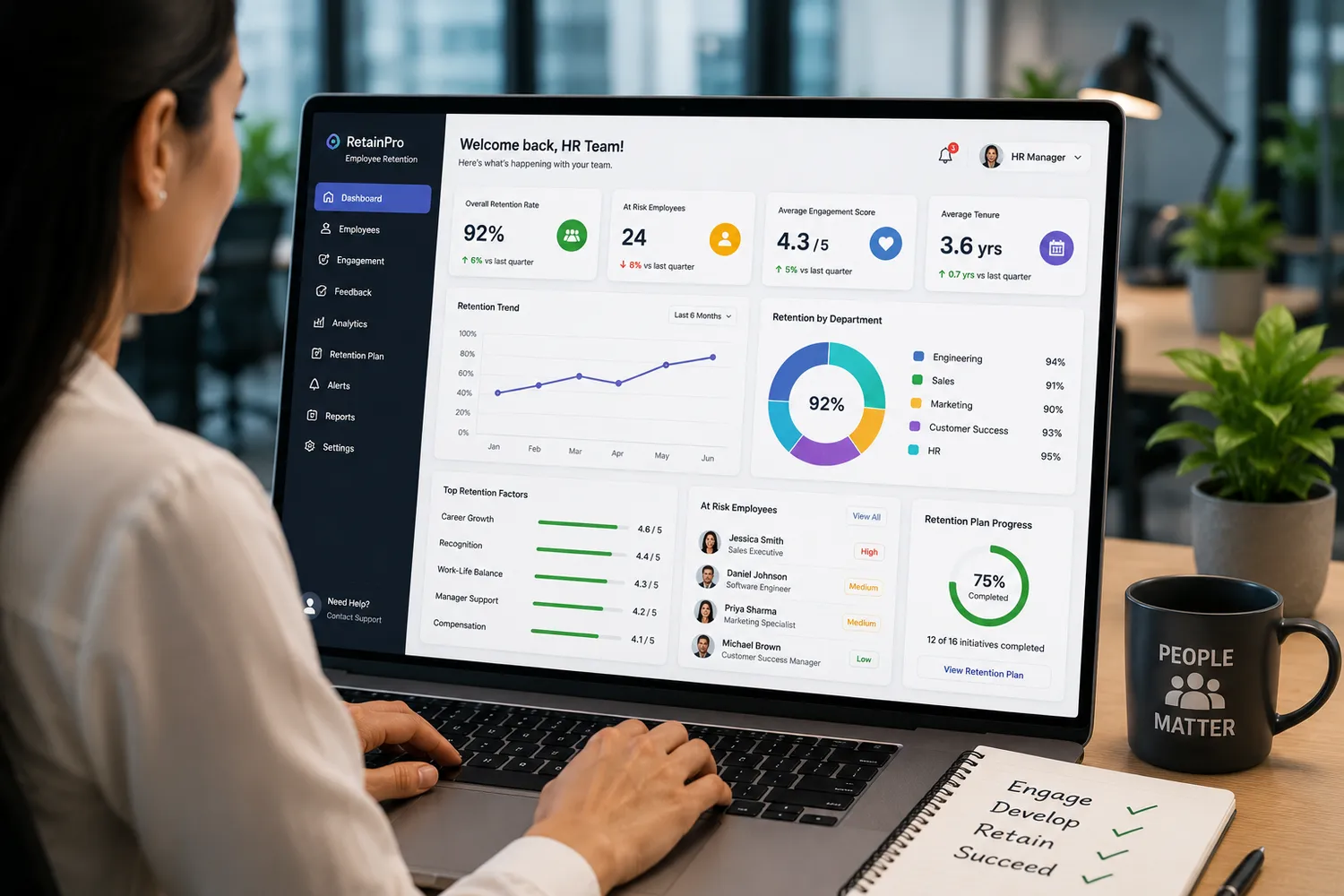
That connection matters because dashboards alone tend to generate more questions than decisions. A chart showing rising attrition risk in a specific department tells a VP of People that something is wrong, but not necessarily what to do about it. Software built around retention outcomes, not just retention reporting, pairs each risk signal with a specific recommended intervention, whether that is a stay conversation, a schedule adjustment, or a targeted retention offer, giving HR leaders a next step rather than another number to interpret. Employers that connect data to action this directly typically move from diagnosis to intervention within thirty days, compared to employers working from a standalone dashboard with no built-in recommendation layer.
This gap between reporting and recommendation explains why many employers already own retention-adjacent data without ever using it to reduce turnover. A company with a mature engagement survey program, a functioning HRIS, and a documented exit interview process can still have no functioning retention strategy, because none of those systems were built to connect their outputs into a single recommended action. The value of purpose-built retention software often lies less in collecting new data than in making existing data usable by pairing it with a specific next step.
FAQs
How can employers identify retention software that goes beyond standard HR reporting?
Retention-specific software connects turnover diagnostics, continuous engagement measurement, and predictive scoring to a recommended action, rather than reporting past turnover alone. Employers evaluating platforms should confirm the software forecasts risk, not just historical rates.
How can continuous measurement improve on an annual engagement survey?
Continuous measurement captures sentiment trends by team on an ongoing cycle instead of once a year, giving managers a two-to-three-month lead time on attrition risk. Employers using continuous measurement typically identify at-risk teams earlier than an annual survey alone.
How can predictive analytics improve retention decision-making?
An Attrition Risk Matrix scores current employees on resignation likelihood using tenure, engagement trend, and compensation position. This lets managers prioritize retention conversations with high-value employees before a resignation happens rather than after.
How can employers sustain results from a retention consulting engagement?
Pairing a diagnostic consulting engagement with software that tracks results against the original recommendations keeps the improvement visible after the engagement ends. Employers using this approach typically sustain gains rather than losing them once consulting support concludes.
How can HR leaders move from a retention dashboard to an actual intervention?
Software that pairs each risk signal with a specific recommended action, rather than a standalone chart, gives HR a clear next step. Employers using this approach typically move from diagnosis to intervention within thirty days.