Ask most executives what turnover costs their company, and you'll get a shrug or a rough guess. Ask them what a 5% reduction in turnover would be worth in real dollars, and the room usually goes quiet. That gap — between knowing turnover is a problem and knowing exactly what it's costing — is where most companies get stuck. Learning how to reduce staff turnover starts with putting an actual number on the problem, because it's very hard to justify fixing something leadership can't see on a spreadsheet.
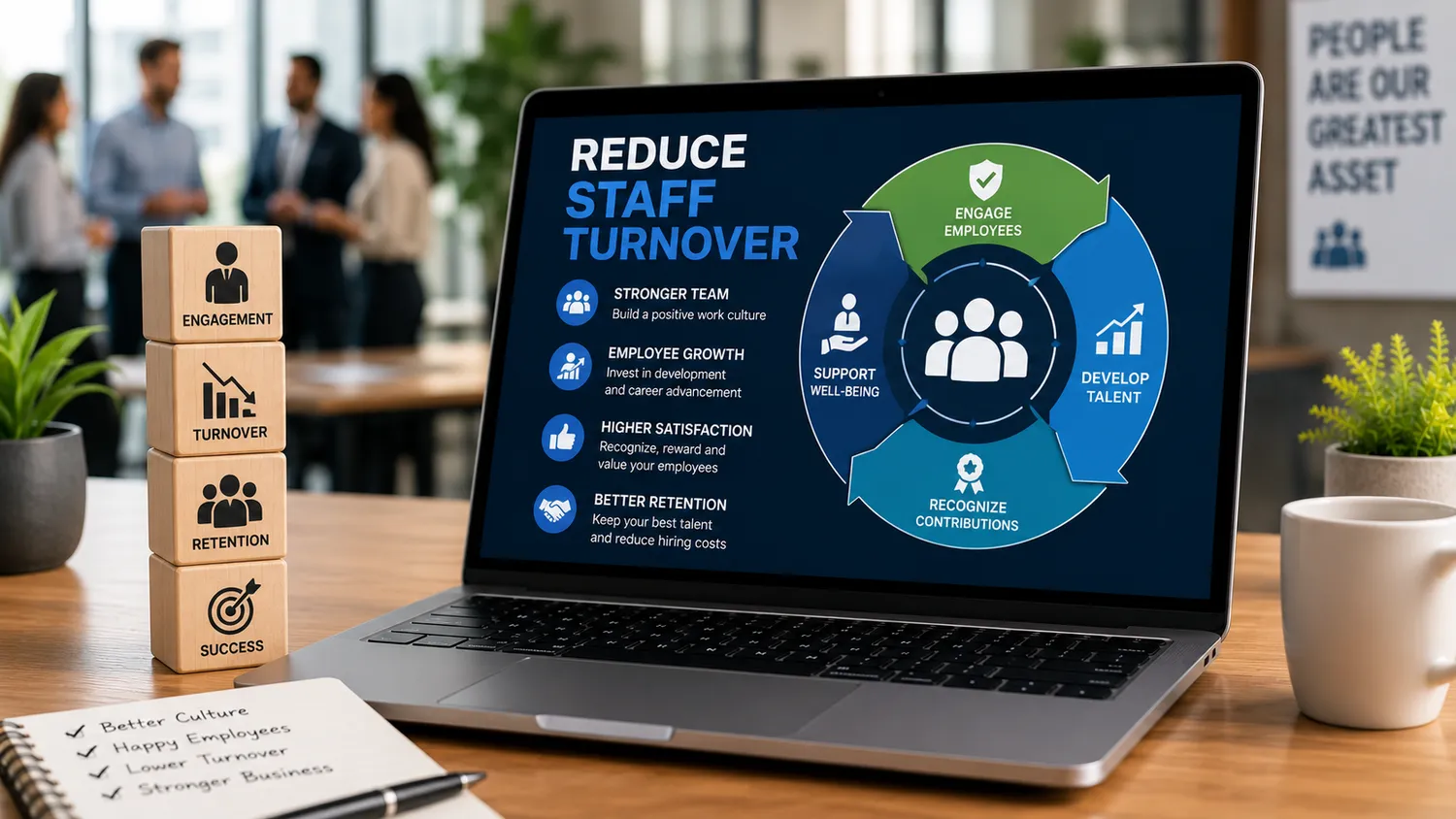
The instinct to treat turnover as a "people problem" rather than a financial one is understandable, but it's also why so many retention efforts stall before they start. Recruiting costs, lost productivity during ramp-up, overtime paid to cover vacant shifts, and the customer relationships that walk out the door with a departing employee all add up into a number that's frequently larger than executives expect — and once that number is visible, funding a fix stops being a hard conversation.
Getting Serious About Reducing Turnover
Start With the Actual Cost, Not a Guess
Before spending a dollar on retention initiatives, it's worth calculating what turnover is actually costing right now. This isn't just replacement salary — it includes recruiter time, advertising spend, onboarding and training hours, the productivity dip while a new hire ramps up, and the ripple effect on remaining team members who absorb extra work during the gap. For roles involving client relationships or specialized skills, the cost climbs even higher, since institutional knowledge and trust take months or years to rebuild.
Once that baseline is clear, the question of how to reduce employee turnover stops being abstract. A company that knows it's losing $40,000 per departure in a critical role has a very different urgency level than one operating on a vague sense that "turnover feels high lately." The number turns a soft HR concern into a hard business case, which is usually what it takes to get budget approved and leadership attention sustained past the first meeting.
Diagnose Before You Spend
The fastest way to waste a retention budget is to guess at the cause. A company might assume pay is the issue and roll out raises, only to see turnover barely move because the real driver was inconsistent scheduling or a disengaged middle-management layer. Structured diagnostics — surveys, stay interviews, exit interview analysis, and workforce data review — exist precisely to prevent this kind of expensive guesswork.
This diagnostic step is where most successful efforts to reduce employee turnover actually begin, well before any new program or benefit gets announced. It's tempting to skip straight to solutions because they feel more visible and more "actionable," but a solution aimed at the wrong cause doesn't just fail to help — it burns budget and credibility that make the next attempt even harder to fund.
The Levers That Actually Decrease Turnover Rate
Once the real drivers are identified, the interventions that consistently work to decrease turnover rate tend to fall into a few categories:
- Manager quality. Since most resignations trace back to the relationship with a direct manager, coaching and accountability at this level often produces the fastest, most durable results.
- Career clarity. Employees who can't see a path forward start looking elsewhere, even if they're otherwise satisfied — a clear advancement framework closes this gap.
- Workload and scheduling. In hourly and shift-based roles especially, unpredictable or excessive scheduling is one of the single biggest drivers of early attrition.
- Recognition and feedback. Employees who feel invisible disengage long before they formally resign; regular, specific recognition keeps that from happening.
- Compensation transparency. Pay doesn't have to be the highest in the market, but employees need to understand how it's determined and how it can grow — ambiguity breeds resentment even at competitive rates.
None of these levers work in isolation particularly well. A company that fixes scheduling but ignores manager quality will likely still see people leave, just for a different reason. The organizations that see the biggest, most lasting drops in turnover tend to work on several of these levers simultaneously, guided by whatever the diagnostic data actually shows is driving departures at that specific company.
Measuring Whether It's Working
Reducing turnover isn't a one-time initiative — it requires ongoing measurement to know whether the interventions are actually working or just feel like they should be. This means tracking turnover rate by department and tenure, not just company-wide, since a company-wide average can hide a serious problem concentrated in one team. It also means running pulse surveys frequently enough to catch shifts in sentiment before they show up as resignations, rather than waiting for an annual survey that arrives too late to act on.
The financial side matters just as much. Calculating the estimated savings from each percentage point of improvement keeps the initiative accountable and gives leadership a reason to keep funding it. A program that can point to a specific dollar figure saved is far more likely to survive the next budget cycle than one that can only point to a slightly improved engagement score.
Why Waiting Makes the Problem Worse
Turnover has a compounding quality that makes delay expensive. Each departure increases the workload on remaining employees, which raises their own flight risk. Each unfilled role delays projects and strains customer relationships, which affects revenue independent of the hiring cost itself. And each new hire brought in to replace someone who left needs months to reach full productivity, which means the true cost of a single resignation often isn't fully felt until well after the exit interview is filed. Acting early, before turnover becomes a visible crisis, is consistently cheaper and faster than trying to fix a culture that's already unraveling.
The Hidden Costs Most Calculations Miss
Even companies that make an effort to calculate turnover cost often stop short of the full picture. Direct costs like recruiting fees and training hours are relatively easy to tally, but the indirect costs tend to be larger and harder to quantify — which is exactly why they're so often left out of the business case. A team operating short-staffed doesn't just work harder; quality often slips, deadlines slip, and the employees covering the gap start reconsidering their own future at the company, which can quietly seed the next round of departures before the first vacancy is even filled.
Customer-facing roles carry an additional layer of hidden cost. A client who has built a relationship with a specific account manager or service rep doesn't automatically transfer that trust to a replacement — some portion of that relationship, and sometimes the account itself, can be at risk during the transition. In sales-driven organizations, this shows up as slower deal cycles and lost pipeline momentum for months after a departure, costs that rarely make it into a standard turnover calculation but are very real to the revenue line.
Why Some Reduction Efforts Stall Even With Good Intentions
Not every well-intentioned turnover initiative succeeds, and the pattern behind the ones that stall is fairly consistent. Some launch with enthusiasm but fade because there was no mechanism to track whether the effort was actually working — a new recognition program gets announced, gets used for a few months, and then quietly disappears from the calendar with nobody accountable for keeping it alive. Others fail because they addressed a symptom rather than a cause, like adding perks in response to exit interview complaints about "culture," when the underlying issue was actually a specific manager whose team accounted for most of the department's departures.
The initiatives that hold up share a structural trait: someone owns them, results are tracked against a baseline, and the plan gets adjusted based on what the data shows rather than staying fixed regardless of outcome. This sounds obvious, but it's the piece most commonly missing from turnover reduction efforts that start strong and lose momentum within a year.
Turning a Turnover Number Into an Executive Priority
Getting sustained leadership attention on turnover reduction usually requires reframing it in language executives already use to evaluate other business problems. A turnover rate on its own is easy to deprioritize next to a revenue shortfall or a product delay. The same turnover rate expressed as an annual dollar cost, benchmarked against the cost of the initiatives needed to bring it down, competes on the same terms as any other line item leadership is used to evaluating — and tends to get funded accordingly.
This reframing also changes how progress gets reported. Instead of updating leadership on engagement scores that are hard to translate into business impact, retention reporting built around cost avoided and dollars saved gives executives a number they can act on immediately, defend to the board, and use to justify continued investment in the following budget cycle.
Bringing the Numbers and the People Together
Reducing turnover isn't about picking the trendiest perk or copying a competitor's benefits package. It's about knowing exactly what turnover is costing, diagnosing the real reasons people are leaving, and applying the right interventions to the right teams — then measuring whether it's actually working. Companies that treat this as a data discipline consistently outperform those treating it as a vague cultural aspiration, because data gives leadership something concrete to fund, track, and hold people accountable to.
If your organization has never calculated the real cost of turnover, that's the natural starting point. Everything else — the manager coaching, the survey cadence, the recognition programs — works far better once there's a clear number attached to the problem it's solving.
Want to know exactly what turnover is costing your business right now? Calculate your cost of turnover and get a clear, data-backed starting point for building a plan that actually moves the number.
Frequently Asked Questions
How can a company calculate the true cost of turnover?By adding recruiting and advertising costs, onboarding and training hours, lost productivity during ramp-up, and overtime covering vacant roles, then factoring in the client relationships and institutional knowledge lost with each departure.
How can businesses reduce staff turnover without a large budget increase?By starting with a diagnostic to target the actual cause, then focusing resources on manager coaching and scheduling fixes, which typically deliver faster, cheaper results than broad compensation increases.
How can leadership know if their turnover reduction efforts are working?By tracking turnover rate by department and tenure, running frequent pulse surveys, and comparing the estimated dollar savings against the initial cost baseline established before the program began.
How can a company decrease turnover rate in high-churn frontline roles?By addressing scheduling predictability, manager accountability, and recognition frequency first, since these three factors typically drive frontline attrition far more than base pay alone.
How can reducing employee turnover improve customer experience, not just HR metrics?Retained employees carry client relationships, product knowledge, and process familiarity that new hires take months to rebuild, so lower turnover directly protects service consistency and customer trust.