To notarize a Power of Attorney (POA) in Dubai, the first step is to prepare a properly drafted document that complies with UAE laws. The applicant must then complete identity verification using an Emirates ID or passport. The notary public reviews the applicant’s identity, intent, and the content of the document before proceeding. The document is signed in the presence of the notary, who witnesses the signature and applies the official stamp and seal. This makes the Power of Attorney legally enforceable. In Dubai, remote or online POA notarization is also permitted, where verification is conducted via secure video call, making it a convenient option for overseas clients.
1. Understand What a Power of Attorney Is and Why Notarization Matters
A Power of Attorney is a legal document where one person (the principal) gives another person (the agent/attorney-in-fact) the authority to act on their behalf in defined matters such as managing property, signing contracts, or handling personal legal matters. Before it has legal “force” in the UAE, especially in Dubai, the document must be notarized by an authorized Notary Public. This process confirms the identity of the signatories and ensures the document’s content meets UAE legal standards.
2. Drafting the POA Document Properly
Before notarization, the POA must be clearly drafted. You can do this either by:
- Preparing a draft yourself, if you are familiar with legal language and requirements.
- Using a lawyer, notary drafting service, or typing center that drafts the document to meet legal criteria.
Key Elements the Draft Should Include
- Full details of the principal and the authorized agent (names, passport numbers, Emirates ID if applicable).
- A clear list of powers being granted (e.g., property sale, banking authority).
- The scope and limits are general (broad powers) or specific (limited to certain tasks).
- Signature lines for the principal (and agent if required by the notary).
3. Translation into Arabic (Mandatory)
In the UAE, Arabic is the official legal language. Thus:
- Your POA must be written in Arabic, or
- If the original is in English or another language, it must be legally translated into Arabic by a certified translator licensed in the UAE before notarization.
Without a certified Arabic translation, the notary will not proceed with the notarization.
4. Notarization Two Main Paths
Dubai now offers two ways to notarize your Power of Attorney:
A. In-Person Notarization
If you are physically present in Dubai:
- Visit a Notary Public office usually at Dubai Courts (e.g., Barsha Mall Notary) or through licensed private notaries.
- Bring original documents:
- The drafted POA (in Arabic or with approved translation)
- Your passport
- Emirates ID (if available)
- Copies of your agent’s passport/Emirates ID.
- Sign the POA before the Notary Public.
- The notary verifies identity and content, stamps and registers the document as notarized.
- You’ll typically receive two or more original copies of the notarized POA (one for you, one for your agent, another for the notary record).
B. E-Notarization (Remote Notarization)
If you are outside the UAE or unable to visit in person, Dubai Courts and other Emirates offer an e-notarization option:
- Submit your draft and IDs electronically (via email or relevant government portal).
- A notary public will conduct a video call (often via BOTIM or a designated system) to verify your identity.
- You confirm your intention to grant authority.
- The notary completes the process and issues a digitally notarized POA that you can download or receive by email.
This method is increasingly popular as it avoids travel and is fully accepted in Dubai and across all Emirates.
5. Identity and Supporting Documents
At notarization, you must present:
- Original passport of the principal (and agent if required).
- Emirates ID if you are a UAE resident.
- Supporting corporate documents if the POA is for a company (e.g., trade license, Memorandum of Association).
6. Fees and Timelines
The notarization fees and timelines vary:
- Notary fees depend on the type of POA (general vs special vs corporate) and whether you use in-person or e-notarization. Typical government notary fees range from a few hundred AED upwards.
- Drafting and translation carry separate costs.
- E-notarization may be faster and sometimes slightly higher in fees if translation and administrative services are included.
Processing may be the same day or within a few days, depending on the completeness of documents and service chosen.
7. After Notarization Legal Acceptance and Attestation
Once notarized in Dubai:
- The POA is legally valid throughout the UAE.
- If the document needs to be used outside the UAE, you must have it attested by the UAE Ministry of Foreign Affairs and the foreign country’s embassy/consulate. This step verifies the document’s authenticity abroad.
8. Special Notes
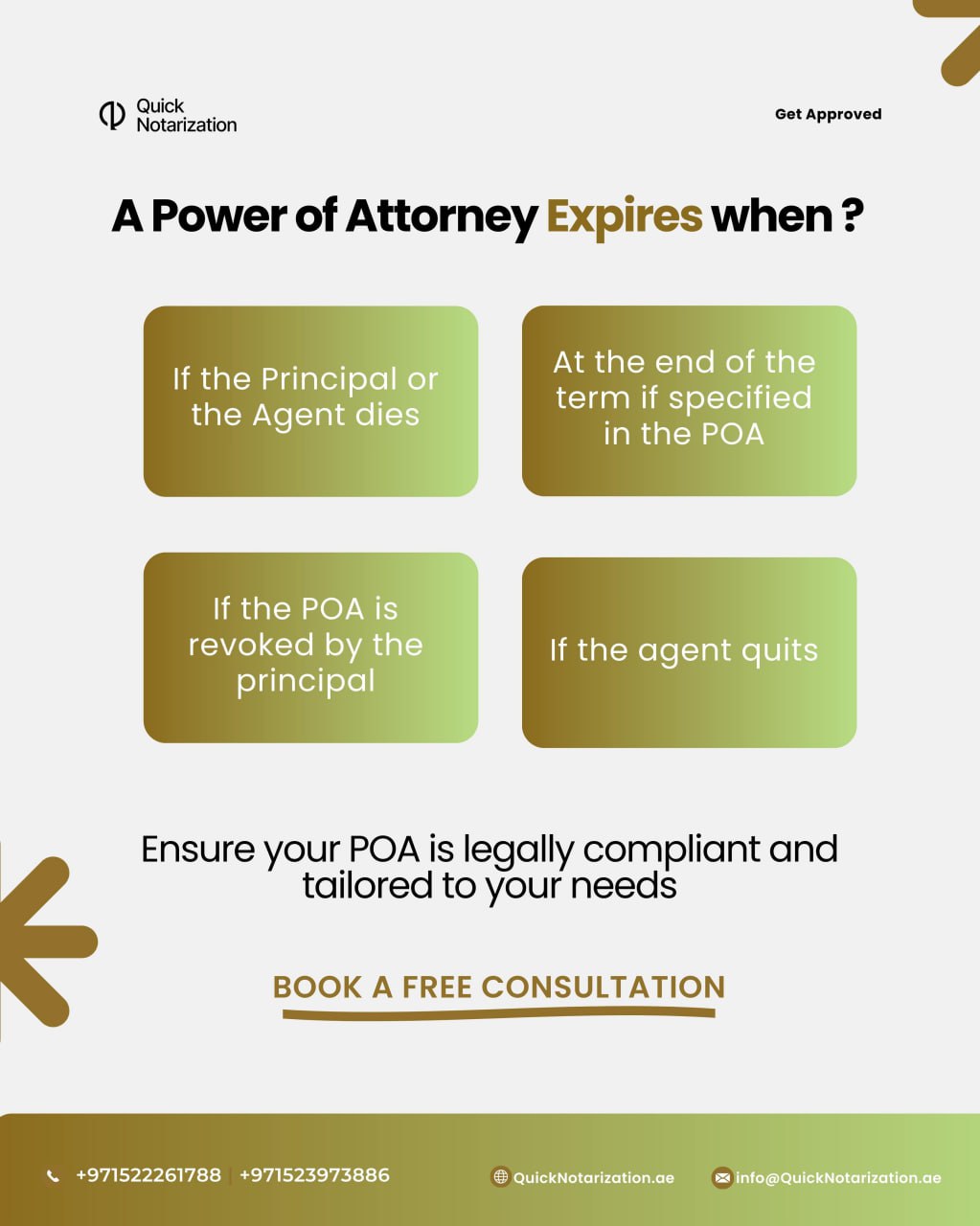
- Validity and Scope: Your POA must clearly outline its scope and expiration if any; vague documents risk rejection.
- Revocation/Cancellation: You can revoke an existing POA later, but that process also involves notarized documentation.