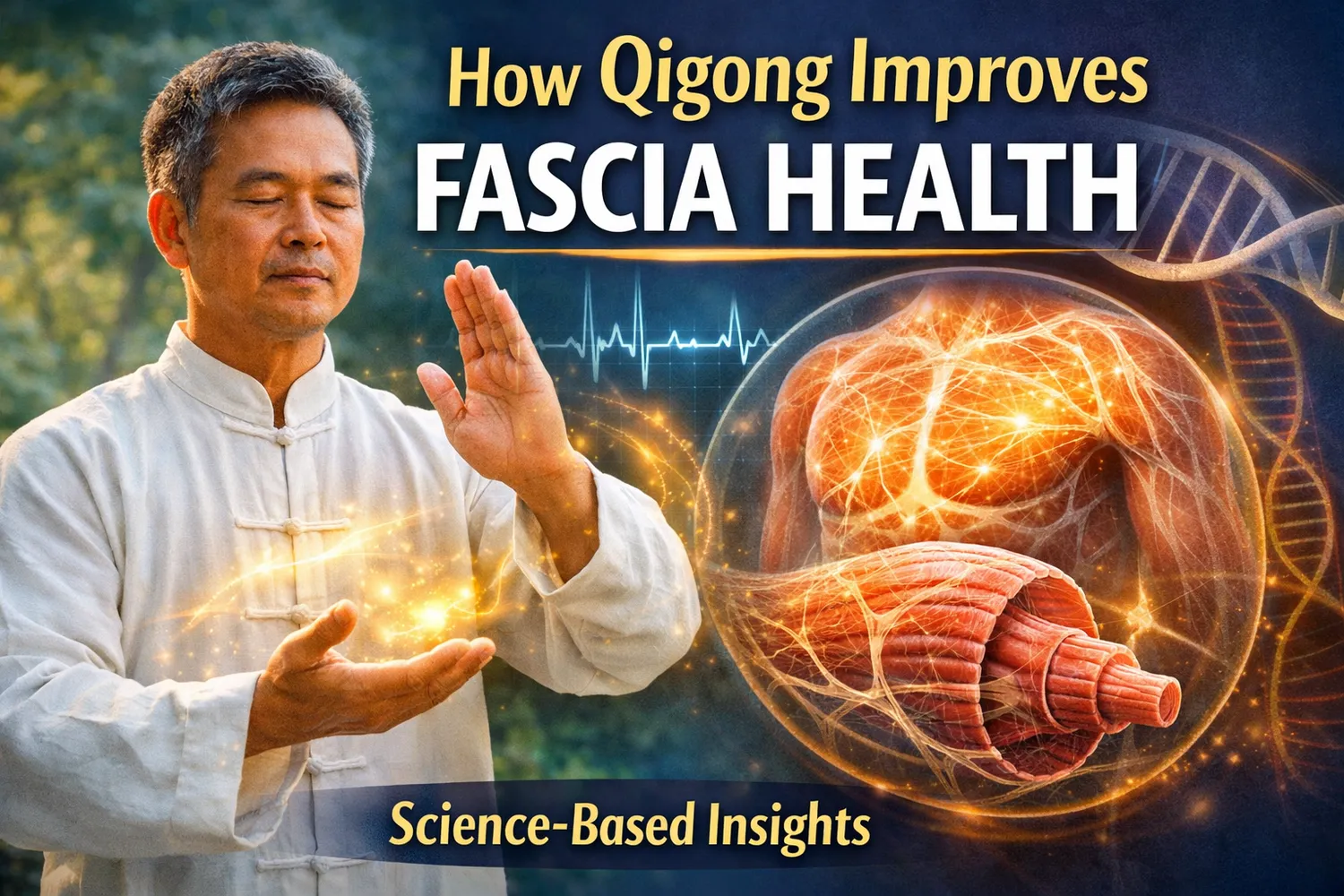
For decades, muscles were seen as the main drivers of movement and strength. Today, modern research tells a more complete story — one that places fascia, the body’s connective tissue network, at the center of mobility, resilience, and pain-free movement.
Interestingly, long before fascia became a scientific buzzword, Qigong was already training it.
This ancient Chinese movement practice uses slow, spiraling motions, breath control, and mindful awareness — precisely the ingredients modern science now recognizes as essential for healthy fascia.
Let’s explore how Qigong improves fascia health, through both traditional wisdom and contemporary research.
What Is Fascia?
Fascia is a continuous web of connective tissue that surrounds and interconnects:
- Muscles
- Bones
- Organs
- Nerves
- Blood vessels
It gives the body structure, transmits force, and allows smooth, coordinated movement.
When fascia is healthy, it is:
✔ Elastic
✔ Hydrated
✔ Responsive
When it’s unhealthy, it becomes:
✖ Stiff
✖ Dehydrated
✖ Pain-sensitive
Sedentary lifestyles, repetitive movement, stress, and injury are major contributors to fascial dysfunction.
What Science Says About Fascia & Movement
Modern fascia research highlights several key principles:
- Fascia adapts best to slow, varied, multi-directional movement
- Gentle loading improves collagen remodeling
- Breath and nervous system regulation affect fascial tone
- Hydration and circulation are critical for fascial glide
These principles align almost perfectly with how Qigong is practiced.
How Qigong Supports Fascia Health
1. Slow, Elastic Loading of Tissue
Qigong movements are intentionally slow and controlled. This provides low-force, long-duration loading, which research shows is ideal for stimulating fascial elasticity and collagen reorganization.
Unlike fast or ballistic movements, Qigong allows fascia to stretch and recoil naturally.
2. Multi-Directional, Spiral Motion
Fascia is not linear — it forms spirals, slings, and tensegrity structures throughout the body.
Qigong uses:
- Rotations
- Twisting
- Wave-like spinal motions
These movements hydrate connective tissue and improve force transmission across the body, not just isolated muscles.
3. Improved Hydration of Fascial Tissue
Fascia relies on movement to stay hydrated. Gentle, rhythmic motion encourages fluid exchange, reducing stiffness and improving glide between tissue layers.
This is one reason people often feel “lighter” and more mobile after Qigong practice.
4. Nervous System Regulation Reduces Fascial Tension
Chronic stress increases muscle and fascial tone via the sympathetic nervous system.
Qigong activates the parasympathetic response through slow breathing and mindful focus, allowing fascia to soften and lengthen naturally.
Relaxed nervous system = healthier fascia
5. Breathwork Enhances Fascial Elasticity
Breathing is not just about oxygen — it creates internal pressure changes that influence connective tissue.
Qigong emphasizes:
- Diaphragmatic breathing
- Coordinated breath-movement patterns
This stimulates fascial chains connected to the diaphragm, spine, and pelvic floor, improving posture and core stability.
Research-Supported Benefits of Fascial Training Like Qigong
Studies on slow mindful movement (including Qigong and Tai Chi) suggest improvements in:
- Chronic pain reduction
- Joint mobility
- Balance and coordination
- Injury prevention
- Postural control
- Functional strength
Fascial training also shows promise for aging populations, as connective tissue stiffness increases with age.
Modern Qigong & Fascia-Focused Training
Some contemporary Qigong systems, such as White Tiger Qigong, intentionally emphasize fascia through:
- Dynamic, elastic movement patterns
- Whole-body connectivity drills
- Spinal wave mechanics
- Breath-driven motion
- Awareness of internal tension lines
This fusion of ancient practice and modern biomechanics makes Qigong especially relevant for today’s movement science.
Who Benefits Most from Fascial Qigong Training?
Qigong is particularly beneficial for:
- Desk workers with stiffness and postural issues
- Athletes seeking better recovery and mobility
- Older adults maintaining flexibility
- People with chronic pain or tension
- Anyone wanting smoother, more efficient movement
Because it’s low-impact, it’s accessible to almost everyone.
How Beginners Can Start Supporting Fascia with Qigong
Simple guidelines:
- Move slowly and smoothly
- Avoid forcing stretches
- Breathe deeply and rhythmically
- Focus on whole-body movement, not isolated muscles
- Practice consistently, even for short sessions
Even 10–15 minutes per day can create noticeable fascial changes over time.
Final Thoughts
Fascia health is no longer a fringe concept — it’s central to modern movement science. What’s remarkable is that Qigong has been training fascia for centuries, using principles only now being validated by research.
By combining gentle elastic movement, breath regulation, and mindful awareness, Qigong offers a scientifically sound, accessible way to restore mobility, reduce pain, and support long-term physical health.