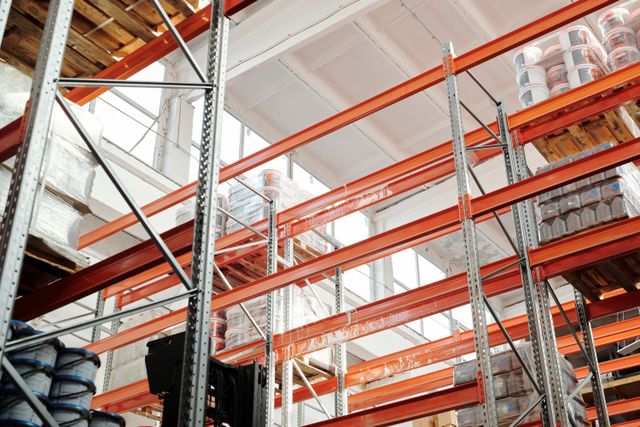
Warehouse space is one of the most valuable assets any distribution center, manufacturing facility, or storage operation has. As inventory grows, businesses often face a difficult decision: expand the building or make better use of the space they already have. In many cases, improving the storage system delivers a far greater return than increasing warehouse size. Push back racking is one of the most effective high-density storage solutions for organizations looking to maximize pallet capacity while maintaining efficient access to inventory.
Unlike traditional selective pallet racking, which dedicates an aisle to every row of storage, push back racking allows multiple pallets to be stored in a single lane. By reducing the number of access aisles required, warehouses can significantly increase storage capacity without increasing their physical footprint. The system combines the simplicity of gravity with intelligent rack design to improve space utilization, shorten forklift travel, and streamline pallet handling.
For operations managing medium- to high-volume inventory with multiple pallets of the same product, push back racking offers an excellent balance between storage density and operational efficiency.
Understanding How Push Back Racking Works
Push back racking is a gravity-assisted storage system that stores pallets several positions deep within each lane. As a forklift loads a new pallet, it gently pushes previously stored pallets farther into the rack. Each additional pallet moves smoothly along inclined rails or nested carts until the storage lane reaches capacity.
When a pallet is removed from the front of the lane, gravity causes the remaining pallets to automatically roll forward into the next available picking position. This continuous replenishment eliminates unnecessary forklift repositioning while ensuring that the next pallet is always ready for retrieval.
Because loading and unloading both occur from the same aisle, warehouse operations become simpler and require fewer travel paths than many other high-density storage systems.
Making Better Use of Available Warehouse Space
One of the primary reasons companies invest in push back racking is the ability to dramatically increase storage density. Traditional pallet racking requires an access aisle for every storage row, leaving valuable warehouse space occupied by forklift travel rather than inventory.
Push back racking minimizes the number of required aisles by storing multiple pallets deep within each lane. More inventory fits into the same warehouse footprint, allowing businesses to maximize both floor space and vertical cube utilization.
This improved space efficiency often postpones the need for warehouse expansion while providing additional room for production, packaging, shipping, or future inventory growth.
For facilities operating near capacity, optimizing existing storage frequently delivers substantial cost savings.
Supporting Efficient Last-In, First-Out Inventory Management
Push back racking naturally operates on a Last-In, First-Out (LIFO) inventory rotation. The most recently loaded pallet becomes the first one retrieved because all loading and unloading occur from the same side of the rack.
For many industries, LIFO inventory management aligns perfectly with operational requirements. Manufacturing operations storing raw materials, building supplies, industrial products, packaged goods, and many non-perishable inventories often benefit from this storage approach because product age is less critical than storage efficiency.
By combining high-density storage with simple inventory handling, push back racking supports fast-moving warehouse operations without unnecessary complexity.
Reducing Forklift Travel Throughout the Warehouse
Forklift productivity has a direct impact on warehouse efficiency. Every additional trip through the warehouse consumes labor, fuel or battery power, and valuable operating time.
Push back racking helps reduce travel distances because forklifts remain within a single working aisle while loading and retrieving inventory. Operators no longer need to drive deep into storage lanes or navigate multiple aisles simply to access pallets located farther back in storage.
The automatically replenishing front pallet position also minimizes handling time, allowing operators to complete more storage and retrieval cycles during each shift.
Reduced travel contributes not only to greater productivity but also to lower equipment wear and decreased operating costs over time.
Accommodating Different Pallet Types and Load Requirements
Warehouse inventories are rarely uniform. Pallet dimensions, product weights, and load configurations often vary significantly depending on the industry and products being stored.
Modern push back racking systems can be designed to accommodate both standard and non-standard pallet sizes while supporting a broad range of load capacities. Some applications utilize nested cart systems for shorter storage depths, while others employ gravity flow rails capable of storing much deeper pallet lanes and heavier loads.
This flexibility allows warehouse designers to match the storage solution to the operational requirements rather than forcing inventory into a one-size-fits-all configuration.
Proper engineering ensures smooth pallet movement while maintaining safe operation throughout the system's service life.
Improving Warehouse Productivity
Storage density alone does not guarantee better warehouse performance. A successful storage system must also support efficient daily operations.
Push back racking allows forklifts to quickly load and retrieve pallets without extensive repositioning. Automatic pallet advancement ensures the next load is always available at the front of the lane, reducing idle time and simplifying inventory handling.
Because each lane typically stores a single product or SKU, inventory organization also becomes more straightforward. Warehouse staff can quickly identify storage locations while reducing the likelihood of retrieval errors.
For businesses managing multiple pallets of fast-moving inventory, these productivity improvements often translate into measurable labor savings.
Lower Maintenance with Gravity-Powered Operation
One of the advantages of push back racking is its reliance on gravity rather than powered automation. Once installed, the system requires no electrical power, motors, batteries, or computerized controls to move inventory through the storage lanes.
This simple operating principle contributes to long-term reliability while keeping maintenance requirements relatively low. Fewer mechanical components reduce the likelihood of downtime and minimize ongoing operating expenses.
Warehouses benefit from dependable performance without the complexity associated with more sophisticated automated storage equipment.
Planning the Right Push Back Racking System
Not every warehouse has identical storage requirements. Factors such as pallet quality, product weight, inventory turnover, forklift equipment, ceiling height, and future expansion plans all influence the ideal push back racking configuration.
Some operations benefit from shorter storage lanes that maximize accessibility, while others prioritize deeper storage to achieve maximum pallet density. Proper system design ensures pallets move consistently while maintaining safe clearances and reliable operation.
Careful planning also helps determine whether push back racking represents the best overall solution or whether it should be combined with other storage systems to support different inventory profiles throughout the warehouse.
Why Push Back Racking Continues to Be a Popular Storage Solution
As warehouses seek greater efficiency without sacrificing accessibility, push back racking continues to offer an outstanding combination of storage density, productivity, and operational simplicity. Its gravity-assisted design allows businesses to store more pallets within the same facility while reducing forklift travel, improving workflow, and lowering operating costs.
For operations that utilize Last-In, First-Out inventory management and regularly store multiple pallets of the same product, push back racking provides a dependable, space-saving solution that supports long-term warehouse growth. By making better use of existing storage space while simplifying pallet handling, it remains one of the most effective high-density pallet storage systems available for modern warehouse environments.