Introduction
Java, a widely-used programming language, provides a set of built-in data types known as primitive data types. These are the most basic types of data with predefined sizes and characteristics. Understanding these data types is fundamental for anyone looking to master Java programming.
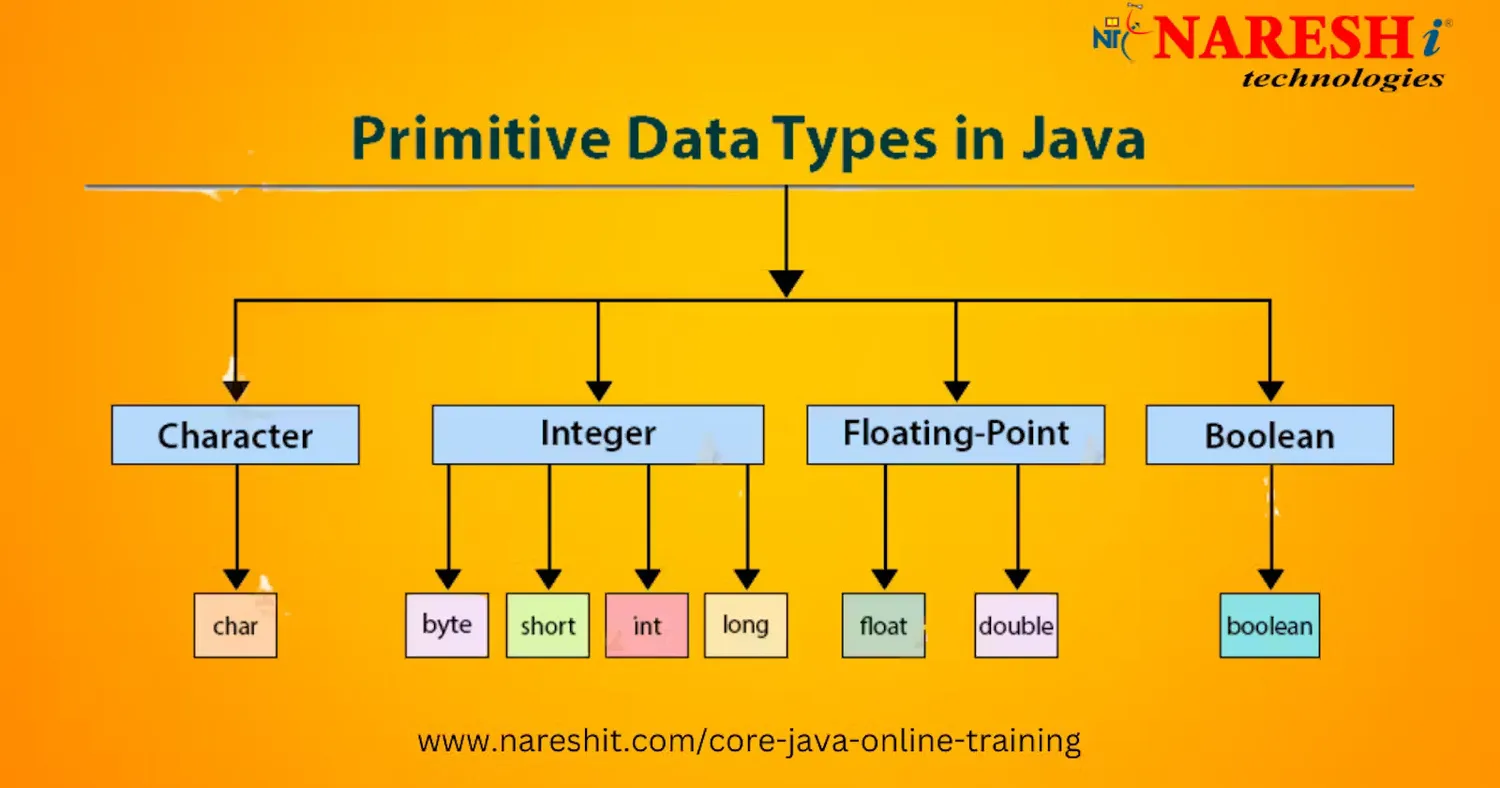
Types of Primitive Data Types Java has eight primitive data types: byte, short, int, long, float, double, char, and boolean. Each serves a specific purpose and has a distinct range and size. They can be grouped into four main categories: Character, Integer, Floating-Point, and Boolean.
Character:
char:
Size: 16 bits Range: 0 to 65,535 (unsigned) Usage: Used to store any single character or Unicode character. Ideal for storing letters, numbers, and symbols.
Integer:
byte: Size: 8 bits
Range: -128 to 127
Usage: Useful for saving memory in large arrays where the memory savings are critical.
short:
Size: 16 bits
Range: -32,768 to 32,767
Usage: Like byte, used to save memory in large arrays with more significant range requirements.
int:
Size: 32 bits
Range: -2^31 to 2^31-1
Usage: Default data type for integer values unless there are memory constraints.
long:
Size: 64 bits
Range: -2^63 to 2^63-1
Usage: When a wider range than int is needed.
Floating-Point:
float: Size: 32 bits
Range: Approximately ±3.40282347E+38F (6-7 significant decimal digits)
Usage: Used for single-precision floating-point arithmetic. Suitable for saving memory in large arrays of floating-point numbers.
double:
Size: 64 bits
Range: Approximately ±1.79769313486231570E+308 (15 significant decimal digits) Usage: Default data type for decimal values, for precision-oriented calculations.
Boolean:
boolean: Size: 1 bit
Values: true or false
Usage: For simple flags that track true/false conditions. Used in conditional statements and control flow. Importance of Primitive Data Types Primitive data types are the building blocks of data manipulation in Java. They provide a means to create variables that store simple values, which can then be used in operations, expressions, and control structures. Each type has its unique properties and use cases, enabling efficient memory management and performance optimization.
Conclusion Understanding Java's primitive data types is crucial for effective programming. They are the foundation upon which more complex data structures are built. Mastering their use and characteristics is a fundamental step in becoming proficient in Java.
For More Details Visit : Core Java Online Training - NareshIT
For Free Demo on UpComing Batches : https://nareshit.com/new-batches