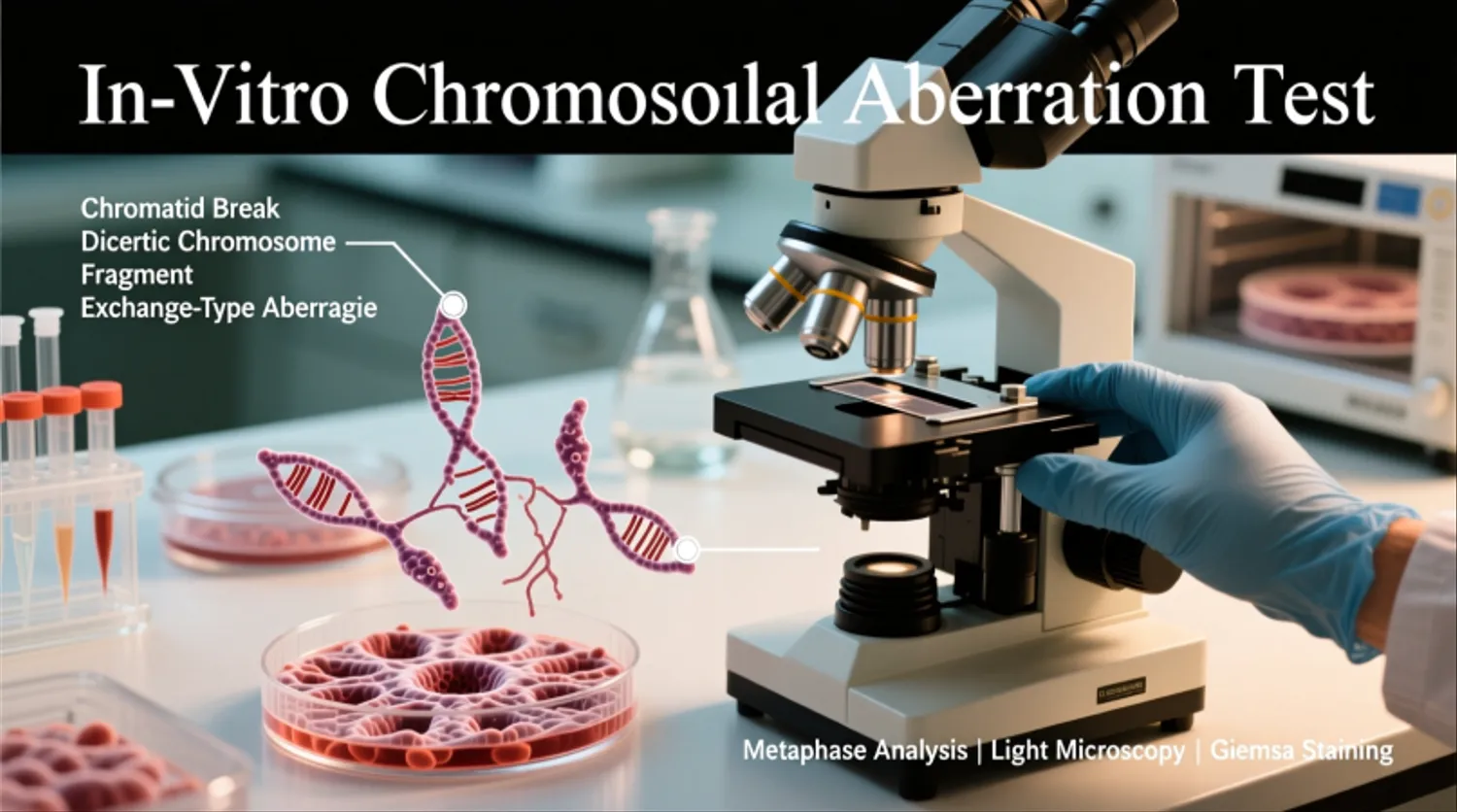
The Chromosome Aberration Test is a fundamental in-vitro assay used to evaluate the potential of chemicals, nanoparticles, and environmental agents to cause structural changes in chromosomes. By examining metaphase cells under a light microscope, researchers can detect aberrations that signal genotoxic activity. This test plays a vital role in understanding the risks of carcinogenicity, mutagenicity, and heritable genetic defects caused by exposure to hazardous agents.
In this blog, we explore the aim, learning objectives, theoretical background, methodology, and applications of the Chromosome Aberration Test, highlighting why it remains an essential tool in genetic toxicology and regulatory science.
General Aim of the Chromosome Aberration Test
The primary aim of the Chromosome Aberration Test is to detect structural chromosomal aberrations by scoring various classes of chromosome changes in metaphase cells under a light microscope. This enables scientists to evaluate whether a test substance induces breaks, gaps, exchanges, or rearrangements in chromosomal structures.
Learning Objectives of the Chromosome Aberration Assay
By the end of the in-vitro mammalian Chromosome Aberration Test, postgraduate students and researchers should be able to:
- Handle the instruments and consumables required for the assay.
- Check confluence and count cells accurately under a microscope.
- Dilute cells to a defined concentration suitable for seeding in culture plates.
- Calculate chemical concentrations and prepare test doses in culture medium.
- Treat cells with genotoxic agents or nanoparticles and monitor changes.
- Harvest, fix, and stain cells using Giemsa stain.
- Analyze chromosomes in metaphase using a light microscope.
- Interpret and represent data graphically, for example, with dot plots.
These objectives ensure that students gain practical laboratory skills and a deeper understanding of cellular genotoxicity testing.
Theoretical Background
1. Genotoxicity vs. Mutagenicity
Genotoxicity refers to the ability of a substance to damage genetic material, potentially leading to mutations or cancer. While all mutagens are genotoxic, not all genotoxic substances are mutagenic. For example, some compounds may cause DNA damage without inducing mutations directly.
Genotoxic events include:
- DNA strand breaks
- Base modifications
- Pyrimidine dimers (from UV exposure)
- DNA cross-links
- Imbalances in nucleotide pools
- Generation of reactive oxygen species (ROS)
Cells attempt to repair this damage through DNA repair pathways or eliminate the damaged cell via apoptosis. However, incomplete or incorrect repair can result in chromosomal aberrations and mutagenesis.
2. Types of Chromosomal Aberrations
Chromosomal mutations fall into two broad categories:
- Structural aberrations: alterations in chromosome structure, including breaks, deletions, inversions, translocations, or duplications.
- Numerical aberrations: changes in chromosome number, such as aneuploidy or polyploidy.
The Chromosome Aberration Test focuses on structural changes visible during metaphase.
3. Environmental and Chemical Relevance
Genotoxic agents present in the environment, industrial chemicals, and nanoparticles can trigger chromosomal mutations. Such aberrations are closely associated with cancer development, congenital anomalies, and heritable genetic disorders.
Principle of the Chromosome Aberration Test
The Chromosome Aberration Test is based on analyzing cultured mammalian cells treated with a test substance. During metaphase, when chromosomes are condensed and visible under a microscope, aberrations such as breaks, gaps, or rearrangements can be scored.
The principle relies on whether one or both chromatids in a metaphase chromosome are involved in the aberration. These structural alterations are then categorized and quantified to determine the genotoxic potential of the tested agent.
Step-by-Step Methodology of the Chromosome Aberration Test
The procedure involves several key steps:
1. Cell Culture Preparation
- Mammalian cells are cultured under controlled conditions until they reach appropriate confluence.
- The cells are counted using a hemocytometer or automated counter.
- Dilution is performed to obtain the correct cell density for seeding in 24-well plates.
2. Treatment with Test Substance
- Test chemicals, drugs, or nanoparticles are prepared at calculated concentrations in culture medium.
- Cells are treated for a defined period, allowing interaction with the genetic material.
3. Harvesting Cells
- Following treatment, cells are harvested at metaphase, when chromosomes are maximally condensed.
- Mitotic arrest is often induced using colchicine or a similar spindle inhibitor.
4. Fixation and Staining
- Cells are fixed using a fixative such as methanol-acetic acid.
- Chromosomes are stained with Giemsa stain, which provides contrast for microscopic analysis.
5. Microscopic Analysis
- Metaphase spreads are examined under a light microscope.
- Structural aberrations are scored, including:
- Chromatid breaks
- Chromosome gaps
- Chromatid exchanges
- Ring chromosomes
- Dicentric chromosomes
6. Data Representation
- Results are quantified as the frequency of aberrations per number of metaphase cells.
- Data can be visualized using dot plots, bar charts, or frequency distributions.
Applications of the Chromosome Aberration Test
The Chromosome Aberration Test is a cornerstone in genetic toxicology, with wide-ranging applications:
- Regulatory Toxicology: Required by agencies such as the OECD and FDA for chemical and pharmaceutical safety assessments.
- Pharmaceutical Industry: Screening of new drugs to detect potential genotoxic side effects.
- Nanotoxicology: Evaluation of nanoparticles, which may interact with DNA and chromosomes.
- Environmental Monitoring: Detecting genotoxic pollutants in air, water, or soil.
- Cancer Research: Understanding mechanisms of chromosomal instability in tumor progression.
Advantages of the Chromosome Aberration Test
- Provides direct evidence of chromosomal damage.
- Applicable to a wide variety of mammalian cell types.
- Compatible with in-vitro testing guidelines, reducing the need for animal studies.
- Can detect both clastogenic and aneugenic effects (structural and numerical changes).
Limitations of the Chromosome Aberration Test
Despite its advantages, the method has certain limitations:
- Requires skilled personnel for accurate scoring of metaphase spreads.
- Time-consuming compared to rapid genotoxicity assays.
- Subjective interpretation of aberrations may introduce variability.
- May not detect all classes of DNA damage, requiring complementary assays (e.g., Comet assay or micronucleus test).
Significance in Genetic Toxicology
The Chromosome Aberration Test holds high significance as it provides mechanistic insights into how environmental chemicals and drugs interact with genetic material. By detecting clastogenic effects, it contributes to:
- Risk assessment for human health.
- Regulatory decisions on chemical approval.
- Preventive measures against exposure to carcinogens and mutagens.
It bridges the gap between molecular biology and toxicology, emphasizing the relevance of chromosomal stability to overall genome integrity.
Conclusion
The Chromosome Aberration Test is an essential in-vitro assay that detects structural changes in chromosomes caused by genotoxic agents. By carefully culturing cells, treating them with test substances, and analyzing metaphase chromosomes under a light microscope, researchers can evaluate the clastogenic potential of chemicals, drugs, or nanoparticles.
This experiment not only provides practical training in cytogenetic techniques but also contributes to global efforts in drug safety, environmental monitoring, and cancer prevention. Despite its labor-intensive nature, the Chromosome Aberration Test remains one of the most reliable tools in genetic toxicology, ensuring the protection of both human health and future generations.