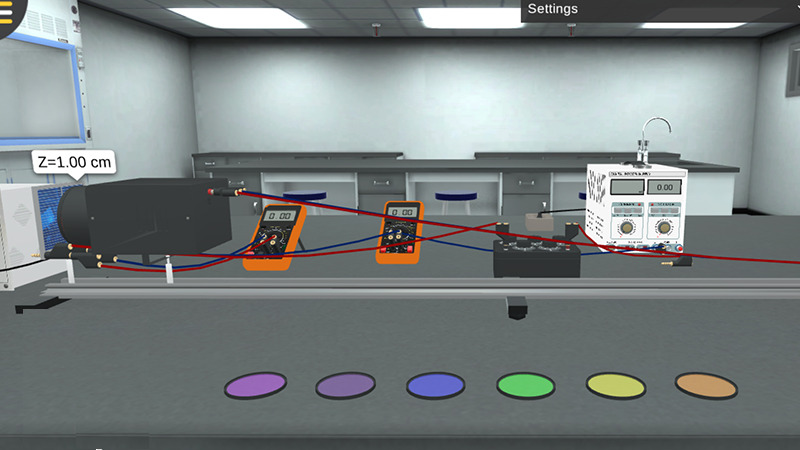
As the world transitions toward clean energy, understanding the science behind solar cells—also known as photovoltaic cells—has become more essential than ever. The Solar Cell Virtual Lab is a powerful educational tool that allows students, educators, and researchers to explore solar energy principles through interactive simulations, without the need for physical hardware or expensive laboratory setups.
What Is a Solar Cell Virtual Lab?
A solar cell virtual lab is a digital simulation environment that replicates the behavior and functionality of real solar panels and photovoltaic systems. It allows users to manipulate variables, observe system responses, and perform experiments that mirror real-world solar energy applications—all through a computer or web-based interface.
These labs are typically used in physics, renewable energy, and electrical engineering courses and often include modules that simulate:
- Solar panel configurations
- Light intensity and angle variations
- Load resistance and circuit integration
- Current-voltage (I-V) characteristics
- Efficiency measurements under different conditions
Why Use a Solar Cell Virtual Lab?
- Accessibility for All Learners
Anyone with a computer and internet access can explore the core concepts of photovoltaic energy—making learning inclusive and scalable. - Safe, Risk-Free Learning
Unlike physical labs, there's no danger from high voltages, weather conditions, or handling complex circuits. - Cost-Effective
Schools and institutions can save money on expensive solar panels, meters, and lab tools. - Real-Time Feedback
Virtual labs provide instant analysis of data, visual graphs, and explanations that help students learn faster. - Customizable Variables
Learners can control the environment: adjusting sunlight angle, intensity, temperature, and material properties to see how each factor impacts efficiency.
Key Concepts Explored in Solar Cell Virtual Labs
A high-quality solar cell simulation lab allows users to experiment with:
- Photoelectric Effect: Understanding how photons convert to electric current.
- Semiconductor Behavior: Investigating how materials like silicon create p-n junctions.
- I-V and P-V Curves: Measuring current and power output as voltage varies.
- Series and Parallel Connections: Exploring how configuration impacts total output.
- Shadow Effects: Observing how partial shading reduces panel efficiency.
- Temperature Dependence: Seeing how panel performance changes in hot or cold conditions.
Educational Benefits
Solar cell virtual labs are suitable for:
- High school physics and environmental science students
Introducing the basics of renewable energy and electricity. - University-level engineering or energy programs
Offering deeper simulations including electrical load balancing, MPPT (Maximum Power Point Tracking), and material science. - STEM outreach and online learning platforms
Providing hands-on experience in distance education or hybrid learning models.
PraxiLabs and Virtual Renewable Energy Experiments
PraxiLabs, a leader in 3D virtual science labs, offers interactive renewable energy modules that include solar cell virtual labs. With user-friendly interfaces, immersive visual environments, and integrated theory content, PraxiLabs allows learners to:
- Simulate photovoltaic experiments step by step
- Adjust environmental variables in real time
- Analyze and interpret experimental data
- Apply theoretical knowledge in practical contexts
- Track progress with assessments and quizzes
These labs are aligned with educational standards and can be integrated into classroom teaching or used for independent learning.
Conclusion
The Solar Cell Virtual Lab is a revolutionary tool for teaching and learning about photovoltaic systems and renewable energy. Whether you're a student exploring green technologies, a teacher looking for dynamic lab alternatives, or an institution transitioning to e-learning, solar cell simulations provide a complete, safe, and cost-efficient learning experience. Embrace the future of clean energy education—one virtual experiment at a time.