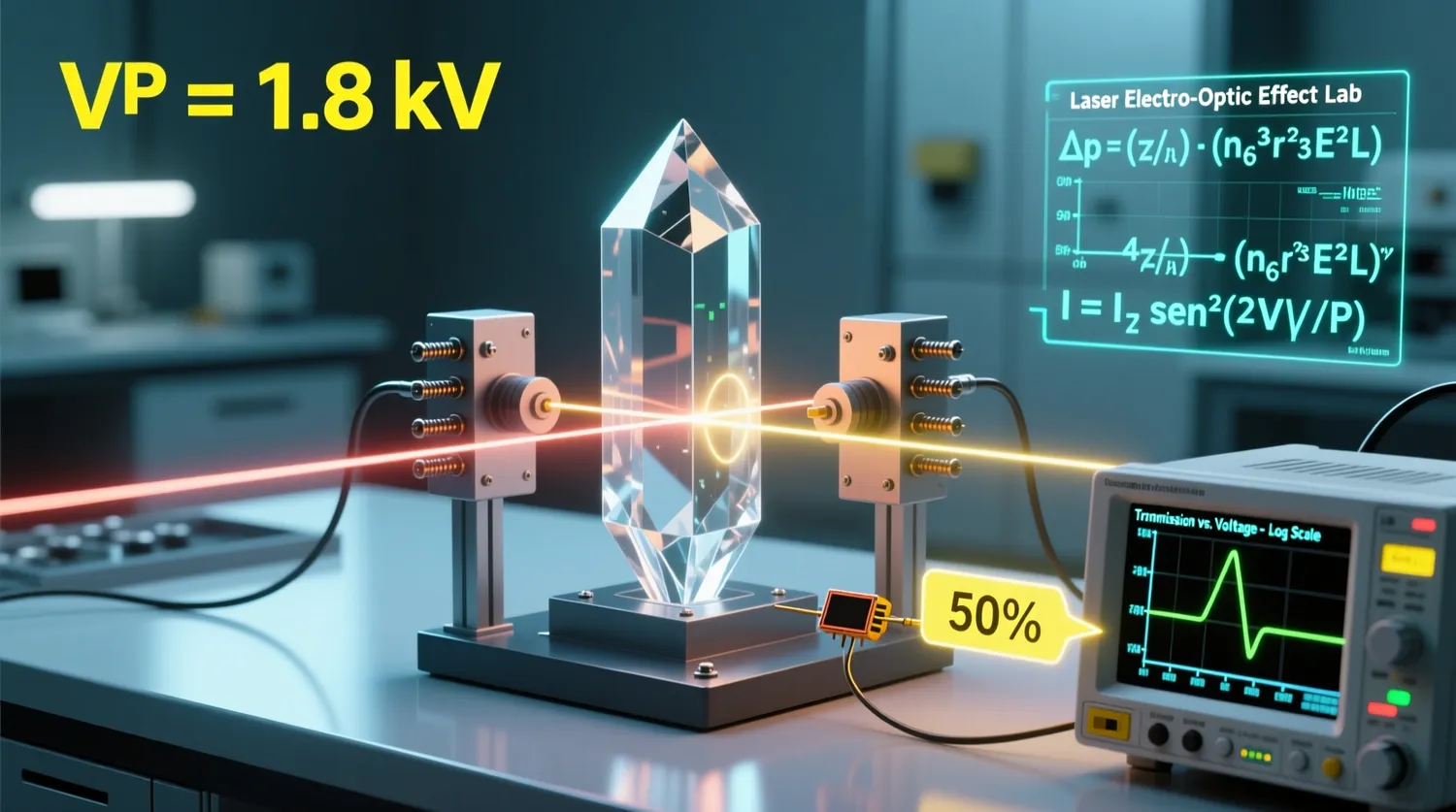
The study of light and its interaction with matter is a cornerstone of modern physics. Among the fascinating phenomena in optics is the electro-optic effect, which lies at the heart of several advanced technologies such as modulators, optical switches, and communication devices. With the emergence of simulation-based education, the Laser Optics Virtual Lab offers students an interactive environment to explore this effect without the need for expensive laboratory equipment.
In this blog, we’ll explore the aim, objectives, theoretical background, methodology, and significance of the Laser Optics Virtual Lab, focusing on the electro-optic effect in lithium niobate crystals using a Kerr cell procedure.
General Aim of the Laser Optics Virtual Lab
The primary aim of the Laser Optics Virtual Lab is to study the electro-optic effect in crystals, particularly lithium niobate, by simulating real-world optical experiments. This virtual lab allows students to visualize and measure how applied electric fields influence the optical properties of materials, deepening their understanding of laser physics and crystal optics.
Learning Objectives (ILOs)
By completing the Laser Optics Virtual Lab, students will be able to:
- Explain the electro-optic effect in a lithium niobate crystal and its applications.
- Set up a virtual optical experiment to study birefringence induced by an electric field.
- Determine the half-voltage value of electro-optic crystals by analyzing experimental data.
- Strengthen their knowledge of polarized light, phase shifts, and laser optics in a modern physics context.
These objectives combine theoretical insight with hands-on virtual practice, helping students connect concepts with experimental application.
Theoretical Background
1. The Electro-Optic Effect
The electro-optic effect refers to the change in a material’s refractive index under an applied electric field. This effect can be classified into two main types:
- Pockels Effect (linear electro-optic effect): The change in refractive index is proportional to the electric field.
- Kerr Effect (quadratic electro-optic effect): The change is proportional to the square of the electric field.
In the Laser Optics Virtual Lab, the focus is on the Kerr effect, where the application of an electric field to a birefringent crystal such as lithium niobate alters the polarization state of transmitted light.
2. Light and Birefringence
When monochromatic polarized light (laser beam) passes through a birefringent material, it splits into two rays: the ordinary and extraordinary rays. A phase shift occurs between them due to their different refractive indices. By applying an electric field, the birefringence changes, allowing the phase shift to be controlled precisely.
3. Half-Voltage Concept
The half-voltage (Vπ) is the voltage required to induce a phase shift of π (180°) between the ordinary and extraordinary components of light. Determining this value is crucial in designing electro-optic modulators and other optical devices.
Principle of Work in the Laser Optics Virtual Lab
The experiment simulates the setup of a laser optics system where:
- A laser beam is polarized at 45° to the vertical and directed at a lithium niobate crystal.
- An electric field is applied across the crystal, causing it to become birefringent.
- The induced birefringence leads to a phase shift between the ordinary and extraordinary light waves.
- The transmitted light intensity changes as a function of the applied electric field.
- A photosensor detects the emerging light, and the intensity is plotted against the applied voltage.
- From this data, the half-voltage value of the crystal is determined.
This principle mimics real-world optical physics experiments, but in a safe and cost-effective digital environment.
Methodology of the Laser Optics Virtual Lab
Step 1: Simulation Setup
- Open the Laser Optics Virtual Lab simulation environment.
- Select the lithium niobate crystal as the electro-optic material.
- Align the incident laser beam at 45° polarization.
Step 2: Application of Electric Field
- Apply a gradually increasing electric field across the crystal.
- Observe how the birefringence of the crystal changes with the field strength.
Step 3: Observation and Measurement
- Use the virtual photosensor to measure the intensity of transmitted light.
- Record data for different values of applied voltage.
Step 4: Determining Half-Voltage
- Analyze the graph of transmitted intensity vs. electric field.
- Identify the point at which a phase shift of π occurs.
- Calculate the half-voltage (Vπ) value of the crystal.
Step 5: Data Representation
- Represent the data graphically, typically using dot plots or sinusoidal curves, to illustrate how light transmission varies with applied voltage.
Applications of Electro-Optic Effect
The Laser Optics Virtual Lab not only helps students understand the electro-optic effect but also emphasizes its applications in real-world technologies, including:
- Electro-Optic Modulators (EOMs): Used in optical communication systems to modulate laser signals.
- Optical Switches: For routing light signals in fiber optic networks.
- Laser Q-Switching: Enabling pulsed laser generation with high peak power.
- Adaptive Optics: Correcting wavefront distortions in advanced imaging and telescopes.
- Electro-Optic Sensors: For detecting and measuring electric fields with high precision.
Advantages of Using the Laser Optics Virtual Lab
- Accessibility: Students can explore complex laser optics experiments without access to costly equipment.
- Safety: Eliminates the risks associated with handling high-voltage devices and delicate crystals.
- Interactivity: Provides a hands-on learning experience in a virtual environment.
- Visualization: Makes abstract optical phenomena easier to grasp through real-time simulation.
- Scalability: Enables multiple students to learn simultaneously without laboratory space constraints.
Limitations of Virtual Simulation
While the Laser Optics Virtual Lab provides many benefits, it cannot fully replace traditional laboratory work. Limitations include:
- Lack of tactile interaction with physical instruments.
- Possible oversimplification of real-world experimental challenges such as noise, alignment errors, and crystal imperfections.
- Dependence on computer access and simulation software.
Nonetheless, virtual labs are an excellent complement to traditional learning, preparing students for hands-on experimentation with stronger conceptual foundations.
Educational Significance
The Laser Optics Virtual Lab is not just a substitute for a physical lab—it is a powerful teaching tool. By simulating modern optical experiments, it allows learners to:
- Grasp the relationship between electric fields and light behavior.
- Connect theory with experiment in advanced physics.
- Develop computational and analytical skills in handling experimental data.
This combination of theory and practice enhances students’ readiness for careers in optics, photonics, and applied physics.
Conclusion
The Laser Optics Virtual Lab provides a unique opportunity for students to study the electro-optic effect in crystals, particularly lithium niobate, through an interactive digital platform. By simulating the Kerr cell procedure, learners can observe how electric fields induce birefringence, measure transmitted light intensity, and determine the half-voltage of crystals.
This experiment bridges the gap between theoretical optics and practical applications, offering insights into technologies like electro-optic modulators, optical communication systems, and adaptive optics. Although it cannot entirely replace physical labs, the Laser Optics Virtual Lab enriches learning by making advanced laser optics experiments accessible, safe, and engaging.
By mastering this simulation, students not only understand the electro-optic effect but also gain valuable skills that connect physics theory with real-world technological innovation.