The Indole Test in microbiology is a vital biochemical assay used to determine an organism’s ability to produce indole from the amino acid tryptophan. It is commonly employed as part of the IMViC test series (Indole, Methyl Red, Voges-Proskauer, and Citrate tests), especially in the identification of Enterobacteriaceae. Quick, simple, and highly informative, the Indole Microbiology Test plays a critical role in differentiating between bacterial species in clinical, environmental, and educational laboratories.
What Is the Indole Test?
The indole microbiology test detects the presence of the enzyme tryptophanase, which breaks down tryptophan into indole, pyruvate, and ammonia. When Kovac’s reagent or Ehrlich’s reagent is added to a culture that contains indole, it reacts to form a red or pink-colored compound on the surface of the medium—indicating a positive test result.
Principle of the Indole Test
The biochemical reaction involved is:
Tryptophan → Indole + Pyruvate + Ammonia
In the presence of Kovac’s reagent (which contains p-dimethylaminobenzaldehyde, HCl, and amyl alcohol), the indole reacts to produce a red-colored compound known as rosindole, which forms a red layer at the top of the culture.
- Positive test: Red or pink layer appears.
- Negative test: No color change or a yellow layer remains.
Test Procedure
- Inoculate a tryptophan-rich medium such as tryptone broth with the test organism.
- Incubate at 35–37°C for 24–48 hours.
- Add 5 drops of Kovac’s reagent to the surface of the broth.
- Observe the color at the interface.
Interpretation of Results
- Positive (red or pink layer):
Organism produces tryptophanase and forms indole.
Examples: Escherichia coli, Proteus vulgaris, Morganella morganii. - Negative (no red color):
Organism lacks tryptophanase.
Examples: Enterobacter cloacae, Klebsiella pneumoniae, Proteus mirabilis.
Applications in Microbiology
The indole test is widely used in:
- Clinical microbiology to differentiate E. coli (indole-positive) from other Enterobacteriaceae.
- Environmental microbiology to analyze bacterial presence in water or soil samples.
- Educational laboratories to teach students about microbial metabolism and identification.
- Industrial microbiology to assess contamination and strain characterization.
Benefits of the Indole Test
- Quick and simple procedure
- High specificity for certain genera/species
- Low cost and minimal equipment needed
- Essential component of the IMViC test battery
Virtual Indole Test Labs
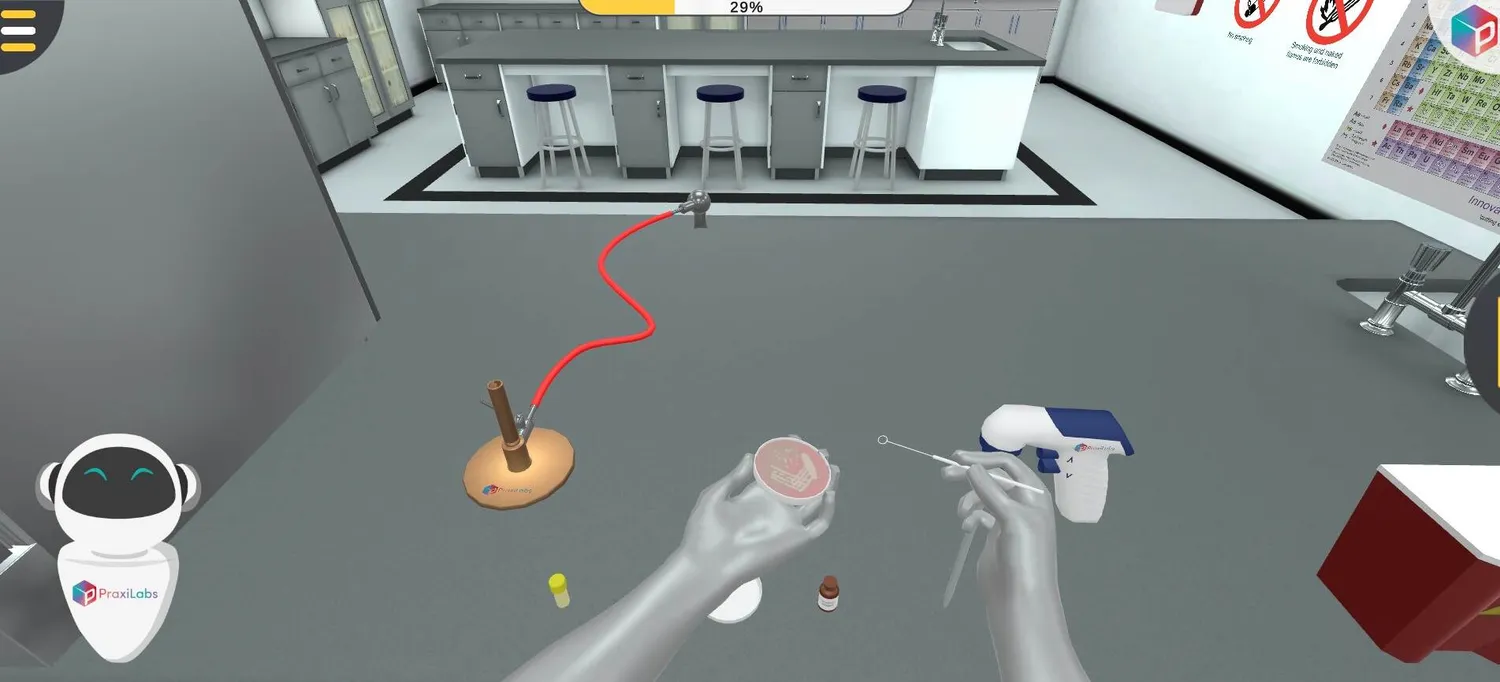
Modern students and institutions are increasingly using virtual labs for microbiology, including the indole test simulation. Platforms like PraxiLabs offer immersive, 3D simulations that allow learners to:
- Perform the indole test step-by-step
- Apply reagents and interpret color reactions
- Receive real-time feedback and assessments
- Access detailed theory and learning objectives
- Practice lab safety without real biohazard exposure
These virtual microbiology labs are ideal for e-learning, remote education, and institutions without full lab facilities.
Conclusion
The Indole Microbiology Test remains one of the most valuable tools for bacterial identification and classification. Whether conducted in a physical lab or simulated through a virtual platform, this test helps microbiologists detect key metabolic traits in bacteria. As education and diagnostics evolve, the use of virtual indole test labs will continue to support deeper learning and broader access to essential microbiological techniques.