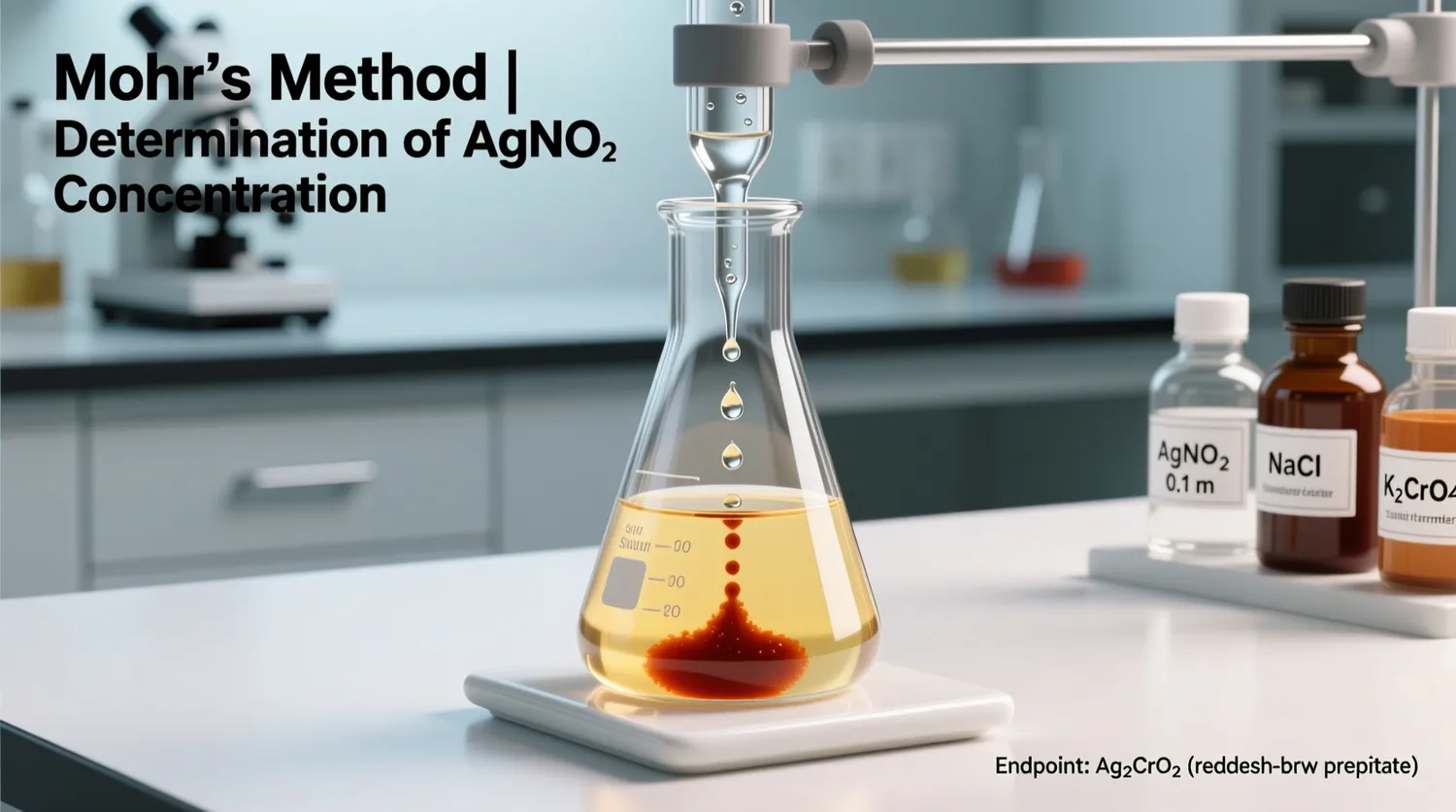
The determination of ionic concentrations through titration is one of the most fundamental techniques in analytical chemistry. Among the different volumetric analysis methods, Mohr’s Method stands out as a classical and widely taught procedure for determining chloride ion concentrations through argentometric titration. In this experiment, students use Mohr’s Method to determine the concentration of silver nitrate (AgNO₃) using a standard sodium chloride (NaCl) solution.
This blog provides an in-depth explanation of the general aim, learning objectives, theoretical background, principles, and applications of Mohr’s Method, offering a clear understanding of why this technique remains essential in chemistry education and research.
General Aim of Mohr’s Method
The primary aim of Mohr’s Method is to determine the concentration of a silver nitrate solution by titrating it against a standard sodium chloride solution. This process is based on the principle of precipitimetry, where an insoluble salt (AgCl) is formed as a reaction product, and the endpoint of the titration is detected with the help of chromate indicator.
Learning Objectives of Mohr’s Method
By the end of this experiment, students should be able to:
- Analyze silver nitrate solution by performing Mohr’s Method titration.
- Understand the principles of argentometric titration in a laboratory setting.
- Explain the theoretical basis of precipitimetry and solubility product (Ksp).
- Detect endpoints accurately using potassium chromate as an indicator.
These learning outcomes equip students with both practical laboratory skills and theoretical insights, reinforcing their knowledge of quantitative chemical analysis.
Theoretical Background
1. Precipitimetry
Precipitimetry is a type of volumetric analysis in which the endpoint is determined by the formation of a practically insoluble salt. In Mohr’s Method, silver nitrate (AgNO₃) reacts with sodium chloride (NaCl) to produce silver chloride (AgCl), a white precipitate that is nearly insoluble in water.
2. Solubility Product (Ksp)
The concept of solubility product (Ksp) plays an important role in understanding why precipitation occurs. For a sparingly soluble salt, the product of ion concentrations raised to the power of their stoichiometric coefficients is constant at a given temperature:
Ksp=[A]n[B]mK_{sp} = [A]^n [B]^mKsp=[A]n[B]m
A salt with a lower Ksp will precipitate before one with a higher Ksp under similar conditions.
3. Requirements for Precipitimetry Reactions
For Mohr’s Method to work effectively, certain conditions must be met:
- The precipitate must be practically insoluble.
- Precipitation should occur rapidly and completely.
- The endpoint must be easy to detect with a suitable indicator.
Principle of Mohr’s Method
Mohr’s Method is a direct argentometric titration where chloride ions are titrated against a standard silver nitrate solution. The process takes place in a neutral or slightly alkaline medium, as acidic or strongly basic conditions can interfere with the reaction.
The reaction between sodium chloride and silver nitrate forms a white precipitate of silver chloride:
NaCl+AgNO3→NaNO3+AgCl(precipitate)NaCl + AgNO_3 → NaNO_3 + AgCl (precipitate)NaCl+AgNO3→NaNO3+AgCl(precipitate)
Once all chloride ions are consumed, the next drop of excess AgNO₃ reacts with the potassium chromate (K₂CrO₄) indicator, producing a brick-red precipitate of silver chromate (Ag₂CrO₄). This reddish-brown color change marks the endpoint of the titration.
2Ag++CrO42−→Ag2CrO4(reddish−brownprecipitate)2Ag^+ + CrO_4^{2-} → Ag_2CrO_4 (reddish-brown precipitate)2Ag++CrO42−→Ag2CrO4(reddish−brownprecipitate)
Thus, the endpoint is detected visually when the first permanent reddish-brown color appears.
Step-by-Step Method of Mohr’s Method
1. Preparation of Solutions
- A standard sodium chloride (NaCl) solution of known molarity is prepared.
- The silver nitrate (AgNO₃) solution of unknown concentration is the titrant.
- Potassium chromate (K₂CrO₄) is used as an indicator.
2. Titration Procedure
- A measured volume of NaCl solution is transferred into a clean conical flask.
- A few drops of potassium chromate indicator are added. The solution turns yellow.
- The AgNO₃ solution is taken in a burette and slowly added to the flask while swirling.
- AgNO₃ reacts with NaCl to form AgCl precipitate until all chloride ions are consumed.
- The first excess drop of AgNO₃ reacts with chromate ions, forming reddish-brown Ag₂CrO₄ precipitate.
- The endpoint is noted as the appearance of this permanent brick-red color.
3. Calculations
The concentration of silver nitrate solution is calculated using the titration formula:
N1V1=N2V2N_1 V_1 = N_2 V_2N1V1=N2V2
Where:
- N1N_1N1 = Normality of NaCl (standard)
- V1V_1V1 = Volume of NaCl used
- N2N_2N2 = Normality of AgNO₃ (unknown)
- V2V_2V2 = Volume of AgNO₃ used
Advantages of Mohr’s Method
- Direct and Simple: Mohr’s Method is straightforward, making it ideal for student laboratories.
- Visual Endpoint Detection: The use of chromate indicator provides a clear, distinct color change.
- High Accuracy: Under controlled conditions, it provides reliable quantitative results.
- Educational Value: It demonstrates the concepts of precipitimetry, solubility product, and titration principles effectively.
Limitations of Mohr’s Method
While Mohr’s Method is widely used, it does have some limitations:
- Requires a neutral medium; acidic solutions dissolve AgCl, while alkaline solutions precipitate silver hydroxide.
- The endpoint may be difficult to detect in colored solutions.
- Interfering ions (such as bromides, iodides, or carbonates) can affect accuracy by forming precipitates with silver.
Applications of Mohr’s Method
The Mohr’s Method has practical applications across chemistry, environmental science, and industry:
- Water Quality Testing: Determining chloride concentration in drinking water and industrial effluents.
- Food Industry: Measuring salt content in processed foods and brines.
- Pharmaceuticals: Estimation of chloride levels in medicinal compounds.
- Environmental Monitoring: Checking salinity levels in rivers, lakes, and groundwater.
- Research and Education: Serving as a foundational experiment in analytical chemistry laboratories.
Significance in Analytical Chemistry
Mohr’s Method is a classic example of how simple chemical principles can be applied to real-world measurements. It highlights the importance of:
- Indicators in detecting endpoints.
- Stoichiometry in quantitative chemical analysis.
- Ion interactions governed by solubility products.
By performing this experiment, students gain practical skills in titration techniques and reinforce their theoretical understanding of chemical equilibria and precipitation reactions.
Conclusion
The Mohr’s Method remains a vital experimental technique in analytical chemistry for the determination of chloride ions and the concentration of silver nitrate solutions. Through its straightforward procedure, reliance on precipitimetry, and clear visual endpoint, it continues to be an invaluable teaching tool in laboratories worldwide.
By the end of the Mohr’s Method titration experiment, students not only learn to analyze silver nitrate solutions but also gain a deeper appreciation for the principles of solubility, precipitation, and stoichiometry. Despite its limitations, the method’s educational and practical value make it a cornerstone of quantitative chemical analysis.