A fixed deposit, often abbreviated as an FD, is an investment instrument furnished by banks and non-banking financial companies (NBFCs) to their patrons to help them save money. With a fixed deposit, you can put your hard-earned funds to work while producing returns at an interest rate determined previously.
What makes FDs popular?
A fixed deposit is a financial instrument wherein you park a certain amount of money with an institution, like a bank, for a definite period at a fixed rate of return. Since there is an element of guarantee of the return without risking the capital, it remains one of India's most popular forms of investment. The returns are taxable but not market-linked. The rate of interest is determined by banks and other NBFCs depending on their liquidity requirement.
More reasons that make FDs popular are:
- There is no fixed amount or tenure for the deposit. You can choose any date and amount based on your requirement.
- FDs ensure safe and assured returns.
- Fixed deposits are easily understandable.
- FDs can easily be broken in case of an emergency without minutes and are often used for parking emergency funds.
Apart from this, a regular FD is a savings strategy that presents greater returns (high FD rates) than a savings account.
Most common types of fixed deposits:
India has multiple types of fixed deposits. The most common types are listed below:
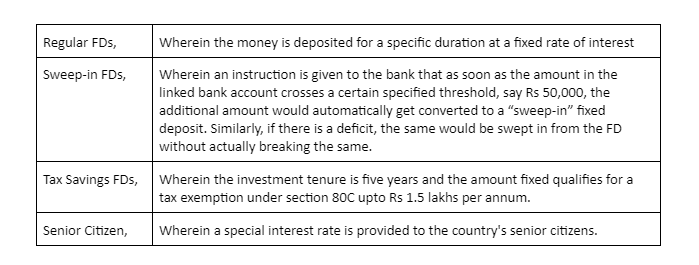
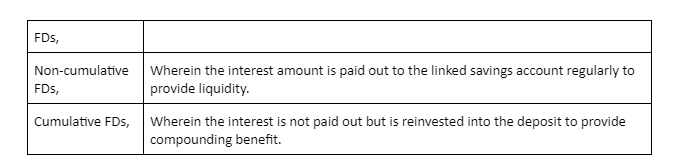
Why Fixed Deposits over other investment schemes?
- Assured Returns:
Fixed deposit returns are predetermined based on the existing FD rates in the market. The banks always honour their commitment to their customers regarding the interest rate. Hence, the investor assumes no risk when there are guaranteed returns. - Interest Rates:
Due to high FD rates, your funds generate more earnings if you put them in an FD instead of a standard savings account. A corporate fixed deposit also allows you to earn more income because the interest rates are often greater than those offered by most banks. All you have to do is research and determine which bank or NBFC offers the best FD rate. - Loan Against Fixed Deposits:
You do not have to break your fixed deposit prematurely in any emergency. Instead, FDs allow you to borrow against it and to continue receiving interest as per the best FD rate (chosen by you) on the principal. Most banks and NBFCs only permit you to use up to 90% of your FD as security for the loan. - Magic of Compounding:
Compound interest, which implies that you will earn interest on both the principal amount and the interest you earn, will benefit you if you pick an FD with a reinvestment option. - Customisable:
There is no maximum cap to open an FD; you may do so for as little as Rs. 5,000. However, the full amount you can invest in an FD is not restricted. - Tax Benefits:
If you choose to invest in tax-saving FDs, you can avail of tax benefits u/s 80C of the Income Tax Act upto Rs 1,50,000 per year. However, these fixed deposits have a lock-in period of 5 years.
How to plan your future with fixed deposits?
To plan your future with Fixed Deposits, you need to plan your investment and your withdrawal. Here are the steps you need to follow to plan your future with fixed deposits.
- Tenure:
Decide the tenure for your investments and when you need to start withdrawing the money so that there is no penalty levied on the same. - Taxation:
Interest accumulation of more than Rs 10,000 per annum is subject to TDS deduction. However, you can choose to submit Form 15G (Form 15H for senior citizens) if you do not wish TDS to be deducted. However, you still need to declare the same when you file the taxes. - Withdrawal frequency:
You need to decide when you need to withdraw the money. In fixed deposits, you can choose to opt for interest payout on a quarterly or annual basis.
Conclusion:
You may thus open a Fixed Deposit Account at any bank offering the best RD rate to plan your future accordingly. Fixed deposits are considered a safe investment as it provides a guaranteed return and it is a trusted instrument amongst the plethora of investment products available in the market.