Human Resource Management is entering a new phase as Generative AI becomes part of everyday business operations. Earlier, HR teams spent significant time on repetitive administrative work. Today, AI helps automate many of these activities, allowing HR professionals to focus more on strategy, employee development, and business growth.
This shift does not reduce the importance of HR professionals. Instead, it changes the skills they need to succeed. Future HR leaders must understand how to use AI responsibly while continuing to build strong workplace relationships.
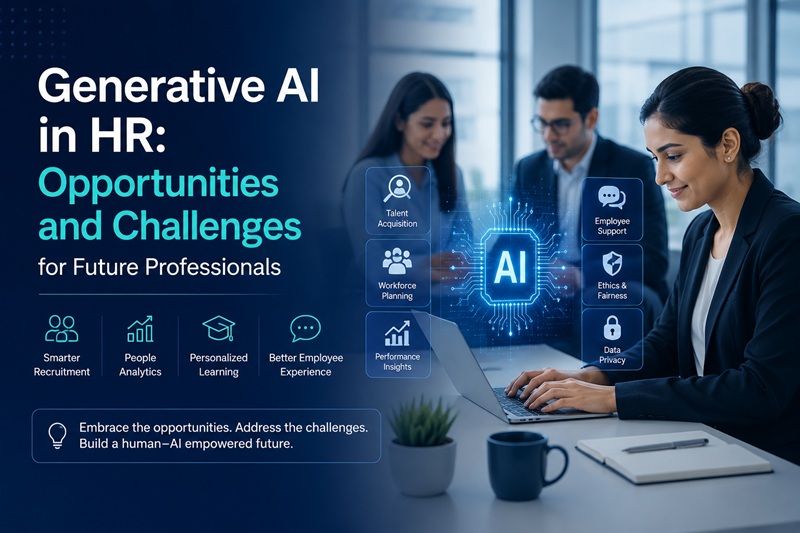
How Generative AI Is Changing HR
Generative AI supports HR teams throughout the employee lifecycle. It helps organizations complete routine tasks more efficiently and provides insights that support better decision-making.
AI is being used for:
- Writing job descriptions
- Screening resumes
- Scheduling interviews
- Creating employee learning content
- Preparing HR reports
- Answering employee queries through chatbots
- Supporting workforce planning
These applications save time and improve operational efficiency.
Opportunities for Future HR Professionals
AI is creating new opportunities for professionals who combine technology awareness with people management skills.
Better Recruitment Decisions
AI helps recruiters review applications quickly and identify candidates whose skills match job requirements. This allows HR teams to spend more time interacting with shortlisted candidates and evaluating cultural fit.
Personalized Employee Learning
Generative AI can recommend learning resources based on an employee's role, performance, and career goals. This supports continuous learning and helps organizations develop future-ready talent.
Smarter Workforce Planning
AI helps HR teams analyse workforce data, identify skill gaps, and forecast future hiring needs. These insights support long-term business planning.
Improved Employee Experience
AI-powered chatbots provide instant responses to common employee questions related to leave policies, benefits, and company procedures. This improves employee satisfaction while reducing administrative workload.
Challenges That HR Professionals Must Address
Although AI offers several advantages, it also presents important challenges.
Ethical Decision-Making
HR professionals must ensure that AI is used fairly and transparently. Decisions involving recruitment, promotions, and employee evaluation should always include human judgment.
Data Privacy
HR departments manage sensitive employee information. Protecting personal data and maintaining confidentiality remain essential responsibilities.
Bias in AI Systems
AI systems learn from existing data. If the training data contains bias, the system may produce unfair recommendations. HR professionals must regularly review AI-supported decisions to maintain fairness.
Building Trust
Employees are more likely to accept AI when organizations communicate openly about how it is being used. HR leaders play an important role in creating trust through transparency and responsible implementation.
Human Skills Will Remain Essential
Technology can improve efficiency, but it cannot replace human qualities that are central to effective HR management.
Future HR professionals should continue developing:
- Emotional intelligence
- Communication skills
- Leadership
- Conflict resolution
- Negotiation
- Coaching and mentoring
- Change management
These abilities help create positive workplace cultures and strong employee relationships.
Why HR Education Must Evolve
As AI becomes more common, management education must prepare students for digital workplaces. Students pursuing a PGDM in HR should develop an understanding of AI, HR analytics, workforce planning, digital transformation, and ethical decision-making alongside traditional HR concepts.
Practical learning through case studies, simulations, internships, and live projects helps students understand how technology supports business objectives while maintaining a people-first approach.
Preparing for the Future of HR
Organizations increasingly seek HR professionals who understand both business strategy and emerging technologies. Students pursuing a PGDM in Human Resource Management should focus on continuous learning, analytical thinking, communication, and leadership while becoming familiar with AI-powered HR tools.
Professionals who combine technical awareness with strong interpersonal skills will be better prepared to lead organizations through future workplace changes.
Final Thoughts
Generative AI is transforming Human Resource Management by improving efficiency, supporting better decisions, and creating new opportunities for strategic HR leadership. At the same time, ethical judgment, empathy, communication, and human-centered leadership remain essential qualities that technology cannot replace.
Vivekanand Business School (VBS) offers a future-focused PGDM in Human Resource Management that combines core HR principles with industry exposure, practical learning, leadership development, and emerging workplace trends. Through experiential learning, corporate interaction, and a career-oriented curriculum, VBS prepares students to become responsible HR professionals who can successfully lead people and organizations in the age of Artificial Intelligence.