Ursula K. Le Guin Retells the Aeneid
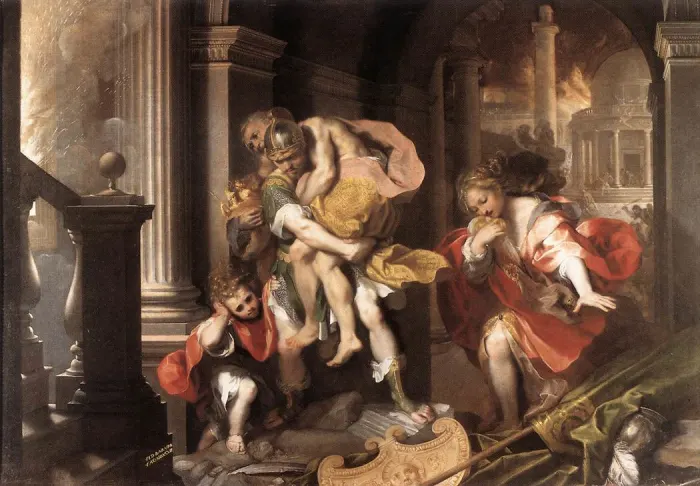
Most of the novel follows the course of events familiar to readers of the last few books of epic poem The Aeneid by Virgil. The perspective, however, is solely Lavinia’s, and this element shines a new light on an old story. The coming of Aeneas and his Trajan warriors, the queen’s madness, and the war Turnus sparks out of pride and jealousy all benefit from this perspective as it allows for more sustained character development. It also provides new insight into the larger-than-life characters from their presentation in Virgil's epic.
The last third of the book takes place after the events of Virgil’s work, and shows Lavinia as confident woman, loving wife and mother, and righteous queen that is missing from The Aeneid. Lavinia shines in this section, showing how her character has grown from the conflict of earlier pages, and a surprising tension is maintained as even readers familiar with Virgil’s epic will find uncharted territory in this part of the novel.
With a strange conceit, Le Guin also introduces the ghost of Virgil, which travels back in time to visit Lavinia and critique himself for some of the liberties he takes in writing his epic. This element makes a connection between the characters Lavinia and Virgil that informs them and the novel.
Narrative Flow
Since the story is essentially already written, Le Guin is free to concentrate on her craft and themes. The novel has a real cadence maintained by lengthy sentences. Since there are no chapter breaks, a reader can follow along with her prose uninterrupted for pages at a time without realizing it. Le Guin is at the apex of her stylistic control. In comparison, Margaret Atwood’s Penelopiad reads like an unfulfilled exercise that lacks the refined completeness and consistent voice found in Lavinia.
Feminist Fate
Le Guin returns to one of her favorite subjects: social differences between genders. Where the Aeneid is about men and arms, Lavinia examines the story from a Classical, female perspective. The distance between men and women is explored with the same thoroughness and even-temper she displays in The Left Hand of Darkness, Tombs of the Atuan, and Tehanu. In this novel, though, she has a real historical framework unlike the purely fictional worlds of the other stories. Nonetheless, the interactions between her characters ring true because they deal with real emotional tension.
Concurrent with her exploration of the roles of men and women Le Guin weaves into the story a question on the nature of fate. The titular heroine learns about her future from the ghost of Virgil—author of The Aeneid—and, as she is confronted with foretold events, ponders whether her choices matter as a human being and as a woman. These same thoughts trouble the ghost of Virgil, and lead the reader to question the consequences of fate and free will in much the same way as the Classical epics.
Though it helps to have a passing knowledge of The Aeneid to enjoy all of Lavinia, it is by no means a requirement. The book is a welcome addition to admirers of historical fiction in a Classic Roman setting, and fans of Le Guin will want to read the novel to see the author at the top of her game.
Source
Le Guin, Ursula. Lavinia. Boston: Mariner Books, 2008.
© 2010 Seth Tomko