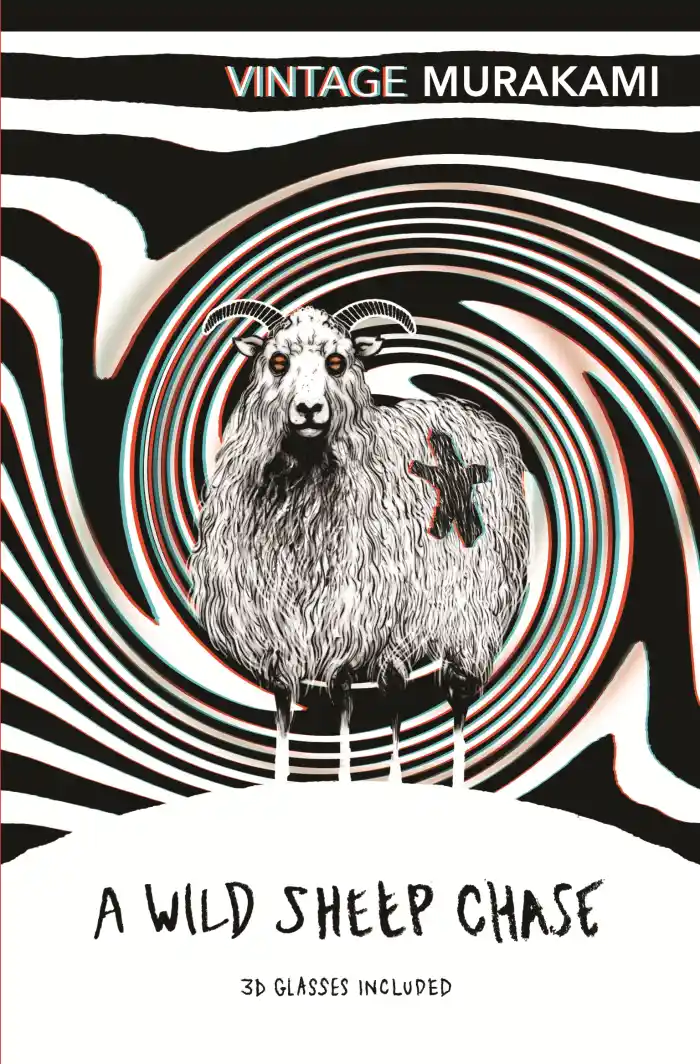
Do the Sheep Look Up?
The unnamed narrator feels stuck in his life as an ad man in 1970s Japan. Recently divorced, approaching 30, and without any direction in life, he already feels as though he is simply running out the clock. One day, however, he is contacted by “The Boss,” one of Japan’s political and social elites and most definitely not Bruce Springsteen. An ad the narrator recently created happens to be of a rural landscape picture that also includes a unique sheep with a dark star on its back. His agents claim this mysterious sheep is the reason that “The Boss” has been able to attain his wealth and position, and demands are made that the narrator track down this special sheep. Doing so will set the narrator up for life, but failure to find it will bring all the retribution “The Boss” can muster. Along with his new girlfriend—who has beautiful and arguably supernatural ears—the narrator begins his trip toward Hokkaido hoping to find the exact place in the photo, the sheep, and his old schoolmate who sent him the original image before disappearing.

The Absurd
A Wild Sheep Chase is an existentialist novel using the core of a detective story to give it shape and structure. As with many existentialist texts, it embraces the fundamental absurdity of the world, but Murakami also remembers that sometimes absurdism is funny. While not exactly a comedic novel, it has plenty of deadpan humor, especially in the first half of its page count. The author also makes sure to point out how life is absurd in its mundanity before it becomes absurd in its commitment to a ludicrous premise and the surreal and/or supernatural elements that materialize. The first-person narration comes across as oddly detached, as though the protagonist is disinterested in his own life or is trying to convince himself to be so. He accepts the off-beat weirdness that happens; the magical realism of the novel being no different to him than the general incongruity of everyday life in late 1970s Japan.
The pace can feel strange because even though there is a main plot, it does not really kick in until a third of the way into the novel, and even then, with a deadline and looming consequences for the protagonist, he reads as someone often disinterested, lethargic, or possibly depressed. Pacing turbulence also comes from conversational digressions that seems rambling sometimes but are thematically relevant, often in ways that are not always obvious at first. This technique might be a homage to a similar device found in classic Russian literature, which the characters mention, along with similar literary references to Moby-Dick and other, complex literary works.

Tripadvisor Scores for the Dolphin Hotel
Mileage will vary depending on readers’ tolerance, but A Wild Sheep Chase has some stylistic quirks that will not be for everyone. For instance, all of the characters are unnamed, which can cause some confusion when trying to sort out who is talking or performing actions sometimes. The amount of ambiguity, too, will bother some readers who simply want definitive answers to some aspects of the novel. Those members of the audience will be let down not only with an ending that is plenty ambiguous but also with much of the novel as a whole. Murakami dances with a lot of different genres—contemporary drama, amateur detective, horror—without ever really committing to any of them, a situation that will be exhilarating or irritating depending on the reader.
Take Me to the Sheep Professor
A Wild Sheep Chase is a fairly smooth read, and while not Murakami’s best novel, it is a good place to start for anyone interested in trying out his fiction. Many of the author’s stylistic choices are present: the effects of a person disappearing, surrealism, a dry tone, travel to strange locations, ambiguity, lost love, pop culture elements, critique of authority, and the complex relationship between memory and nostalgia.
Source
Murakami, Haruki. A Wild Sheep Chase. Translated by Alfred Birnbaum. Vintage, 2002.
© 2025 Seth Tomko