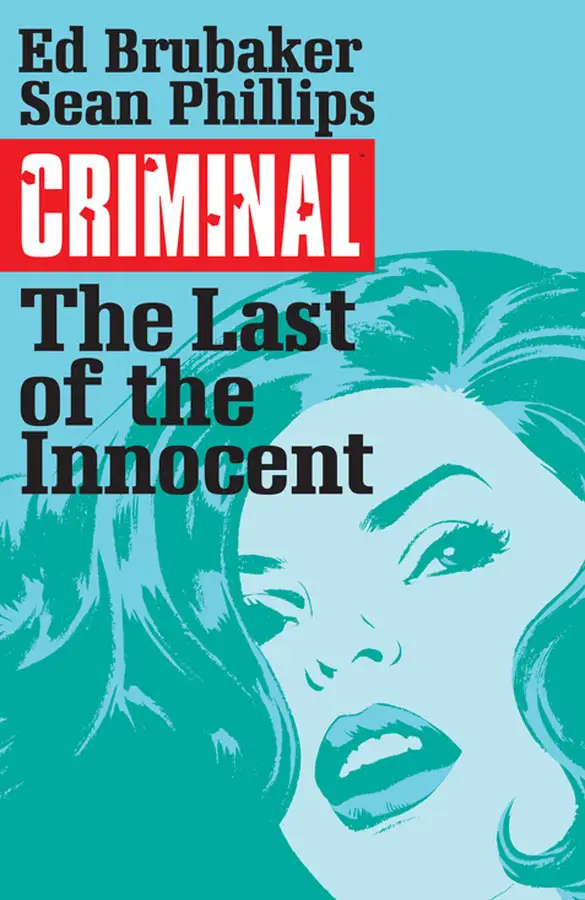
Misery in Having Everything You Want
On the surface, it looks like Riley Richards has everything going for him: he’s married to the sophisticated and wealthy Felicity “Felix” Doolittle, he has an easy job, and he lives in the city, having left behind Brookview, the small town of his youth. Riley has everything, and he’s miserable. His wife is cheating on him, he has no money of his own, the city provides plenty of opportunities for him to fall into his vices of gambling and lose women, he lacks meaningful relationships with anyone else, and his parents are old and in poor health. Brookview, with its simplicity and sense of community, is looking better and better to him every day. Fearing divorce would leave him destitute and a burden on others, Riley begins contemplating a scheme that would give him a chance to remake his life and get him out from under the humiliation and observation of his father-in-law. For Riley to remake his life, however, his wife has to die.
Every Criminal Is an Optimist
Criminal: The Last of the Innocent is a noir story like The Postman Always Rings Twice, Double Indemnity, or Strangers on a Train, where morally compromised people try to better their lives, ironically, through illegal and immoral actions. Riley is desperate to recover the freedom and relationships of his youth but thinks there’s no way there other than to murder his wife and get away with the crime. Another layer of the irony is that he is motivated to this end because of his childhood friend, Liz, who is so kind and compassionate that it makes him want to cut himself free of his old life and start anew, possibly in the hometown he hated when he was growing up in it. Her goodness and the visions it ignites within Riley make him consider horrible acts to make it a reality.
Similar to those protagonists from other noir stories, Riley is not a criminal exactly. He’s not a particularly good man, and both he and the audience are aware of his vices. Unlike the protagonists of other volumes in this series, who were all varieties of criminals, this story charts a different path. While he may begin the story as unethical but not a criminal, Riley becomes one over the course of the story, going to increasingly terrible and illegal lengths to achieve his ends. He’s not always heartless, but his regrets do not prevent him from appalling deeds like wrecking his friend’s sobriety, murder, framing others for his crimes, and getting involved with organized crime to tie up loose ends (parts 2, 2, 3, 4). Readers watch Riley turn himself into a worse person while he tries to convince himself and the audience that it’s all to improve his life. He’s helped a bit in that many of the other characters are also vicious or scummy—with the exception of Liz—but that type of cynicism only makes all the other characters look worse rather than making Riley look better. At best, Riley becomes an anti-hero or a tragic protagonist like Michael Corleone, Walter White, or Macbeth.
The Pain From an Old Wound
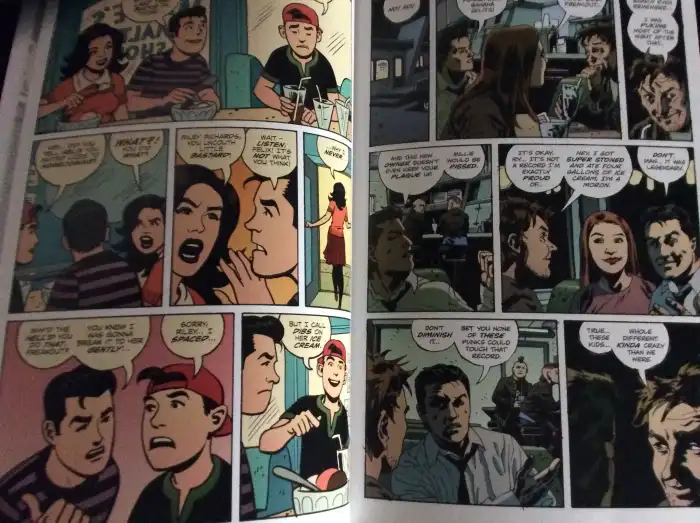
The flashbacks to Brookview have a fantastic stylistic shift, looking like Archie comics compared to the grim and gritty art of Riley’s present life. The colors by Val Staples and Dave Stewart really show off this contrast. This is the most engaged and symbolic the art styles have been, and it helps put the reader in Riley’s head while also inviting questions as to how accurate his memories are. It’s possible and maybe even a bit tragic that Riley is chasing something that is beyond his grasp because no one can turn back the clock. The change in art puts a filter on how readers understand Riley’s past because even though the art is cartoony and carefree, it depicts drug use, attempted murder, manipulation of jealousy, and voyeurism, among other less-than-savory activities (1, 2, 3, 4). It adds another layer of irony to consider Riley might be doing all this work because he mistakenly recalls his youth because of nostalgia.
As with all of Criminal, this volume is an excellent piece of noir storytelling. Because it's only tangentially related to other volumes, readers could even start with The Last of the Innocent without missing much of anything. Fans of the series and anyone who wants to see a tense noir story should check out this volume.
Source
Brubaker, Ed; Phillips, Sean. Criminal: The Last of the Innocent. Image, 2015.
© 2020 Seth Tomko