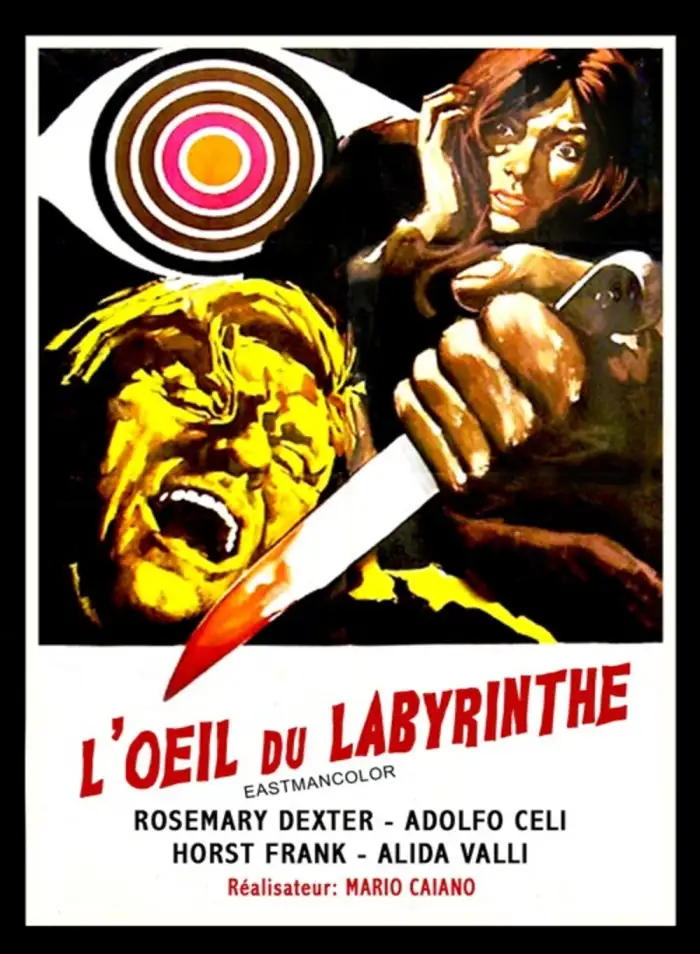
L’occhio nel Labirinto
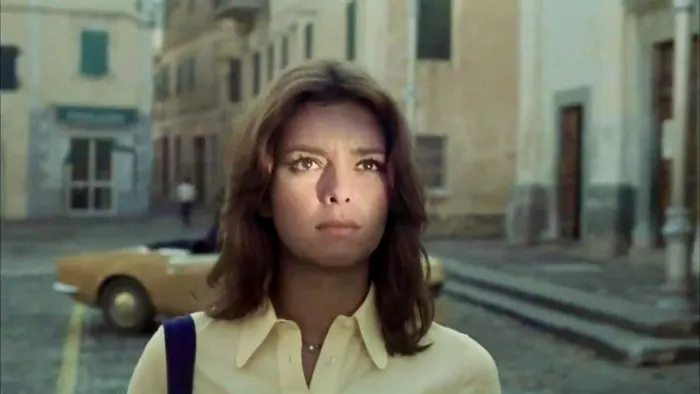
Julie (Rosemary Dexter) wakes from a nightmare in which her maybe boyfriend, maybe psychiatrist Dr. Luca (Horst Frank) is murdered in a brutal and surreal manner. When she and his coworker discover that no one knows where he is, Julie goes with the only lead she has, a small, seaside town called Maracudi. Once there, she receives conflicting information from a retired criminal named Frank (Adolfo Celi) and the hodgepodge of artists staying at a nearby coastal villa owned by the wealthy eccentric Gerda (Alida Valli). As she asks questions and chases obscure leads, Julie narrowly escapes from multiple attempts on her life and discovers that everyone at the villa has secrets, not the least of which may be those of Luca and herself.
Ulterior Motives
If there is anything fun about this giallo, it is the reveal and picking apart of the various ulterior motives of all the characters. Frank, who comes across by turns as sleazy and helpful, turns out to be making a play to regain control of the villa and its attendant criminal activities. Gerda surrounds herself with artists and a drug-addicted gigolo to inflate her ego, but she is really middleman drug smuggler. Luca, who everyone talked about as a luminary in the field of psychiatry, turns out to be a controlling sociopath, primarily interested in learning peoples’ secrets just for the power such knowledge gives him. Julie also oscillates between being frantic to find Luca and alarmingly disinterested in the search or her own personal safety. The conflicts and deceptions add a layer of mistrust and uncertainty to what might otherwise be the standard plot of a mysterious disappearance.
Cannot Find a Way Out
Eye in the Labyrinth, however, also does nothing to counter the claim that giallo movies have silly, contrived plots that fall apart under minimal scrutiny. There are nonsensical sequences that lead to deaths. Julie inexplicably decides to remain at the villa, even after multiple attempts on her life, only to turn around and say she wants to leave and never see any of these people again after getting some confirmation that her earlier suspicions were at least partially correct. The scattershot plotting and explanation of some behavior strains audience credulity even for a mean-spirited, little thriller movie. Similarly, the psychosexual gibberish that is meant as an revelation as to why some characters made they choices they did is totally unbelievable (even for 1972), delivered by a character that would not have any of these insights, and is all unloaded in the last 10 minutes or so of the movie. It makes the wrap-up of Alfred Hitchcock’s Psycho sound like compassionate, leading-edge psychological analysis.
The movie is also egregiously padded. Prolonged sequences of driving along Italian coastal roads, walking from location to location, pleasure rides in a yacht, and sun bathing are almost certainly included to get this movie to feature length because they are too numerous and too lengthy to be called establishing shots in good conscience. With Julie stopping on a whim to do some nude swimming on a beach, the audience is well within its rights to question how dedicated she is finding the missing Luca.
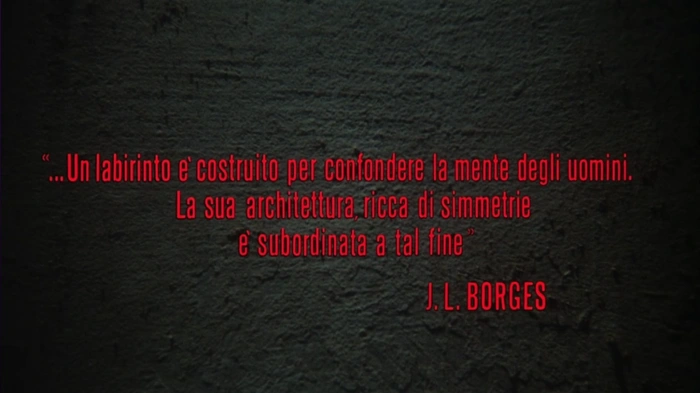
"...a labyrinth is built to bewilder the mind of man. Its architecture, however rich in symmetries it might be, is subordinate to this end" - J.L. Borges
Giallo Villa
Eye in the Labyrinth is not a great giallo movie, and certainly not one of the highlights of the genre. It might be worth watching for an audience in the mood for a psychologically twisted thriller who won’t mind a general absence of characters worth rooting for, or for anyone taking a broad survey of giallo movies in general.
Source
Eye in the Labyrinth. Directed by Mario Caiano, performances by Rosemary Dexter, Adolfo Celi, Alida Valli, and Horst Frank, Transeuropa Film, 1972.
© 2024 Seth Tomko