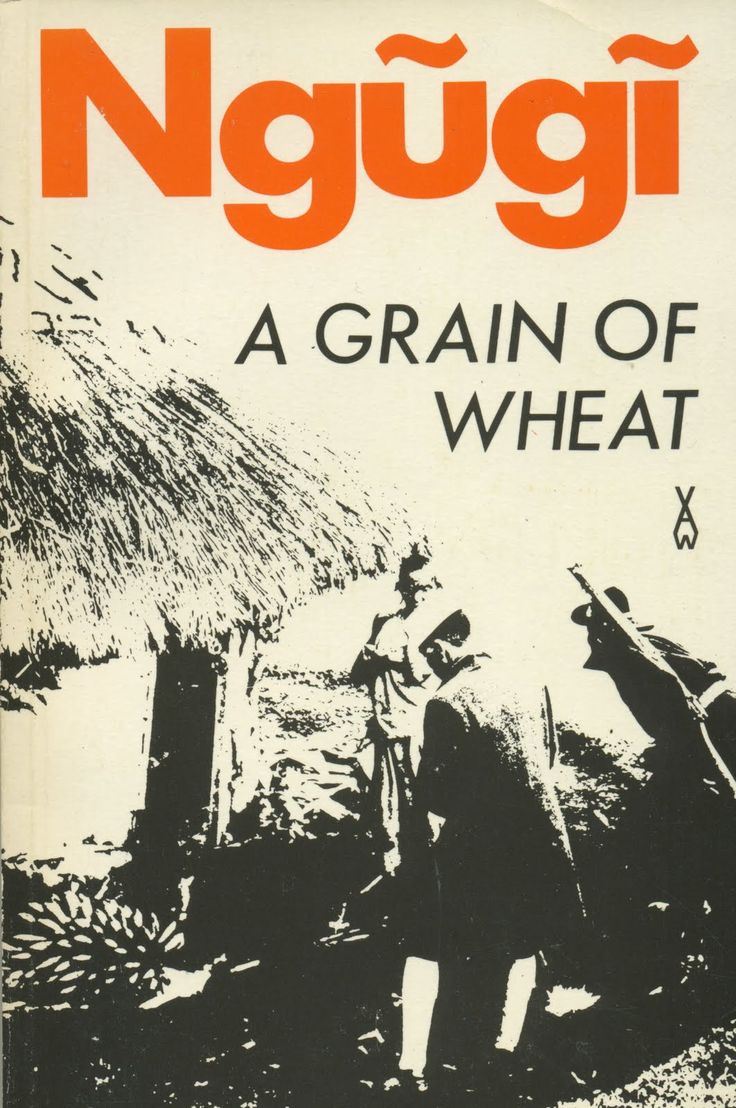
Reap What You Sow
Even for readers unfamiliar with the subject matter, A Grain of Wheat makes a great introduction to African Literature. On its surface, the novel is one of people coming to terms with Kenyan national independence, many realizing they have simply traded one taskmaster for another. Characters like Karanja slowly become disillusioned with the new government when he discovers his own countrymen are just as willing to cheat him as the Europeans were. Likewise, his personal relationships do not improve the way he dreamed they would, as though casting off foreign rule was somehow going to make Mumbi love him.
One of Ngugi’s most successful elements in making this novel accessible to readers with little or no knowledge of post-colonial African history is to wrap much of the present action in a mystery. The plot centers around the old revolutionaries searching for the man who betrayed their messianic leader, Kihika, to his execution while organizing a rally in his memory as part of the Uhuru celebration. The atmosphere of a covert fugitive hunt gives A Grain of Wheat a tense feeling that is reflected in the characters but none more so than the keynote speaker and protagonist, Mugo. It is the humble and heroic Mugo, praised for his resistance activities while in a detainment camp, who actually turned in Kihika and has lived with the secret all along. His flashbacks and anxiety over remaining silent build in harmony with the atmospheric tension to pull the reader along regardless of his or her level of knowledge of Africa outside of the text.
Kenyan Mystery
Readers will also get drawn in by Ngugi’s style. Though the subject matter is dense, he freely opens the character’s minds to the reader. Several events from the past are examined in flashback but from the points of view from different characters, giving readers a chance to see how the same situation is interpreted in different ways. Similarly, there are a few echoing occurrences. For instance, Karanja runs two races, and both of them deal with trying to win Mumbi’s affection. Since the races happen at different points in time, the readers get insight into how much or how little has changed for everyone involved.
Sowers of Wheat and Tares
Though a novel loaded with social and political themes, underpinning the whole of A Grain of Wheat is a conflict between religious messages. On the one hand there is the fiery Kihika who sees his revolutionary activities in a distorted Christian light. He feels called to serve the poor and free the oppressed as he learned Jesus Christ was sent to do. Kihika also believes, however, that the Kenyans will never be free unless Europeans are removed from their country by force. Believing God is on his side, Kihika uses religion as a basis for his insurrectionist beliefs. Mugo, on the other hand, is more traditionally devout and suffers guilt for his act of betrayal where Kihika feels none for the suffering he causes to others in pursuit of a nebulous greater good. In an ironic twist, it is Mugo—with his concern for others and desire for a simple life—who does the work of Judas work in A Grain of Wheat.
Source
Thiong'o, Wa Ngugi. A Grain of Wheat. Johannesburg: Heinemann Education, 1967.
© 2009 Seth Tomko