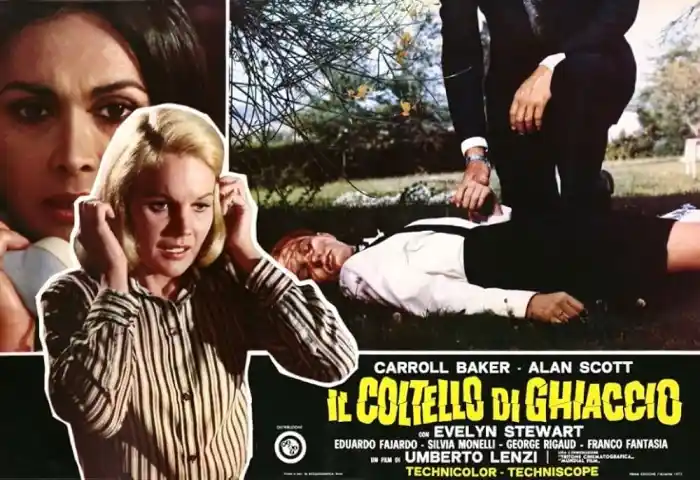
Il Coltello di Ghiaccio
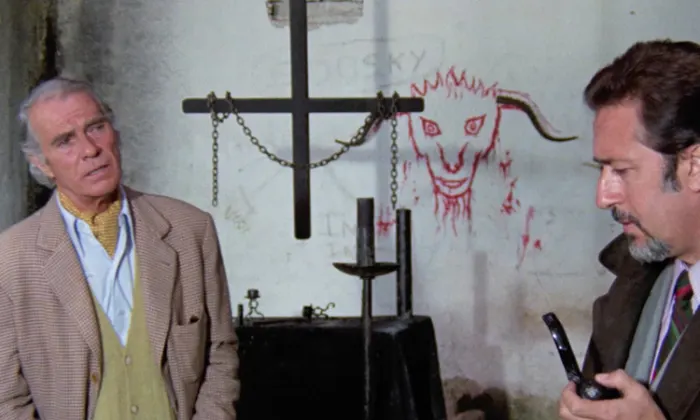
Martha Caldwell (Carroll Baker) and her Uncle Ralph (George Rigaud) are hosting her cousin Jenny (Evelyn Stewart) in their villa in Martinet, Spain. Jenny, a famous singer and soloist, recently completed a tour and wants to reconnect with her cousin, Martha, who has been mute for the last 15 years since witnessing her parents’ death in a catastrophic train accident. After a party at which she meets and impresses the higher social circle of the town, Jenny goes to investigate a disturbance in the house late at night and is murdered. When the crime is discovered, the police tie it to a similar death from earlier that same day, which may or may not have been committed by a pearly-eyed drifter (Mario Pardo) that Martha and Jenny encountered in town. When another murder occurs—this time with Satanic imagery nearby—suspicions fall again on the British transient who is also a morphine addict and devil worshiper. Additional deaths and a robbery of the pharmacy lead to a manhunt and increased tension for Martha. Even when the police close in, more deaths bring even more suspicion, and no one in Martinet seems safe.
Satanic Panic
The bulk of the movie consists of misdirection and suspicion about who is committing the murders. There are a number of red herrings throughout, which seem increasingly ludicrous until the final reveal—an even more ridiculous twist. The most prominent distraction is the inclusion of an itinerant, drug-addicted, devil worshiper with strange eyes. He is over-the-top and so obviously an outlier that it is almost impossible to take him seriously as the perpetrator of the murders in the mystery story. That he is immediately the prime suspect is, however, the most plausible part of the story. Also, the police in this movie are largely portrayed as unprofessional and incompetent, even for a giallo.
Rest in the Spanish Pyrenees, Forever!
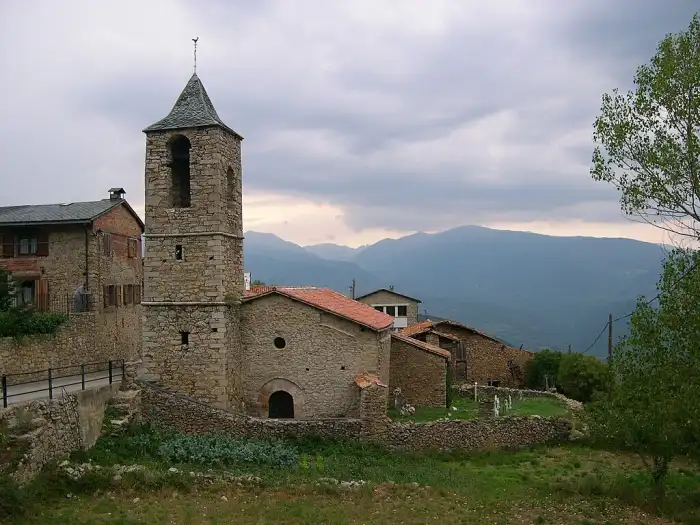
Murders aside, Martinet appears as a pleasant, old world town with a rustic, rural charm. The audience will be forgiven for believing that the town’s main industry is production of dry ice because there are several sequences when, inexplicably, huge banks of artificial fog swallow the town for no other reason than to make the audience and characters lose track of one another and create more suspicion around the actions and intentions of other characters. Even without the unannounced obscuring mists, there are plenty of scenes of tension, often capitalizing on Martha's muteness, and some unsettling camerawork, including intrusive flashbacks. While there are several deaths, there is little in the way of gore, which might surprise most watchers of giallo as will the minimal inclusion of any sexual or sleazy material often found in the genre.
There will be modest spoilers for a movie from 1972.
Silent Horror
The increasing frequency of deaths around Martha and her survival of an encounter with an alleged killer ought to be enough to clue in the audience that something is amiss, even if unfamiliar with giallo. While initially shocking, the final reveal is flimsy in its execution, requiring earlier information presented to the audience be either lies or hidden outright. These choices make the finale a cheat rather than a shock. Plenty of other giallo have a surprising twist where something the characters and the audience have seen is recontextualized in the light of new discoveries: The Bird with Crystal Plumage, Deep Red, Torso, and Don’t Torture a Duckling. The last swerve in Knife of Ice, however, is less about a revelation than it is a realization the audience has been left out of the information loop. How forgiving to be about this is up to each viewer, but it certainly feels less earned than the aforementioned movies.
The Mouse’s Tale
Knife of Ice is not a great giallo, but it might work as a reasonable entry point for anyone curious about the genre but apprehensive about the violence and sex that is often a part of these stories. This movie goes another route while still maintaining many giallo hallmarks.
Source
Knife of Ice. Directed by Umberto Lenzi, performances by Carroll Baker, George Rigaud, and Evelyn Stewart, Tritone Cinematografica, 1972.
© 2024 Seth Tomko