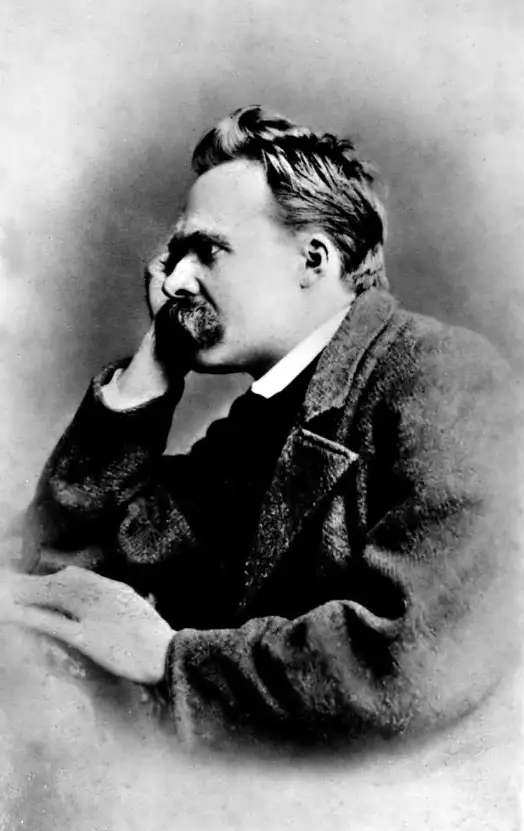
Friedrich Neitzsche’s drive in Twilight of the Idols is to promote authentic living by any means necessary.
Most People, as Nietzsche sees them, don’t have the faintest idea of who they are, much less who they should be. Toward the end of his maxims he asks questions of conscience, which include, “Are you genuine? or only an actor? A representative, or that itself which is represented? ⎯Finally, you are no more than an imitation of an actor" (37). He feels it is imperative for people to seriously question themselves and whether or not they are simply being led around by the institutions designed to help them.
When these questions are no longer asked, the whole society begins to suffer. The commonality and banality of life lived within an unquestioned system devalues people. This belief is a continuation of the Socratic idea that an unexamined life is not worth living. To affirm life and freedom one must recognize and dissolve the artificial chains that bind one to be ruled by external forces. Neitzsche concludes there is no Prime Mover, or originating force that creates a man, and that this fact "alone is the great liberation" (65). To break free of imposed restraints is to be a person who comes from one's self and is on the path to taking control of one's life.
With the death of limitation comes the birth of an authentic life. When freed from socially-constructed binary systems, people are allowed to express feelings and desires of a more authentic nature. In such a state one lives with greater intensity and on a level beyond the scope of the unliberated mind.
The most spiritual human beings, assuming they are the most courageous, also by experience by far the most painful tragedies: but it is precisely for this reason they honor life, because it brings against them its most formidable weapons. (88)
To feel something, anything, in such a way affirms life, even in moments of great suffering.
Since most people do not or will not live with such intensity, Nietzsche refuses to distinguish between good or ill. He even prefers genuine hypocrisy to the lukewarm virtues and vices of the masses (88-9). A life of half-measures is the worst of all possible worlds.
I greatly fear that modern man is simply too indolent for certain vices: so that they are dying out . . . . The few hypocrites I have known impersonate hypocrisy: they were, like virtually every tenth man nowadays, actors. (88-9)
For Nietzsche anything authentic is preferable to the stagnant, milquetoast life that modern humans have constructed for themselves. The preoccupation with "security" has led to lives that aren't lived much less examined with any rigor.
Taking this view of morality into account, it will come as no surprise that Nietzsche looks warily on what people typically call virtue and vice. He first notes the subjectivity of these terms. For example, where the assistance of an invalid is called virtue by one, it is scorned as cowardice by others (102). From the start there can be little agreement because there is no single set of beliefs held in common and views change over time as well. It is entirely possible that the virtues of today were vices in the past (110). Essentially, what any culture deems a virtue or a vice is susceptible to change over time.
Nietzsche is ultimately unconcerned with good and evil since he feels those are transitory terms meant to describe how a culture views actions at a certain point in time. Instead, he argues it is better for someone to try to take control of his or her life rather than submit to what other institutions say is right or wrong.
Source
Nietzsche, Friedrich. Twilight of the Idols. Trans. R.J. Hollingdale. New York: Penguin, 1968.
© 2010 Seth Tomko