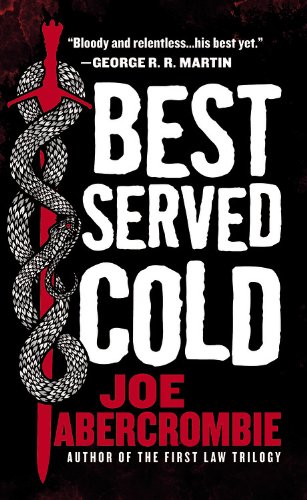
A fantasy novel with grit, Best Served Cold follows Monza Murcatto, a mercenary general who was betrayed and left for dead by her former employer. Swearing to get revenge on the seven men who killed her brother and tried to kill her, she assembles criminals and killers desperate or crazy enough to sign up with her task of assassinating seven of the most important figures in the country of Styria. Among her crew are Morveer, a vain but skillful poisoner, Friendly, an obsessive-compulsive convicted murderer, and Caul Shivers, a soldier from the far north who came to Styria trying to be a better man.
The novel is broken into seven sections, each focusing on a different target of Monza’s vengeance in one of the different cities in Styria, and each time Monza constructs a different, lethal plan to fit her circumstances and her target. Meanwhile, she must also work to hold together her motley gang that is constantly at odds with each other and face her growing addiction to a pain-killing drug that she takes ever since her betrayal and attempted murder. In her most lucid moments, the quest for revenge even seems doomed to her, but since she has nothing left, she presses forward toward a spectacular climax that demands annihilation of one party or another.
Escalation
One of the most interesting aspects of the novel, aside from the scenes where revenge plots are enacted, is that Abercrombie also examines the repercussions of Monza’s work, both external and internal. As she actually takes her vengeance, there is all manner of unintended consequences. Civic institutions collapse, diplomatic missions are destroyed, and people who had nothing to do with Monza, her betrayers, or the Years of Blood, are devastated by war and famine. At several junctures, characters comment on how the people who suffered the worst are farmers and laborers whose lives are thrown into chaos and frequently brought to violent ends without justification as soldiers, mercenaries, and vengeful hosts take advantage of them without regards for the consequences. Similar observations are made in novels like Game of Thrones, but here the reader witnesses several scenes of devastation brought upon undeserving bystanders. The more violence Monza uses, the more violent the repercussions are from her surviving targets as she is drawn into rebellions and open warfare so that her personal vendetta may eventually throw the whole of Styria into even deeper chaos.
The Price of Revenge
The personal toll is no less destructive. Monza starts her revenge hardly thinking about the harm it will cause to anyone other than the seven men she intends to kill. As she witnesses the ways in which she must attain her revenge, however, a lingering question of the value of revenge looms across the whole novel. The reader is encouraged to contemplate the problem, too, as he or she learns more about Monza and her brother and whether or not her mission of revenge is justified. Similarly, Caul Shivers begins the novel dedicated to making himself a better man, an honest man. It is both tragic and fascinating to watch his slide into nihilism as his attitude toward violence and mayhem changes with each murder and each injury he takes in pursuit of someone else’s revenge. He begins the book as an optimist and near the end comes to think, “you have to take what you can while you still have breath. The earth holds no rewards but darkness” (789). His belief that men don’t change on their own but are broken into the lives they must live is a sentiment that shows his self-awareness, believing that the capacity for ruthless violence was crouched in him all along, and that being a better man and being an honest man might not be the same thing.
Fantasy in the Dark Places
Best Served Cold is an exercise in contemporary fantasy excellence. The book is superbly paced with virtually no sections that drag because the plot is tightly focused on the actions of just a few characters. The scenes where there isn’t build up or action provide insight, often grim and frightening, into the minds of the characters engaged in the business of revenge, humanizing them even as they go about pitiless and violent work. As with Abercrombie’s other works like the First Law Trilogy and The Heroes, the book is not for the weak of heart; he pulls no punches when describing the horrific carnage and torture the characters inflict nor in his examinations of their brutal and often warped psyches.
Source
Abercrombie, Joe. Best Served Cold. New York: Orbit Books, 2009.
© 2012 Seth Tomko