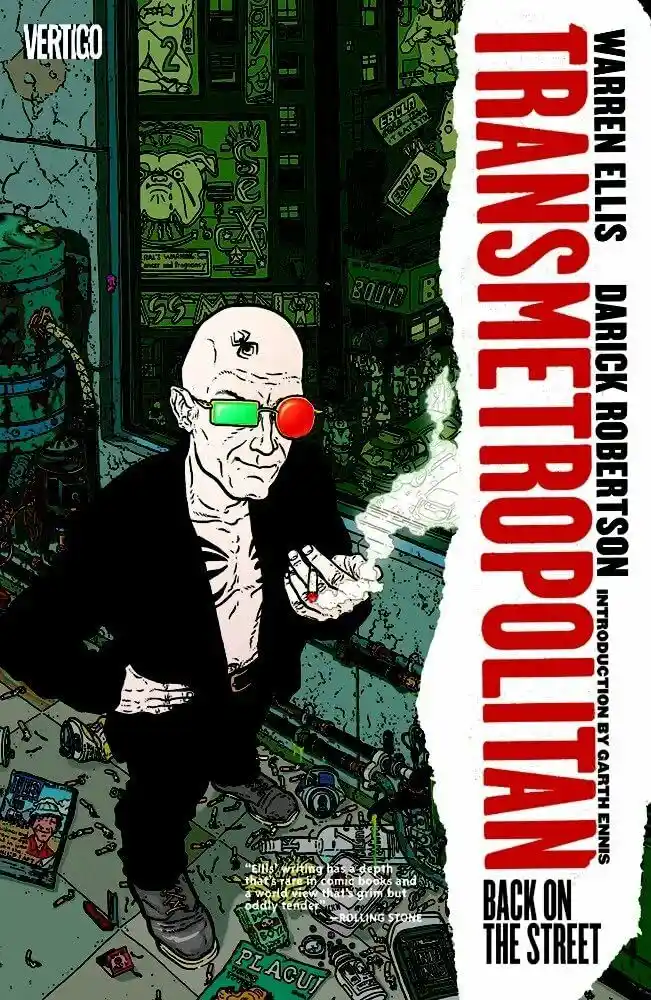
Spider Jerusalem
Gonzo journalist and all-around firebrand Spider Jerusalem has lived in seclusion the last few years in his remote mountain cabin. A less than friendly call from his publisher reminds him that he owes them at least two more books. Out of material and nearly out of his mind, Spider Jerusalem returns to the City to pick up work as a journalist and prepare himself to write more books, likely about the madness and corruption he sees in the futuristic, cyberpunk setting. His first assignment leads him to investigate a new separatist cult and the authoritarian crackdown on it orchestrated by selfish governmental leaders. Of course, Spider Jerusalem finds there is plenty of fraud and blame for all sides as he reports from the middle of a riot. With his journalistic credentials reestablished, Spider Jerusalem continues with firsthand investigations of the president, the endless, nightmarish inundation of television content, and the endemic scamming perpetrated by all the religious leaders of a variety of faiths gathering for a convention in the city.
The Word on the Street
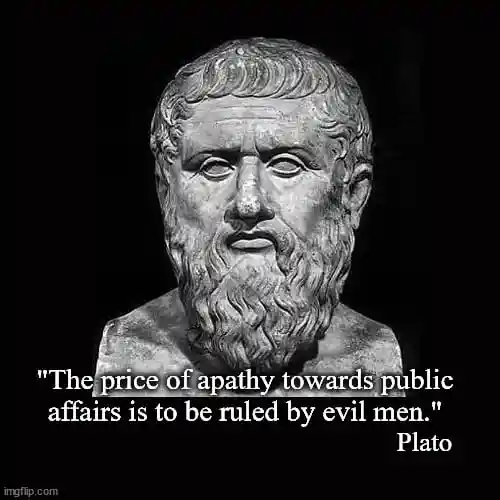
The main draw of the series is the constant, acerbic anger of Spider Jerusalem as he finds life made nearly intolerable by the parade of egomaniacs and snake-oil salesmen who have wormed their way into positions of power. Royce, his editor, and Channon, his assistant, have their moments, but they are side characters to Spider Jerusalem’s derisive, stream of consciousness critique of everything he sees around him. He does not let regular citizens off the hook either, pointing out that through their complacency, they have allowed themselves to be ruled by evil and covetous men and women, always hungry to steal more of their freedoms and money for themselves. Spider Jerusalem also aims his sarcastic criticism as himself, too, acknowledging times when he contributes to societal problems even as he remains committed to the idea that unflinching journalism can make a change and bring peoples’ attention to the evils—both banal and extraordinary—that occur around them.

Don’t Take Any Guff from These Swine
It should be obvious that significant parts of the character of Spider Jerusalem are modeled on the late gonzo journalist Hunter S. Thompson, known for his unconventional reporting style and books like Hell’s Angels, Fear and Loathing in Las Vegas, and Kingdom of Fear. While there is nothing wrong with this technique, it may not impress anyone who is already not a fan of Thompson and his methods, and it may not get the same spark from readers who already have Hunter S. Thompson at home, so to speak. There is also the potential issue of Spider Jerusalem’s caustic ranting falling flat because he is preaching to the choir. It is unlikely readers willing to pick up Transmetropolitan are going to be shocked at the discovery that people in positional of any sort of authority are corrupt and devious. In fact, many of the scandals Spider Jerusalem investigates will seem tame in comparison to a real 21st century America where a convicted felon was elected to the highest position of political power, and people are bombarded by 24-hour streaming media, generative AI garbage, economic policies that become self-inflicted wounds, and over-reaching moralistic paternalism in most aspects of life.
Gonzo
There is nothing really wrong with Transmetropolitan: Back on the Street. It can be a fun read, and Spider Jerusalem’s outrage often seems justified. The passage of time, however, means the stories have less impact and shock value than they once had because real life, it turns out, is wilder and more outrageous than Ellis feared the future would be. It’s worth picking up if readers come across it, but it may not have the vitality and power that they might be seeking.
Source
Ellis, Warren. Transmetropolitan: Back on the Street. Art by Darick Robertson. DC Comics, 2009.
© 2025 Seth Tomko