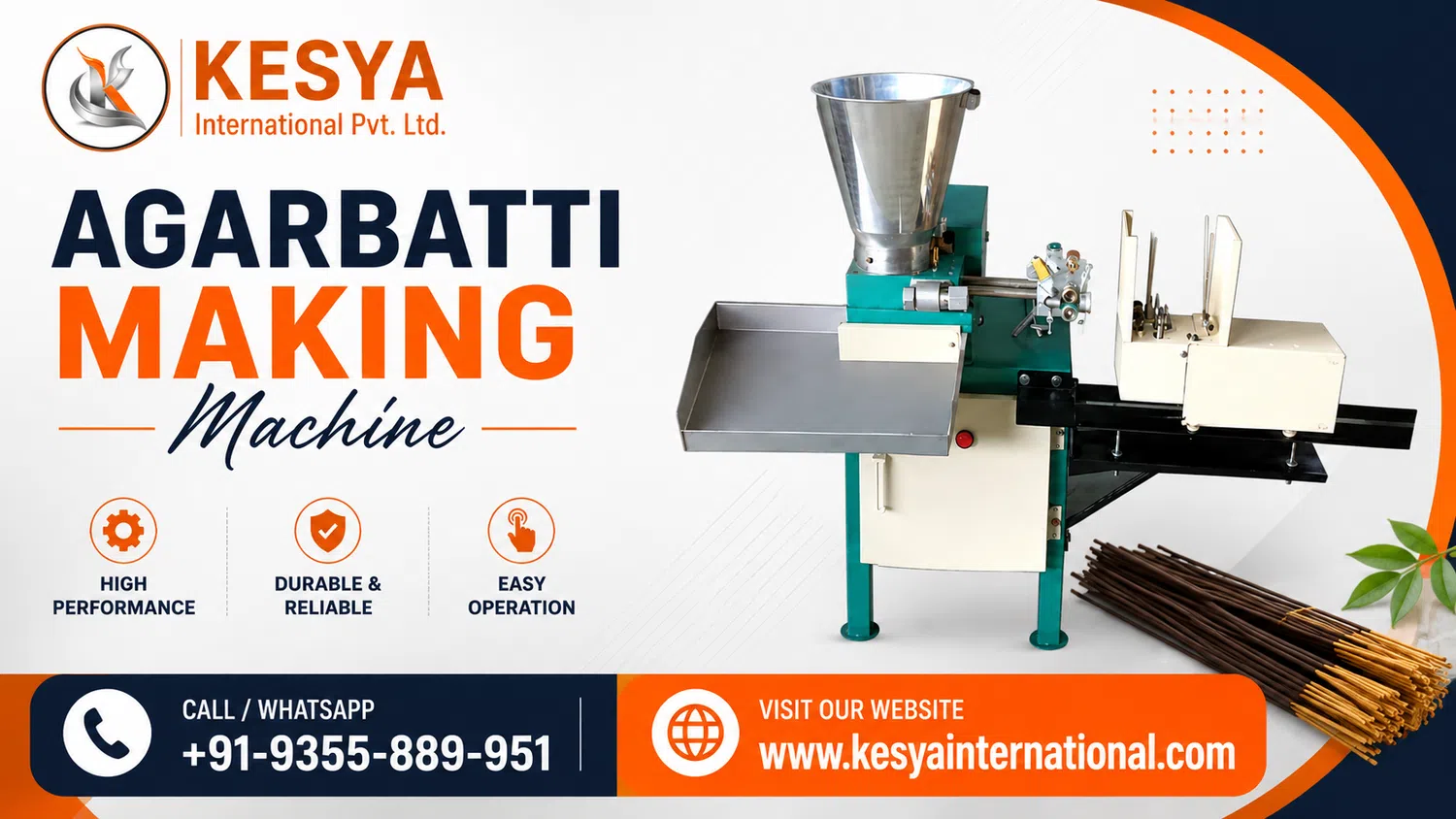
Agarbatti Making Machine: Beginner's Guide to Starting Incense Stick Production
Starting a manufacturing business requires careful planning, especially when machinery is involved. If you are considering an incense-stick business, an Agarbatti Making Machine can help simplify the production process and increase the number of sticks produced in a working day.
Agarbatti is used in homes, temples, offices, meditation spaces, and religious ceremonies. Different fragrances, sizes, and packaging options are available in the market. This gives manufacturers the flexibility to develop products for different types of customers.
Before buying an agarbatti machine, however, it is important to understand how it works, what materials are required, how much production you need, and what factors can affect your overall business cost.
What Is an Agarbatti Making Machine?
An Agarbatti Making Machine is a piece of manufacturing equipment used to make raw incense sticks. It applies a prepared mixture around a bamboo stick and forms the material into a suitable cylindrical shape.
The machine can reduce the amount of manual work required during production. Depending on the model, it may also help increase production speed and maintain consistency in the size and shape of the sticks.
The raw sticks produced by the machine are not necessarily the final retail product. They normally require drying and may go through fragrance application, quality inspection, and packaging before being sold.
How Does Agarbatti Manufacturing Work?
A typical manufacturing process starts with the preparation of the agarbatti mixture. The ingredients are selected according to the type and quality of incense being produced.
Bamboo sticks are then supplied to the machine. The machine carries the sticks through its working mechanism and applies the prepared material around them.
After the raw sticks are formed, they are removed from the machine and dried. Drying is an important step because the moisture level of the sticks can affect their final performance.
Once they are properly dried, fragrance can be added. The sticks can then be checked for quality and packed according to the intended market.
The exact process may vary depending on the machine and the manufacturer's production method.
What Are the Different Agarbatti Machine Options?
Agarbatti machines can be selected based on the level of automation.
Manual Machines
Manual machines involve more operator participation. They can be suitable for entrepreneurs who are starting with a small production target.
They may require a lower initial investment compared with more automated machines, although the actual cost depends on the model and supplier.
Semi-Automatic Machines
Semi-automatic machines perform part of the production mechanically while the operator handles certain activities.
They can be useful when a business wants to improve production efficiency without moving directly to a highly automated system.
Fully Automatic Machines
Fully automatic machines are designed to reduce manual intervention and support higher production requirements.
They can be suitable for businesses with established demand and larger orders. However, the higher investment should be considered against expected production and sales.
How Much Does an Agarbatti Making Machine Cost?
The Agarbatti Making Machine price depends on the machine's specifications and manufacturer. Different models can have significantly different prices.
Some of the factors affecting cost are:
Production capacity
Automation level
Motor power
Machine construction
Size and design
Manufacturer
Warranty
Installation
Training
After-sales service
A machine's purchase price should not be considered the complete business investment. Buyers may also have expenses for transportation, installation, raw materials, electricity, drying, packaging, and other operations.
Getting quotations from different suppliers can make it easier to compare available options.
How Much Production Is Possible?
Production capacity depends on the particular machine model. Suppliers generally provide an estimated output based on their machine's specifications.
Actual output can vary because production depends on several factors. These include raw material quality, machine settings, operator experience, working hours, maintenance, and operating conditions.
For this reason, businesses should ask about realistic production capacity rather than focusing only on the maximum figure mentioned in promotional material.
A machine demonstration can provide a better understanding of practical output.
What Materials Are Used to Make Agarbatti?
The raw materials used can vary depending on the type of agarbatti.
Commonly used materials include:
Bamboo sticks
Wood powder
Charcoal powder
Binding materials
Fragrance
Packaging material
Each material has a role in the manufacturing process. The formulation can affect the stick's appearance, burning behaviour, fragrance, and overall quality.
Businesses should establish a consistent raw material supply before increasing production. Sudden changes in material quality can affect the consistency of the finished product.
What Are the Benefits of an Agarbatti Making Machine?
Using machinery can provide several advantages to an incense-stick manufacturer.
Increased Production
A machine can help produce more sticks within a given working period compared with many manual production methods.
Consistent Shape
Proper machine settings can help create sticks with a more uniform shape and thickness.
Less Repetitive Work
The machine can reduce repetitive physical work for operators.
Easier Production Planning
Businesses can plan production targets around machine capacity and working hours.
Scope for Expansion
As demand increases, a manufacturer can consider increasing machine capacity or adding equipment to the production setup.
What Should a Beginner Consider Before Buying?
A beginner should first determine the expected production requirement. This is one of the most important factors when choosing a machine.
If the business is starting with limited orders, buying a very high-capacity machine may not be necessary. A smaller machine may provide enough capacity while keeping the initial investment more manageable.
You should also check the machine's power requirements and whether the available electricity supply is suitable.
The supplier's reputation and service support should also be considered. A machine may require spare parts or technical assistance during its operating life.
Why Is After-Sales Service Important?
After-sales service can become important when a machine requires maintenance or develops a technical problem.
Before purchasing, ask the supplier about warranty coverage, spare-part availability, installation assistance, operator training, and repair support.
A machine from a supplier with accessible service support can be easier to manage over the long term.
Buyers should also understand which components are covered under warranty and for how long.
How to Maintain an Agarbatti Machine?
Proper maintenance can help maintain production performance.
The machine should be cleaned regularly to prevent material from accumulating in working areas. Important components should be inspected according to the manufacturer's maintenance schedule.
Operators should follow the recommended operating procedure and avoid exceeding the machine's intended capacity.
If production suddenly decreases or the machine develops unusual sounds or vibrations, the problem should be inspected promptly.
How Can You Start an Agarbatti Manufacturing Business?
Starting the business involves more than purchasing machinery.
First, research the market and identify the type of agarbatti customers are looking for. Next, estimate the cost of the machine, raw materials, labour, electricity, packaging, transportation, and other expenses.
A suitable workspace should be arranged for manufacturing, drying, storage, and packing.
You should also research the business registrations, licences, and other requirements that apply to your location.
Finally, decide how you will sell the finished product. Depending on your business model, you can approach retailers, wholesalers, distributors, religious-product stores, or suitable online channels.
Is Agarbatti Manufacturing a Good Business?
Agarbatti manufacturing can be considered a business opportunity because incense sticks have many everyday and religious uses.
However, the success of the business depends on more than product demand. Production costs, selling prices, competition, product quality, packaging, distribution, and customer relationships all influence business performance.
There is no guaranteed profit from purchasing an agarbatti machine. A realistic cost and sales estimate should be prepared before making an investment.
Frequently Asked Questions
What is an Agarbatti Making Machine used for?
It is used to form raw incense sticks by applying an agarbatti-making mixture around bamboo sticks.
Can a beginner use an agarbatti machine?
Yes. Beginners can use suitable machines after receiving basic operating and safety training from the supplier or manufacturer.
Which machine is suitable for low production?
A manual or semi-automatic machine may be considered when the expected production volume is relatively low.
What determines agarbatti machine production capacity?
Machine design, operating speed, raw material consistency, operator experience, machine settings, and working hours can affect production output.
Do I need separate equipment for drying?
Drying is generally a separate stage of the manufacturing process. The exact equipment or arrangement depends on the production setup.
What is the most important factor when buying an agarbatti machine?
There is no single factor. Production capacity, total cost, machine quality, power requirements, warranty, spare parts, and after-sales service should all be evaluated together.
Conclusion
An Agarbatti Making Machine can be a useful addition to an incense-stick manufacturing setup. It can increase production efficiency, reduce repetitive manual work, and help manufacturers maintain consistency.
For beginners, the best approach is to understand the market first and then choose a machine that matches the expected production requirement. Comparing machine specifications, operating costs, warranty, service support, and total investment can help avoid unnecessary expenses.
With suitable machinery, consistent raw materials, proper production practices, effective packaging, and a clear sales strategy, an agarbatti manufacturing business can be developed gradually according to market demand.
More info : Agarbatti Making Machine , Automatic Agarbatti Making Machine