Denied claims go far beyond being routine administrative issues; they carry significant financial consequences for healthcare organizations. Delayed reimbursements can disrupt cash flow, increase operational costs due to repeated corrections and resubmissions, and create growing backlogs of unpaid claims. In the context of claim denial management in specialty practices, these challenges are often magnified because specialty services involve complex procedures, detailed documentation, and strict payer guidelines. Healthcare specialties such as plastic surgery and emergency medicine are particularly vulnerable to higher denial rates due to intricate procedure codes, extensive medical necessity requirements, and the need for precise prior authorizations. Without effective denial management strategies, these denials can consume valuable staff time, diverting resources away from patient care and key revenue cycle initiatives.
What Are Denied Claims?
At its core, a denied claim is a healthcare insurance claim that has been submitted to a payer but is rejected by the payer before payment. A denial typically means that the payer reviewed the claim but determined that some aspect of the submission did not meet coverage criteria, contract requirements, or documentation standards — making it ineligible for payment without further action. Common reasons for denials include:
Incorrect or Missing Patient Information: Claims are denied when patient demographics or insurance details are inaccurate or incomplete, preventing proper claim processing.
• Coding Errors: Use of incorrect, outdated, or mismatched diagnosis and procedure codes.
• Lack of Medical Necessity: The documentation does not clearly justify that a service was medically necessary.
• Missing Prior Authorization or Referrals: Services requiring pre-approval may be denied when prior authorization or referral documentation is not obtained or submitted.
• Duplicate Claims:Submitting the same claim more than once.
• Timely Filing Issues: Claims submitted after the payer’s allowable filing window are commonly denied regardless of service validity.
• Non-covered Services: Procedures not included under the patient’s insurance plan or policy limitations.
Understanding what denied claims are lays the foundation for building robust denial management strategies that catch issues early and recover lost revenue.
Top Denial Management Strategies for Specialty Practices
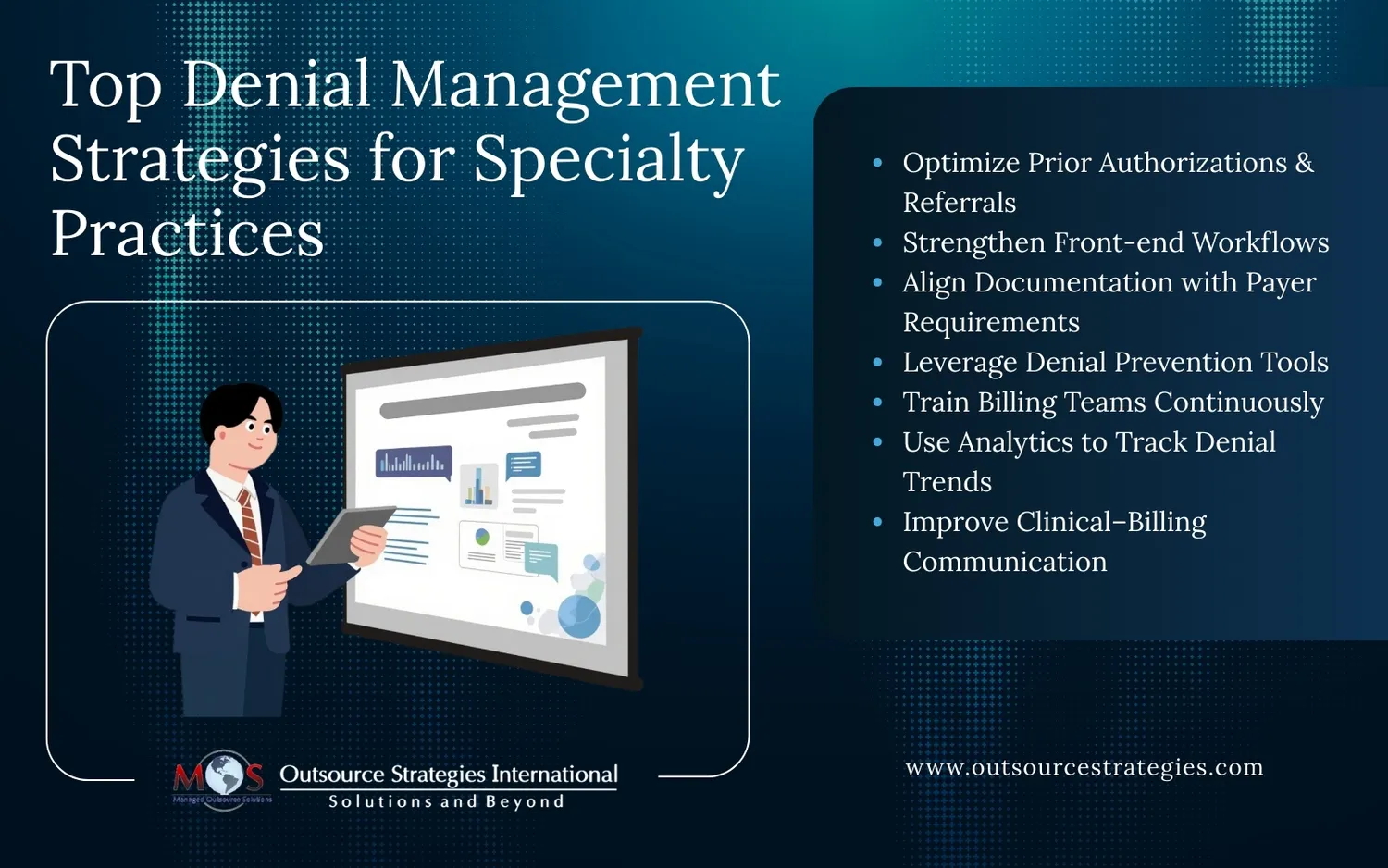
For specialty practices, where claim complexity is greater than general care, applying targeted denial management strategies can make a significant difference. Below discussed are top strategies to reduce claim denials in specialty practices:
• Optimize Prior Authorization and Referral Workflows: Many denials start from authorization issues or missing referrals. Establish dedicated processes to verify authorization requirements before care is delivered and confirm that all necessary referrals are documented prior to submission.
• Strengthen Front-end Workflows: Upfront processes like real-time eligibility verification, precise data capture, and thorough verification of prior authorizations reduce the potential for denials before claims ever reach the payer. Using automated systems to verify insurance coverage and eligibility helps catch issues at the earliest point in the workflow.
• Ensure Documentation Meets Clinical and Payer Requirements: Detailed clinical documentation is critical in specialty care. Align billing codes with clinical records — especially for services with stringent medical necessity requirements — to reduce pushback from payers. This joint effort between providers and billers prevents mismatches that lead to frequent denials.
• Leverage Denial Prevention Tools: Coding validation systems, and eligibility automation all help reduce the number of denials your practice has to manage. These technologies flag potential problems before claims are submitted.
• Train Staff Continuously: The healthcare billing landscape evolves constantly. Regular staff training on coding updates, payer-specific rules, and timely filing requirements ensures you don’t encounter medical claim denials.
• Leverage Analytics for Insight: Analyzing denial trends — such as which services or payer groups lead to the most denials — helps refine your broader denial management strategy. Use data to predict problem areas and adjust workflows accordingly, leading to systemic improvements rather than isolated fixes.
• Strengthen Communication between Clinical and Billing Teams: A lack of coordination between clinical and administrative teams often creates documentation gaps that result in claim denials. Clear communication protocols and shared access to patient records help ensure that billing staff have all the necessary clinical context to support claims accurately.
Effectively handling claim denials in specialty practices is more than a technical necessity — it is a strategic advantage that strengthens financial stability, supports patient care continuity, and enhances revenue cycle health. Through a defined denial management process, proactive denial management strategies, and continuous performance monitoring, specialty practices can significantly reduce the burden of medical claim denials and improve both operational resilience and bottom-line results.