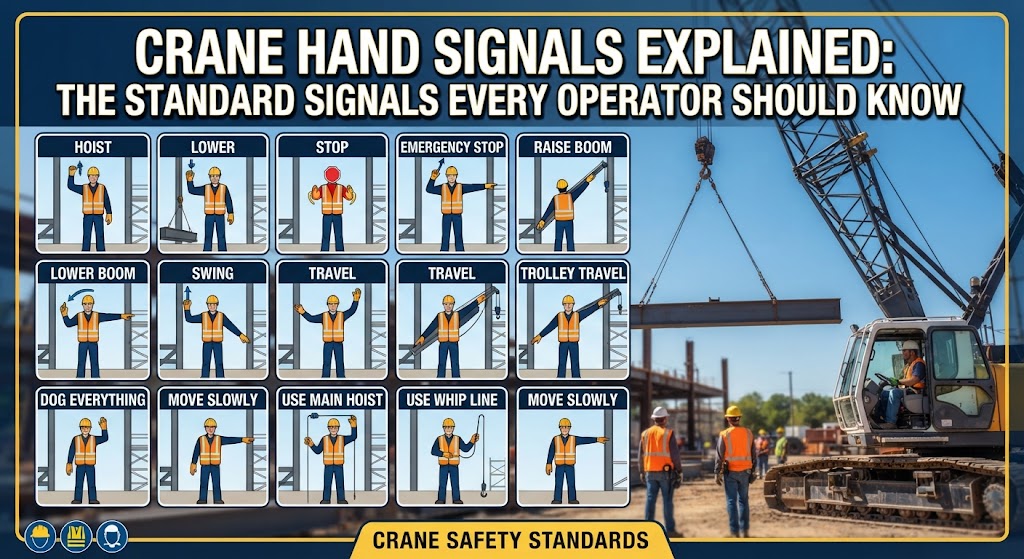
If you've ever watched a crane lift a load across a busy job site, you've probably noticed a worker on the ground moving their arms in specific, deliberate patterns. That's not random — it's a standardized communication system that keeps everyone on site safe when a multi-ton load is swinging overhead.
Why Standardized Signals Matter
A crane operator often can't see the load once it clears the boom or moves behind a structure. That's where the signalperson comes in — they act as the operator's eyes for everything happening outside the cab's view. If every crew made up its own signals, an operator switching job sites would be relearning communication from scratch at the worst possible moment. Standardizing these signals nationally means an operator can walk onto any certified site and instantly understand the person directing the lift. You can see the full breakdown of how crane hand signals work and why they're standardized in more detail.
When a Signalperson Steps In
A signalperson isn't required on every single lift. They're brought in when the load path, the landing area, or the operator's line of sight is blocked, or when site conditions like dust, poor lighting, or distance make visual confirmation unreliable. In these situations, only a qualified signalperson is allowed to direct the crane.
The Core Signals Every Operator Should Recognize
There are 19 standard signals covering everything from hoisting and lowering to boom movement and emergency stops. A few of the most critical:
- Hoist – arm up, finger circling to raise the load
- Lower – arm down, finger circling to lower the load
- Stop – one arm extended, palm down, moved side to side
- Emergency Stop – both arms extended, palms down, moving simultaneously — this overrides everything else on the lift
- Dog everything – hands clasped at waist level, meaning hold position
These signals aren't just gestures — they're a shared safety language recognized on every certified site in the country.
Hand Signals vs. Voice Communication
Radios and voice commands are allowed as an alternative, but they still have to follow the same structured terminology as hand signals. It's a format swap, not a shortcut around the standard.
Becoming a Certified Signalperson
Getting certified involves both a written exam and a practical demonstration, and the certification stays valid for five years. Many operators pair this with rigging training since the two roles work closely together on most lifts. If you want the complete path — including what the certification process actually covers — it's worth reviewing before you commit to a program.
Learning this system properly, rather than picking it up piecemeal on a job site, is what separates operators who move confidently between crews from those who are always playing catch-up. A structured training program builds this knowledge the right way from day one, which is exactly why proper hand signal training is baked into serious rigging and crane certification courses.
Ready to learn crane hand signals the way they're actually used on certified job sites? A hands-on Rigging and Signalperson program covers both the OSHA qualification standard and the full NCCCO certification path — call (800) 383-7364 or apply online to get started today.