You've likely heard the saying "take care of yourself first." This isn't just good advice; it's a key to success in today's competitive job market.
Self-management skills are no longer just nice to have; they're necessary. Employers expect professionals to stay focused, flexible, and aggressive without being micromanaged as more industries adopt hybrid work, new technologies, and a results-driven culture. So, being able to handle things on your own is important.
But what are they, and how can you improve them to help your career?
Let's break it down.
The Core of Self-Management: Leading From Within
A key component of self-management is taking responsibility for one's own behaviors, objectives, emotions, and sense of time. It is about taking responsibility for your projects and making excellent use of both your professional skills and personal skills in order to complete duties in an efficient manner each and every time.
The most important parts of self-management are:
- Time management: Establishing priorities and preventing procrastination.
- Emotional regulation: The ability to remain composed in the presence of obstacles.
- Goal-setting: The process of establishing and pursuing substantial objectives.
- Accountability: Accepting responsibility for one's actions.
- Adaptability: Maintaining an open mind to novel concepts and concentrating on identifying solutions in the face of change.
These traits are what enable people to perform well, regardless of their profession or industry.
The Real-World Benefits of Self-Management at Work
Let's get practical. What does a self-managed professional look like at work?
- They met goals without being told to.
- They stay cool and do what they can when things go wrong.
- They don't complain when the team's objectives change.
- They take comments in a helpful way and use them to improve.
- They demonstrate professionalism, making them excellent choices for leadership positions.
- To put it another way, being able to handle yourself is what makes you marketable.
Self-Management Skills Examples: You Can Start Practicing Today
Want to see progress right away?
Below are some self-management skills examples that you can try.
- The Two-Minute Rule: This principle suggests that you should act immediately if a task can be completed in under two minutes.
- Daily Routines for Planning: Every morning, take 10 minutes to make a list of your top three objectives.
- Energy Mapping: Determine when you're most alert (such as in the morning) and plan your deep work accordingly.
- Weekly Reviews: Every Friday afternoon, think about what went well, what didn't, and what you learned.
- Pause Before Reacting: When you feel triggered, pause for 10 seconds and take a deep breath before responding.
Long-lasting habits are composed of small, consistent actions.
How A Self Development Course Can Help You Get Good at These Things?
Making changes in habits can be challenging when you have a lot going on in your life and at work. That's why taking a lesson on the importance of self-management to get better can be so helpful.
The Mastering Self-Management Skills Specialization by Learnkarts on Coursera could help you understand what I mean. There is more to it than just theory.
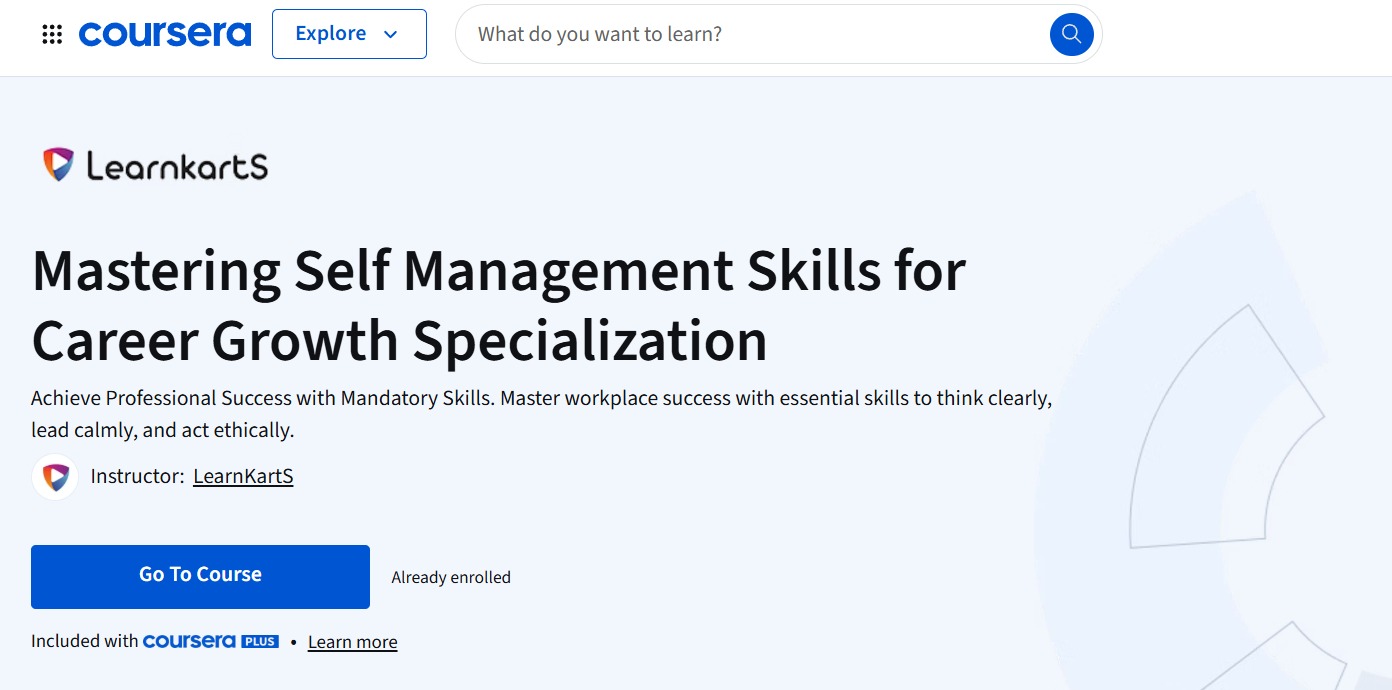
This self development course provides a step-by-step plan for learning how to manage your time and goals more effectively, as well as how to make wise choices and manage your emotions. You can look at your success and learn new things in your everyday life with the help of the plan.
Whether you're a recent college graduate or a worker in the middle of your job, this kind of training and self-development could give you the edge you need.
How Self-Management Can Help You Move Up in Your Career?
Being able to manage yourself is what keeps you grounded and helps you grow in a world that's changing faster than ever.
You'll come across:
- Making your messages clearer
- Taking better care of stress
- Being proactive without waiting to be told what to do
- Being trusted, able to do things well, and ready for more responsibility
That's exactly what bosses look for when they choose who to promote or give important tasks to.
As self-development training becomes more accessible, those who act quickly will be ahead of the competition.
Final Thoughts: Your Career Is a Reflection of How You Manage Yourself
The truth is that you don't need a rank to be a leader. You'll have to show that you can lead yourself before you can be a Team Lead, Manager, Director, or even CEO.
One of the best things you can do for your job is to learn how to manage yourself well. There is no such thing as perfection; what matters is steady growth.