Being involved in a motor vehicle collision in British Columbia can instantly upend your life, leaving you to navigate physical pain, disorienting neck stiffness, and a overwhelming wave of post-crash uncertainty. In the chaotic days following an accident, trying to manage soft-tissue injuries, sudden mobility loss, and everyday daily responsibilities can feel like an uphill battle.
As a patient advocate, I want you to know that regaining your health and mobility does not have to be a complicated or financially stressful ordeal. Navigating your post-accident care and insurance coverage through the Insurance Corporation of British Columbia (ICBC) is often far simpler and more direct than most people realize—provided you know your rights and how to unlock the benefits available to you.
Takeaway 1: You Are Automatically Approved for 25 Free Sessions (Zero Out-of-Pocket Cost)
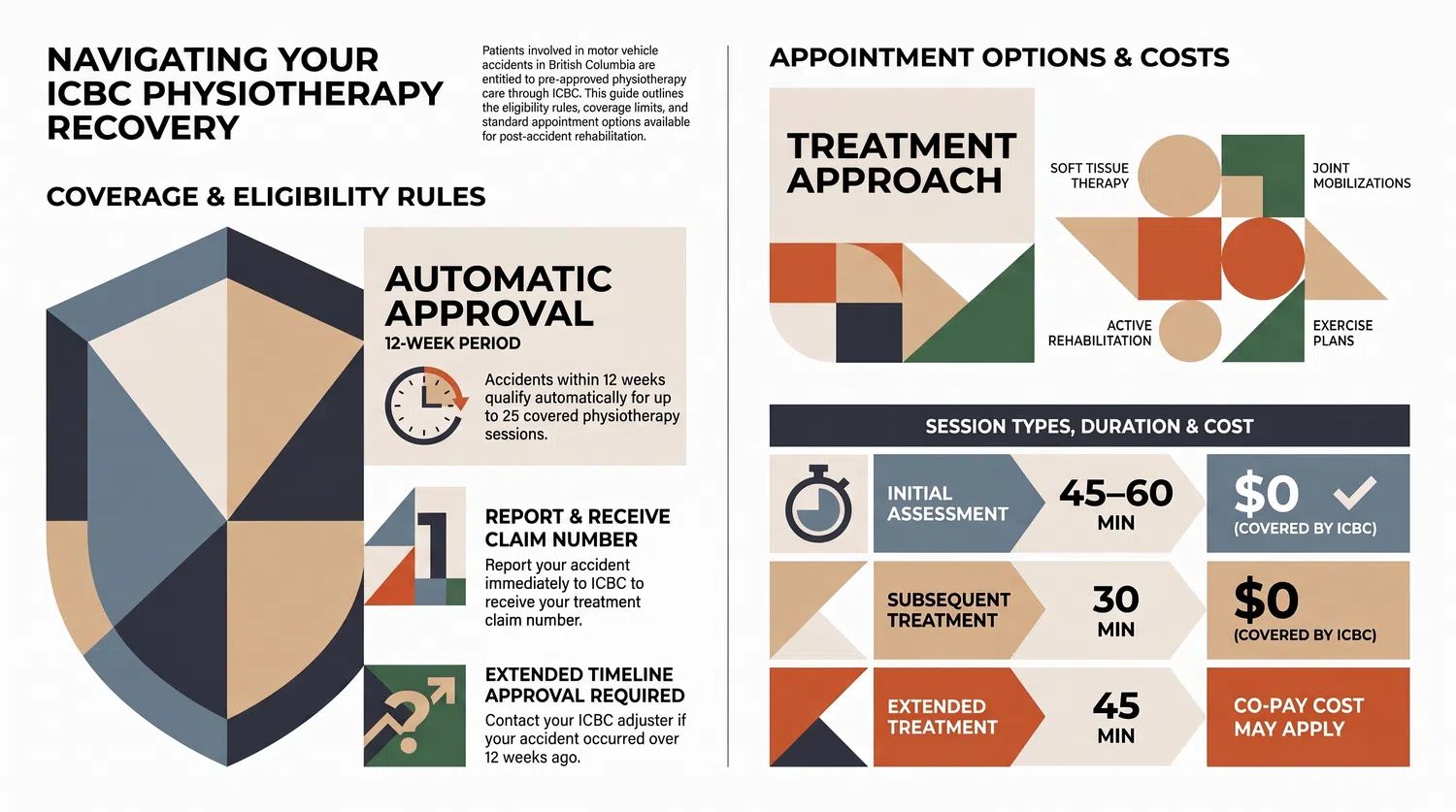
If you were involved in an auto collision in British Columbia within the last 12 weeks, ICBC policies automatically pre-approve you for up to 25 physiotherapy sessions over a 12-week period. You do not need to wait for a doctor's referral or lengthy approval letters to start your rehabilitation.
To ensure complete financial transparency and prevent any unexpected out-of-pocket stress, here is exactly how treatment coverage breaks down:
Initial Assessment: $0 out-of-pocket (Fully covered by ICBC, 45–60 minutes)
Subsequent Treatments: $0 out-of-pocket (Fully covered by ICBC, 30 minutes)
Extended Treatments: 45 minutes (ICBC covers the standard rate; a small co-pay cost may apply for extended time)
This direct-billing arrangement removes immediate financial barriers, allowing you to focus entirely on your physical healing. Furthermore, when reporting your accident, ICBC coverage extends beyond physical therapy to include prescriptions for pain management medication if needed. Combining targeted physical care with an integrated pain management plan ensures you can move comfortably through your early recovery without worrying about medical bills.
Takeaway 2: The Clock Is Ticking — Why the "12-Week Window" Is Critical
When it comes to soft-tissue trauma, early intervention is the single most critical factor in preventing acute discomfort from turning into chronic pain. To access your automatic care seamlessly, you must act within the 12-week windowfollowing your accident.
To advocate for yourself effectively, take these two actionable steps immediately after a crash:
Report the collision promptly: Contact ICBC to file your report and obtain your ICBC claim number.
Keep a symptom log: Document your physical discomfort, mobility limitations, and pain levels from day one.
Having your ICBC claim number in hand instantly unlocks your 25 pre-approved sessions at the clinic—no special adjuster approvals required during those initial 12 weeks. If your collision occurred more than 12 weeks ago, do not lose hope: you can still access care by reaching out directly to your ICBC adjuster to inquire about special extension options. However, seeking care right away drastically enhances your long-term recovery outcomes, rebuilding your strength and accelerating a safe return to work and daily life.
Takeaway 3: Effective Rehab Doesn't Require Buying Expensive Equipment
A widespread misconception about physical rehabilitation is that full recovery requires buying costly home gym machinery, complex weights, or specialized gadgets. In reality, effective clinical rehabilitation is grounded in real-world functionality and everyday human movement.
Dedicated rehabilitation clinics deliberately structure their spaces and treatment plans to mirror the environments you navigate every day at home. Rather than relying on high-tech machinery, physiotherapists design customized exercise programs centered on bodyweight movements, targeted resistance bands, and simple household setups. This approach ensures you can comfortably perform your rehab routine in your own living room without spending a dime on extra equipment. Consistency in executing these functional exercises—not fancy gear—is the true engine of recovery.
"Alex has been a great physiotherapist; he's provided many practical exercises and stretches that are easy to fit into my daily routine... I've seen noticeable improvement in my range of motion." — Cayley C.
Takeaway 4: True Recovery Addresses More Than Just Physical Symptoms
True healing from a motor vehicle accident requires looking past the immediate localized pain site. A truly restorative treatment plan takes a multi-dimensional approach, addressing physical symptoms alongside your mental well-being, lifestyle demands, and overall health education.
To treat common post-accident injuries such as sprains, strains, and whiplash-induced neck pain, physical rehabilitation utilizes advanced, evidence-based modalities:
Intramuscular Stimulation (IMS): Uses fine needles to release deep, stubborn muscle knots and nerve-related muscle tightness.
Joint Mobilizations & Manual Therapy: Hands-on techniques applied to restore normal joint glides, decrease stiffness, and realign movement patterns.
Soft Tissue Therapy & Active Rehab: Targeted therapy to reduce localized inflammation, combined with structured active movement to rebuild endurance.
Optimal recovery often thrives on multidisciplinary care. While chiropractic care focuses on restoring spinal alignment and joint mechanics, and massage therapy targets soft-tissue tightness while easing systemic stress, physiotherapy ties these modalities together through active functional strengthening. Working in harmony, this comprehensive care model ensures long-term resilience and restores your true quality of life.
Moving Forward on Your Path to Recovery
Taking control of your physical health after a car accident does not have to feel daunting. By leveraging your pre-approved ICBC coverage, reporting your claim promptly, and staying committed to practical, real-world exercises, you can take steady, confident steps back to a pain-free life.
Are you ready to stop letting post-accident discomfort dictate your daily routine? Retrieve your ICBC claim number and schedule your assessment today—or share this guide with a loved one who needs help taking that vital first step toward full recovery.