Foot discomfort can affect everyday movement in ways that are easy to underestimate.
The feet are the body’s contact point with the ground, and every step involves a coordinated interaction between the feet, ankles, knees, hips, pelvis, and trunk.
That does not mean every problem higher up the body begins at the feet. It does mean that, for some people, foot mechanics can be one relevant part of a broader movement or rehabilitation picture.
At Northwest Rehab Group in Vancouver, custom orthotics are considered based on individual assessment findings, symptoms, activity demands, and footwear needs.
Learn more about custom orthotics at Northwest Rehab Group: https://nwrehab.ca/orthotics/
What Are Custom Orthotics?
Custom orthotics are individually prescribed devices designed to sit inside footwear and provide support based on a person’s foot shape, movement patterns, symptoms, and clinical assessment.
They differ from generic insoles because they are made using information collected specifically from the individual.
That said, custom devices are not automatically the best choice for everyone.
Some people may do well with an appropriate prefabricated insert. Others may have particular support needs that make a custom device more suitable.
The key question is not simply whether an orthotic is custom-made, but whether it is appropriate for that individual.
Why the Feet Matter in Movement
The feet play an important role during standing, walking, and running.
As the foot contacts the ground, it helps manage load and contributes to the sequence of movement through the lower limb.
This connected relationship is often described as the kinetic chain.
A clinician assessing foot or lower-limb symptoms may look at factors such as:
foot posture
joint mobility
walking pattern
footwear
previous injury history
strength
mobility
activity level
symptom behaviour
The goal is not to make every person’s feet move in exactly the same way.
Natural variation is normal.
Instead, the assessment helps determine whether additional support could be useful as part of the person’s overall care.
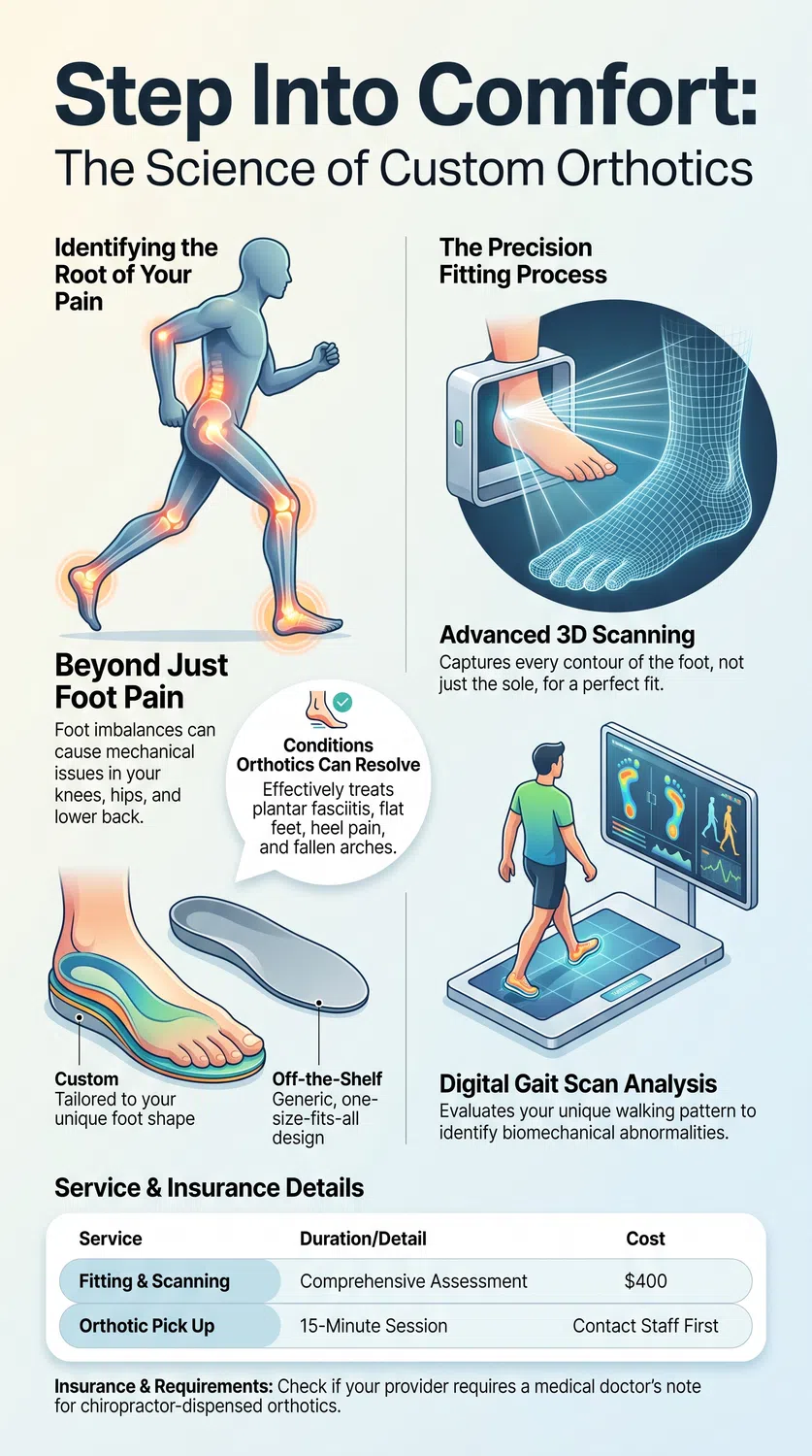
An orthotics assessment may include evaluation of foot mechanics, gait, footwear, and individual support requirements.
The Role of 3D Scanning
Modern orthotics fitting may include digital 3D scanning.
A 3D scan captures the contours and shape of the foot and provides information that can be used during the fabrication of a custom device.
This allows the orthotic to be made according to the person’s measurements and the specifications determined during assessment.
The scan itself is only one part of the process.
Clinical reasoning remains important because foot shape alone does not explain why someone is experiencing symptoms.
Digital Gait Assessment
Gait assessment looks at how someone walks.
A practitioner may observe how the feet contact the ground, how weight transfers through each step, and whether there are movement patterns that could be relevant to the person’s symptoms.
Gait findings can then be considered alongside the rest of the assessment.
A gait scan should not be viewed as a diagnosis by itself.
It provides additional information that can help guide clinical decision-making.
Custom Orthotics vs. Generic Insoles
One common misconception is that custom orthotics are always superior to off-the-shelf insoles.
The evidence is more nuanced.
Research reviewed through the National Center for Biotechnology Information has found that custom-made orthotics were not consistently more effective than prefabricated orthotics for pain in several studies involving conditions such as plantar fasciitis and flat feet.
Authority source: https://www.ncbi.nlm.nih.gov/books/NBK595390/
This is important because it supports an individualized approach.
For some patients, a generic insert may be perfectly appropriate.
For others, a custom device may offer advantages because of specific biomechanics, symptoms, footwear requirements, or activity demands.
Can Orthotics Affect More Than the Feet?
Because the feet are part of the kinetic chain, changing support at the foot may influence movement elsewhere in the lower limb.
That can sometimes be relevant when someone is experiencing symptoms around the ankle, knee, or hip.
However, it would be too simplistic to claim that foot position is the cause of all lower-limb or back problems.
Pain is usually influenced by multiple factors.
A person’s activity level, previous injuries, strength, mobility, training load, footwear, and general movement patterns may all matter.
Orthotics are therefore best considered as one potential tool rather than a universal solution.
This Northwest Rehab Group video explains how custom orthotics are assessed, scanned, and fitted, and how they differ from standard insoles.
Orthotics and Rehabilitation
Custom orthotics are often most useful when they are part of a broader plan.
Depending on the person and the condition being managed, that plan may also include:
strengthening exercises
mobility work
progressive loading
footwear changes
activity modification
balance exercises
gradual return to sport
manual therapy where appropriate
education and self-management strategies
The objective is not to make somebody permanently dependent on a device.
Instead, an orthotic may provide useful support while the person continues to build strength, mobility, and confidence in movement.
When Might Someone Consider an Orthotics Assessment?
An orthotics assessment may be worth considering for people experiencing:
persistent heel discomfort
arch pain
plantar heel pain
foot fatigue
symptomatic flat feet
painful high arches
forefoot discomfort
recurring pain during walking
symptoms related to prolonged standing
difficulty finding comfortable footwear
recurring lower-limb symptoms where foot mechanics may be relevant
Having a particular foot shape or posture does not automatically mean someone needs orthotics.
For example, pronation is a normal part of walking.
The important question is whether a person’s specific movement pattern appears to be relevant to their symptoms.
Insurance and Orthotics
People planning to use extended health insurance for custom orthotics should check their policy before proceeding.
Coverage requirements can vary.
Some providers may require specific documentation or a medical referral, while others may have rules about who can prescribe, assess, or dispense the device.
Checking these details before an appointment can make the process more straightforward.
Custom Orthotics in Vancouver
Northwest Rehab Group provides custom orthotics from its multidisciplinary clinic in Mount Pleasant, Vancouver.
The process is based on assessment and individual need rather than automatically prescribing orthotics for every foot complaint.
If you are experiencing ongoing foot or lower-limb discomfort and would like to learn whether custom orthotics may be suitable for you, you can find more information here: https://nwrehab.ca/orthotics/
Final Thoughts
Custom orthotics can be useful in the right circumstances, but their value depends on the person and the reason they are being prescribed.
They are not a universal treatment for foot, knee, hip, or back pain.
For some people, they may provide helpful additional support.
For others, exercise, rehabilitation, footwear changes, an off-the-shelf insert, or another approach may be more appropriate.
The most useful starting point is an individual assessment.